Transistor
ALTERANATIVE NAME/S:
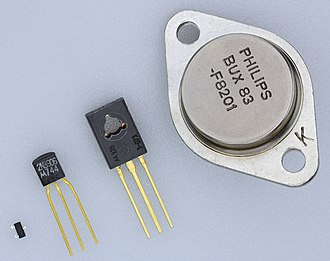
DETAILS/DESCRIPTION: The transistor is a small piece of equipment used for the amplification, control, and generation of electrical signals. Transistors became ubiquitous in the 20th century's Electronic Age, driving everything from the simplest radio to the most intricate communications satellite.
John Bardeen*, William Shockley*, and Walter Brattain* developed the transistor at Bell Telephone Laboratories in 1947. The invention garnered the trio of scientists a Nobel Prize in Physics in 1956.
By the 1950s, transistors replaced vacuum tubes as the primary device for electrical amplification. Transistors proved smaller, less expensive, and more reliable, primarily because they were built upon solid-state technology. Solid-state refers to electrical conduction achieved via a solid medium called a semiconductor. Around 1960, silicon had become the chief semiconductor used in transistors, hundreds of thousands of which powered the earliest mainframe computers.
By the 1970s, individual transistors were replaced by integrated circuits, which combined numerous transistors and other components onto a single chip of silicon. Integrated circuits (also called microcircuits) became smaller over time, and this led to lowered cost and increased efficiency. Microcircuits, used in microprocessors, which are in turn used in microcomputers, have defined technology in the late 20th and early 21st centuries, and have made possible the many advances of the Information Age.
ONELINER: The transistor became ubiquitous in the 20th century's Electronic Age
OTHER CONNECTIONS: None
BIBLIOGRAPHY:
EB
AUDIO/VISUAL:
Institute of Electrical and Electronics Engineers (IEEE) Virtual Museum:
http://www.ieee-virtual-museum.org/
Bell System Memorial, Bell Labs/Transistor Page