Hauy V
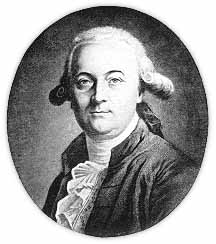
Name: Valentin Hauy
Achievements: French professor of calligraphy who founded the first school for the blind and is known as "Father and Apostle of the Blind".
Born: November 13, 1745; Saint-Just-en-Chaussée, Oise, France.
Died: March 18, 1822; Paris, France (Aged 76)
Field & Discipline: Education
Language: French
Father: Just Hauy
Mother: Madeleine Candelot
Siblings: Rene-Just(1743-1822)
Spouse: Elisabeth-Victoire Vaillard, married 1774; Louise-Marguerite Allain, married 1791
Children: Two daughters by first marriage; one son by second marriage
Education: Premonstratensian Abbey School, 1852-60
Major Work:
“Essai sur l'education des aveugles ou expose des differents moyens, verifies par l'experience, pour les mettre en etat de lire, a l'aide du tact, d'imprimer des livres . . . d'executer differents travaux relatifs aux metiers”, (“On the Education of the Blind, etc…”) 1787
Life & Times:
Valentin Hauy’s elder brother, [brother was] RJ Hauy* , was the founder of crystallography. In 1860 Hauy went to Paris, where he studied calligraphy, the classics and modern languages. Proving to have an exceptional ability with languages, in 1769 Hauy was appointed as official translator to the rector and provost of the University of Paris and to the Paris aldermen.
In the autumn of 1771, the 26-year-old Hauy, experienced a life-changing event when, while sitting at a cafe table in the busy Foire St-Ovide in Paris, he witnessed the performance by a group of blind men, who were being exhibited as mock musicians in ridiculous garb in a sideshow before jeering crowds.
Unlike almost all his fellow spectators, Hauy was appalled by this extreme cruelty and resolved to help the blind, who were generally regarded as sub-human. In 1783 Hauy then took up an appointment as translator in German, English, Dutch and Swedish to the French Admiralty, and in 1784 he became the state examiner at the Academic Writing Bureau.
Meanwhile, however, Hauy had not forgotten his pledge to help the blind, and was increasingly inspired by the work of the [inspired by] l'Epee* at his institution for the deaf and dumb. In 1784, Hauy then met his first blind pupil, sixteen-year-old Francois Lesueur: having given a few coins to this young blind beggar at the church door of Saint-Germain des Pres, Hauy watched in fascination as the boy quickly assessed the value of the coins by touching their embossed faces - almost immediately, Hauy realized that if the sense of touch could be used to detect the value of coins, it could also be used to read the meaning of words, provided the letters were raised - i.e. in relief, as were the faces of the embossed coins.
By Christmas 1784, Hauy had given up his post in the civil service, had taken Lesueur in, and had commissioned a wood carver to shape a set of small blocks on which the letters of the alphabet and the numerals zero to nine were raised in relief, stylised and enlarged for easy recognition by touch.
He then set about the extremely difficult task of teaching the boy to read, while paying him a few sous a day to support his parents. By the summer of 1785, he met with a great deal of success. This led to plans for the production of textbooks and teaching manuals for the blind and, with the help of his brother Rene-Just, Hauy petitioned for subscriptions from the rich, arranged for the printing of the first embossed teaching texts for the blind, and by late 1785 had been given the use of a house on the Rue Notre-Dame des Victoires, where he established at his own expense, the first free school in the world for blind juveniles.
Hauy then began to investigate the problem of producing printed books in relief for the blind, and by early 1786 he had managed to produce several books in embossed type using a movable letterpress.
During this year, Francois Lesueur became the first teacher at the school, where a growing number of blind juveniles were taught spelling, grammar, history and geography by finger-reading a dozen or so original books with the typescript lifted into relief, and cards outlined with shapes of countries and continents.
In early December Hauy printed his influential paper in embossed type, and on 26 December 1786 he was called to Versailles in order to show off the learning of his blind pupils to [demonstrated for] Louis XVI* and Marie Antoinette, who immediately gave the title of Institut Royale des Jeunes Aveugles to Hauy's school.
This led in to the French Academy of Literature expressing an interest in Hauy's work, and in 1787 he was called to the Academie des Sciences to report on his methods and display the learning of some of his pupils. The members of the Academie were so impressed by Hauy's achievements that he was asked to supply regular reports of his progress, while the patronage of the king also brought Hauy the support of the Philanthropic Society.
In 1791 the French National Assembly declared Hauy's school a national institution and voted it an annual subsidy, installing his blind pupils, along with many deaf and dumb children, in the Convent of the Celestin nuns, with Hauy given the title “Head Teacher of the Blind”. In early 1794, the school was then transferred to the rue des Lombards, and on 28 July 1795 the Convention published another decree, guaranteeing the school's national status.
However, despite these successes, the same year Hauy was denounced by the committee of general security, and was arrested. He was later pardoned and released, and in 1798 was back in favour with the revolutionary government, employed to decipher the intercepted correspondence of the exiled French emigres for the revolutionary government.
He continued as head of the Institut, and published a new syllabus for the school in early 1800, but in October 1800, the schoolwas merged with a workhouse and the following year Hauy was removed from his position.
In 1806, learning of the imprisonment of his brother Hauy fled to Prussia where he was persuaded to open the first German school for the blind in Berlin (August 1806). Alexander I of Russia then sent for Hauy, who spent the next decade establishing the first school for blind children in St. Petersburg.
On his return to Paris in 1817 he was not permitted to return to the establishment he had founded until 21 August 1821, when he was at last invited by the new director, Dr. Andre Pignier. Hauy died only six months later, at his brother's house in Paris in 1822, aged 76, and so did not witness the school’s development in the late 1820s and 1830s of a new code designed to facilitate reading for the blind, developed by one of the Institut's own inmates, [influenced] Braille*.
Hauy's work was continued by Braille and others, most notably by the U.S. educator and reformer [influenced] Samuel Gridley Howe*s, and his legacy continues to this day.
Assessment: Valentin Hauy was a late 18th-century French calligrapher and linguist who, stricken by the plight of the blind, established the first school for the blind in Paris during the 1780s.
Oneliner: Valentin Hauy, pioneer in teaching the blind
Bibliography:
Encyclopedia Britannica.
Henri, P., La vie et l'oeuvre de Valentin Hauy, Paris, 1984
Nationale Biographie Francaise.