Louis XVI
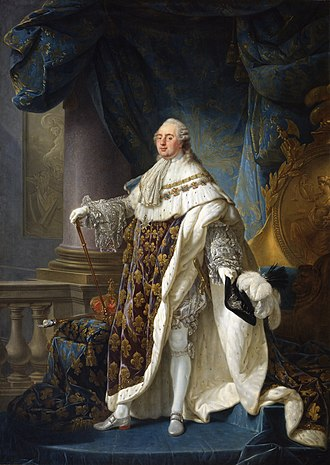
Name: Louis XVI, King of France and Navarre
Nickname/Alias: Louis Bourbon
Achievements: King of France.
Born: August 23, 1754; Versailles, France
Died: September 21, 1792; Paris, France (Aged 38)
Field & Discipline: Royalty; King
Language: French
Father: Dauphin of France
Mother: Marie Joseph of Saxony.
Siblings: Duc de Bourgogne; Duc d’Acquitaine; Comte de Provence (later Louis XVIII); Comte d’Artois (later Charles X); Clötilde, Elizabeth
Spouse: Maria-Antonia (daughter of Emperor Francis I and Maria-Theresa)
Children: Louis XVII of France; Marie Thérèse of France; Louis Joseph, Dauphin of France; Princess Sophie Hélène Béatrice of France
Education:
Life & Times:
In 1770, Louis married Maria-Antonia, the youngest daughter of the rulers of Bohemia and Hungary. On April 27, 1774, his father died of smallpox, Louis became King and the illiterate Maria-Antonia became Queen Marie-Antoinette. His predecessors left him problems to deal with.
Louis XIV had taken away civil liberties, revoking the Edict of Nantes (which had given the Huguenot Protestants religious freedom) and draining the economy with his wars. Louis XV had been extravagant and self-indulgent and had brought the country to the brink of financial disaster. The power of the monarchy was declining, government was crippled by debt, trade had deteriorated and the financial, religious and aristocratic classes were exempt from taxation. Louis was faced with demands for reform and he had no idea how to cope.
One of his first actions was to restore the powers of the Parlement, and he appointed the reformer, [first Minister was] Turgot* as first minister. Turgot had plans to impose a strict economy on the government and the royal households, rework the entire system of taxation, abolish the monopoly of the guilds and remove internal barriers to the circulation of grain.
Unsurprisingly, Turgot faced serious opposition from a royal household determined not to surrender its perks. The King (and his advisor, [advisor was] Maurepas*) felt that Turgot was exceeding his authority. Eventually, when he tried to reform the royal corvee (the organization of forced labor on roads and bridges) opposition was so strong that he was forced to resign.
With Turgot out of the way, Maurepas' put [finance Minister was] Jacques Necker* in charge of public finances. France was already an ally of the American colonial rebels in their War of Independence against the British. Necker favored financial reform, and imposed spending restrictions which enabled him to fund the Americans without raising taxes.
Despite this, his popularity with the court sank when he revealed his “Compte Rendu,” (Account Rendered), in which he published the country’s public finance accounts. Unfortunately, in publishing it, he revealed to taxpayers how much money taxes took from them. He also revealed how much the King, who was exempt from taxation, spent on his household. As might be expected, Necker was sacked.
By 1789, the country was bankrupt, so, for the first time since 1614 Louis called together the States-General, an assembly made up of three chambers: the Clergy, the Nobility and the Commons (known as the Third Estate). The function of the assembly was to advise the King, each chamber having a vote. Because the members of the commons far outnumbered the clergy or the nobility, the Third Estate soon began to demand that voting should on an individual basis, not by chamber.
The demand was refused. The Third Estate held their own meeting in the covered tennis court in Versailles, where they passed The Tennis Court Oath, agreeing not to disperse until a new constitutional body had been formed. On June 20, 1789, this new body was established and named the National Assembly.
Louis' actions triggered the French Revolution, the storming of the Bastille prison on July 14, 1789. Many people, including [American Minister was] Gouverneur Morris*, the American minister in Paris, suggested to Louis that the time had come to run for it, but he would not listen, mistakenly believing that his people still wanted him.
The National Assembly drew up a new constitution on August 4 and issued the “Declaration of the Rights of Man.” It was rumoured that Louis planned a counter-revolution, but the Paris rebels arrived in Versailles October 5, 1789 and took him and his family back to Paris, where they were detained in the Palace of Tuilleries and closely observed until Louis swore to uphold the new constitution, on July 14, 1790.
On June 20, 1791, Louis and his family attempted to flee, but were captured at Varennes. They were returned to Paris, where Louis was made a constitutional monarch, with all power now in the hands of the common people.
Later, Austria was found to be hatching a pro-Louis plot, so the National Assembly declared war on the Austrians.
By now, extremists were in control of the National Assembly and they forced Louis to replace it with a radical Convention. The trap was sprung when the first act of the new Convention, on 21st September 1791, was to abolish the monarchy. In January of 1793, Louis was tried for treason and condemned to death. On the morning of January 21, 1793, both he and Marie Antoinette were beheaded.
Extra Connections:
[his removal justified by] Condorcet* wrote justification of his removal.
Ennobled [he ennobled] PS Du Pont*.
[American Minister was] Jefferson* was American minister to his court.
Knew [he knew] Lagrange*, [he knew] Lafayette*.
[his spy was] Beaumarchais* spied for him.
He appointed [had mesmerism tested by] Franklin to the Mesmer committee
[a courtier was] Lafayette* was a courtier.
Witnessed [witnessed balloon of] Montgolfier* animal-crewed balloon flight
[death boosted career of] Napoleon’s* career was boosted by his death.
[execution opposed by] Thomas Paine* spoke against his execution.
[birth-music written by] Rameau* wrote music for his birth
[execution approved by] David* voted for his execution
He banished the [banished] de Grasse*
He saw a demonstration by [saw demo by] Valentin Hauy*
His Minister for the Navy was the Marquis de [Min. for Navy was] Castries*
Assessment: Louis’ indecision brought the downfall of the monarchy and the French Revolution, but at the beginning of his reign, his support of the Americans assured their victory in the War of Independence.
Oneliner: Louix XVI of France, executed by Revolutionaries
Bibliography:
- John Hardman, Louis XVI, Yale University Press, New Haven & London, 1993.