Villa D'Este
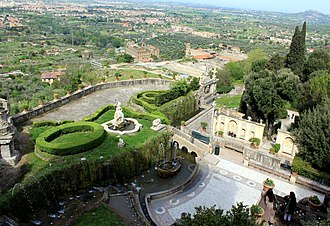
NAME: Villa d'Este Gardens
ALTERNATIVE NAME: None
LANGUAGE: Italian
TIME: Begun 1560
LOCATION: Tivoli, Italy (near Rome)
DISCIPLINE: Garden
FIELD: Renaissance design
SHORT DESCRIPTION: Late Renaissance garden renowned for its water features.
DESCRIPTION: The Villa d'Este gardens (created by Cardinal Ippolito d'Este, brother of <created by brother of> Isabella d’Este*) sit on top of a small hill at Tivoli, about 20 miles east of Rome, and are named for their creator, a member of the ruling family of Ferrara. In 1550, Ippolito was appointed Governor of Tivoli, then a possession of the Papal States, and for the next 20 years rebuilt the villa and created the garden.
The Cardinal was faced with a formidable task. The land below the villa was uneven and filled with huge rocks and craters. Some of the land he wanted was taken up by about a quarter of the town of Tivoli. Villagers who owned land were obliged to sell. Those who didn't were thrown out.
D'Este widened the valley and sliced tons of earth off the side of the hill to make steeply-descending gardens. The surplus earth was deposited at the bottom of the valley, with the walls of Tivoli acting as retaining support. The design of the garden called for nine vertical alleys intersected by 13 horizontal alleys, and above, a single dominant cross alley, and diagonal paths, contrasting with the vertical/horizontal motif below.
The main work began in 1560 and the following year one of the three principal springs to supply the garden was discovered. The Cardinal used a third of the water supply to service his villa and gar, den and let the rest go to the village. A conduit was also dug under Tivoli to bring water from the Aniene River. These waters were stored in a huge reservoir in the upper reaches of the garden.
From 1560-65, the main work was engineering and produced a series of water features that made Villa d'Este the talk of Europe. Stairways of water ran down the steep slope from the villa.
Handrails gushed with water. Visitors could sit on seats where holes in the backrest spurted cool water down their backs. Some of the paving stones sent up jets of water when they were stepped on. And the gate onto a picturesque bridge sprayed water over visitors when it was opened.
Water fell into a round vaulted cave, forcing the air trapped inside it up into the pipes of a water organ, then played by a water-drived wheel carrying teeth which struck the organ keyboard. In one fountain, two bronze birds sang until the appearance of an owl silenced them.
Both the organ and the owl were adapted from accounts of gardens in the works of ancient Roman architect <modelled on work of> Vitruvius*. In the fountain of the dragons, a variety of water jets hissed and roared. The gardens also included an oval fountain, a fountain of Leda, and an alley of 100 fountains.
When the hydraulic experts had completed their preliminary work, stonecutters arrived to make the stairs, fountains and loggias. Sculptors restored the classical antique statuary or carved new fountain statues.
The lower storey of one loggia formed the grotto of the fountain of Leda. The upper storey formed a balcony from which the whole garden could be surveyed. Arches were built to provide stunning perspectives and long views.
The central square in the garden was divided into four main flowerbeds, and around the sides of the square were pairs of mazes. Giant fish pools were set on a cross axis below the hillside in the flat part of the garden, and filled with exotic and domestic fish and fowl. Hundreds of trees were planted, including fir, elm, laurel, citron and chestnut.
The Cardinal's walk along the retaining wall of the terrace on which the villa sits was espaliered with pomegranates. Mazes were planted with paired trees and bushes: orange trees were paired with myrtle, cherries with honeysuckle, pine with thyme.
The garden was taken over by the Italian state in the 20th century and attracts multitudes of visitors every year.
EXTRA CONNECTION: French writer <visited by> Montaigne* visited in 1581 and published an account of the villa.
The water organ technology was originally devised by <used technology of> Bouchon*.
ONELINER: Villa d’Este, major Renaissance architecture
BIBLIOGRAPHY:
Coffin, David R, The Villa in the Life of Renaissance Rome, Princeton University Press, Princeton, New Jersey, 1979
Lazzaro, Claudia, The Italian Renaissance Garden, Yale University Press, London, 1990.