D'Este, Isabella
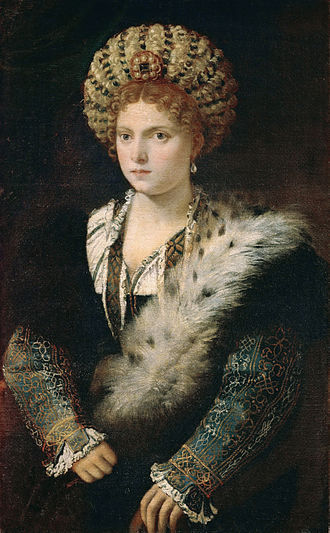
Name: Isabella d'Este
Achievements: Patron of the arts
Born: May 18, 1474; Ferrara, Italy
Died: February 13, 1539; Mantua, Italy (Aged 64)
Field & Discipline: Royalty; Arts; Patron
Language: Italian
Father: Ercole, Duke of Ferrara
Mother: Leonora of Aragon
Siblings: 4 brothers, among whom: Alfonso (Alfonso I of Ferrara, who married as second wife Lucrezia Borgia, sister of Cesare Borgia); Ippolito (Cardinal, owned [family owned] Villa d'Este* outside Rome); 1 sister: Beatrice
Spouse: Francesco I Gongaza
Children: Frederico; Ercole; Ferrante; Leonora; Ippolita; Paola
Education: Private tutors
Life & Times:
D'Este's parents were keen art patrons and from an early age she was taught to appreciate the masterpieces of Pisanello, [admirer of] Della Francesca*, and other artists. She was given a classical education and developed a talent for lute-playing and singing.
A beautiful girl, she was married at the age of sixteen to the man to whom she had been betrothed since the age of six: Francesco I Gonzaga, Marquis of Mantua. After magnificent celebrations in Ferrara, the wedding party sailed up the River Po to Mantua, where Isabella made a triumphal entry.
D'Este settled in to Mantuan court life with enthusiasm and extravagance. She continued her family's tradition of being a patron of the arts, willingly assisted by her husband. She assailed merchants, goldsmiths, embroiderers, engravers, jewelers and even diplomats with demands and detailed instructions, frequently following up with impassioned pleas for delivery.
She ordered the finest of everything: exotic fabrics, priceless jewels, antiquarian artifacts, and multitudes of books, from French courtly romances to bawdy Italian works such as those by Boccaccio, to the classics, which she preferred: Virgil, Horace, Livy and Pliny.
D'Este commissioned works by many local artists, including artist [commissioned] Mantegna*, whose paintings she praised highly until she commissioned him to paint her portrait. The project ended in disaster. D'Este didn't like the portrait, claimed it didn't look like her, and cast it aside, ordering another by Giovanni Santi, the father of artist Raphael.
D'Este's love of antiquities, plus her acquisitive nature, made the little studio she was given when she first married too small to hold all her treasures, and in 1496, she moved into a suite of rooms on the ground floor of the Corte Vecchia, part of the old palace. These rooms became famous for their contents, and this was where d'Este liked to spend her time, singing and playing her lute, conversing with cultured men such as Pietro Bembo and Baldassarre Castiglione and gossiping with her ladies-in-waiting.
The apartment was decorated with gilding, carving and paintings. The floors were paved with majolica and the favorite Gonzaga emblems (eagles, doves, the sun, lions) were everywhere. Adorning the rooms were beautiful furnishings and decorative objects from all over the world. She collected newly-discovered Greek and Roman antiquities: marble heads, reliefs and statues At the end of his life, Mantegna (whom she had forgiven for making a mess of her portrait) painted two works for the room: "Parnassus" (1497) and "Wisdom Overcoming the Vices" (1502).
When Italian artist [drawn by] Da Vinci* visited Mantua in 1499, he drew only a sketch of d'Este in red chalk, despite her repeated demands that he paint her portrait.
Italian artist [commissioned] Perugino* was no more cooperative. In 1496, she asked him for a picture, and was still asking in 1502. Eventually, she offered him a huge advance and he reluctantly agreed to paint a crowded composition of her own devising, called "Love and Chastity". It was a project entirely unsuited to Perugino, who usually painted simple pictures. She finally got the painting in 1505, but unsurprisingly, it was not one of his best.
Florentine mathematician [book dedicated by] Pacioli*, on the other hand, succumbed to her charms and dedicated his Book of Games to her.
In politics, Isabella was a pragmatist. When the king of France invaded Italy in 1494, she was at first sympathetic, as were all the d'Este’s, but soon changed her mind when she found out how much territory the French were after. Her husband Francesco was appointed captain-general of the Papal forces against the French and during his absence over the next few years, Isabella ran things at home single-handedly.
In 1502, when the Duke of Urbino fled to Mantua, after being forced out by [knew] Borgia*, d'Este expressed sympathy, received him kindly, but three days later wrote to Borgia asking him to send her a torso of Venus and a Cupid by Florentine sculptor [a fan of] Michelangelo* from the Duke's palace. When the Duke eventually got his palace back, it was minus his statues.
The Venetians arrested Francesco in 1509. To obtain his release, d'Este proposed a marriage between their daughter Leonora and Pope [relative of] Julius II*'s nephew. The Pope eventually agreed to the release, but while Francesco was waiting, d'Este sent him a tenor, a lute player, and other musicians to relieve his boredom.
In 1514, now 40, d'Este visited Rome for the first time and loved it so much she wanted to stay. After Francesco, whose health was declining, ordered her to return, she again took charge of Mantua, but the family was falling on financially difficult times. D'Este melted down plate, pawned her jewels, imposed new taxes, and supported Mantua with her personal fortune.
In 1517, d'Este traveled to France incognito, because she lacked the funds to keep up the necessary style. After Francesco died in 1519, Isabella remained in Mantua, assisting her son, and continuing to enjoy her cultured lifestyle.
[painted by] Titian* painted her portrait in 1529, and again in 1536. At Porto, her summer retreat outside Mantua, she oversaw her gardens, and once dispatched her gardener to humanist [knew] Trissino* at his villa at Cricioli when he asked her for some gardening advice.
Extra Connections: During a visit to Venice in 1492, d'Este admired the frescoes in the Doge's Palace by Venetian brothers [a fan of] Gentile Bellini* and [a fan of] Giovanni* Bellini.
Boccaccio?
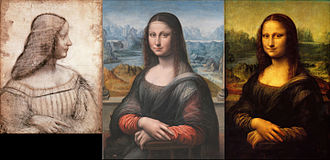
In the current catalogue raisonné of Leonardo da Vinci (2019), only Isabella d'Este is documented as a plausible alternative as the subject of Leonardo's Mona Lisa, usually considered a portrait of Lisa del Giocondo.[89]
A year after her 1502 marriage to Isabella's brother Alfonso, the notorious Lucrezia Borgia became the mistress of her husband Francesco.[47] At about the same time, Isabella had given birth to a daughter, Ippolita, and she continued to bear him children throughout Francesco and Lucrezia's long, passionate affair, which was more sexual than romantic.[48] Lucrezia had previously made overtures of friendship to Isabella which the latter had coldly and disdainfully ignored. From the time Lucrezia had first arrived in Ferrara as Alfonso's intended bride, Isabella, despite having acted as hostess during the wedding festivities, had regarded Lucrezia as a rival, whom she sought to outdo at every opportunity. [49] Francesco's affair with Lucrezia, whose beauty was renowned,[39] caused Isabella much jealous suffering and emotional pain.[48] The liaison ended when he contracted syphilis as a result of encounters with prostitutes.
Assessment: A Renaissance court lady who exemplified the ideal of practical wisdom combined with love of learning
Oneliner: Isabella d’Este, high-living Renaissance aristocrat
Bibliography:
- Cartwright, Julia, Isabella d'Este, Marchioness of Mantua, A Study of the Renaissance, Vols 1 and 2, John Murray, London, 1903.
- Simon, Kate, A Renaissance Tapestry, The Gonzaga of Mantua, Harrap, London, 1981.