Zipper
ALTERNATIVE NAME/S: slide fastener, UK zip, or occasionally zip-fastener)
DETAILS/DESCRIPTION:
First developed in its modern form bySundbach*, the zipper is a device for holding together the edges of an opening in an article of clothing, leather goods, luggage and many other products. It consists of two strips of material with metal or plastic teeth set along the edges, and a sliding piece that, moving in one direction, pulls the teeth into interlocking position, and in the other, separates the teeth. Animation
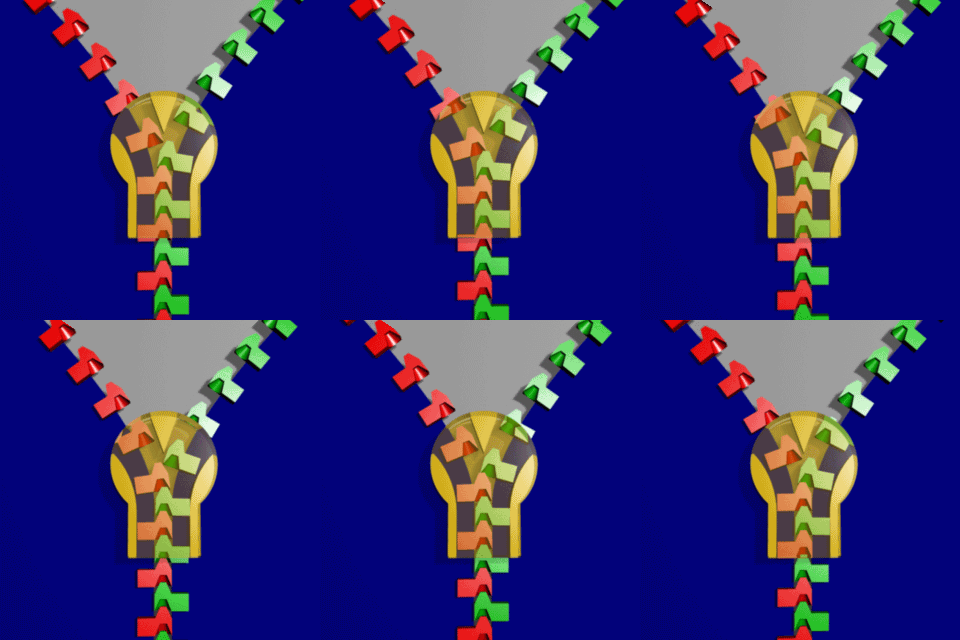
The name was coined by B.G. Work of the B.F. Goodrich Company in 1923 when the device was adapted to close overshoes. Today by far the largest amount of zippers is manufactured in Japan. Recently the zipper has to some extent been replaced by Velcro. Velcro was discovered by looking at a burr taken from a dog under a microscope, seeing that it was made of many tiny hooks. Velco worked better whne made from synthetic materials like nylon, and was popularized after being used by NASA (combined with another opposite material from space, Teflon).
ONELINER: Zipper is a commonly used device for binding together two edges of fabric.
OTHER CONNECTIONS:
In 1851, Elias Howe received a patent for an "Improvement in Fastenings for Garments".[4]He did not try seriously to market it, thus missing the recognition that he might otherwise have received.[2] Howe's device was more like an elaborate drawstring than a true slide fastener.
BIBLIOGRAPHY:
Wikipedia: A zipper, zip, fly or zip fastener, formerly known as a clasp locker, is a commonly used device for binding the edges of an opening of fabric or other flexible material, as on a garment or a bag.[1] It is used in clothing (e.g., jackets and jeans), luggage and other bags, sporting goods, camping gear (e.g. tents and sleeping bags), and other items. Whitcomb L. Judson was an American mechanical engineer from Chicago who was the first to invent, conceive of the idea, and to construct a workable zipper.[2] The method, still in use today, is based on interlocking teeth. Initially it was called the “hookless fastener” and was later redesigned to become more reliable.