Bechet, Sidney
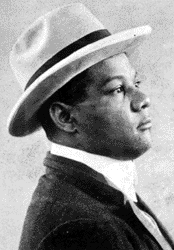
ACHIEVEMENTS: Major early jazz soloist.
NICKNAME/ALIAS:
DATE AND PLACE OF BIRTH: May 14, 1897, New Orleans, LA.
DATE/PLACE OF DEATH/AGE AT DEATH: May 14, 1959, Paris, France. Age 62.
DISCIPLINE: Musician
FIELD: Jazz
LANGUAGE: French/English
PARENTS: Omar Bechet, Josephine Michel.
SIBLINGS: Sisters, Bertha and Albertine. Four older brothers, all amateur musicians and tradesmen: Homer (Janitor, string bass), Leonard (dentist, trombone), Albert (butcher, violin), Joseph (plasterer, guitar).
SPOUSE: Many, most durably, Elizabeth Ziegler (married in France 1951) and Jacqueline Pekaldy, his mistress during the same years. Major liaisons included Bessie Smith and Tallulah Bankhead.
CHILDREN: With Pekaldy, a son, Daniel Bechet, born April 3, 1953.
EDUCATION: Almost none.
MAJOR WORK:
LIFE AND TIMES:
Bechet’s family were New Orleans ‘Creoles of Color,’ descended from French colonists and free Blacks. Bechet was a child prodigy. Settling on the clarinet, he was an object of wonder to the working musicians of New Orleans. Bechet gathered instruction from most of the best clarinetists in the city and was working with major local bands before he was 10 years old.
In this early period, Bechet played the cornet in many parades, even Louis Armstrong* played second to him. Bechet’s overwhelming talent, combined with his intense temperament, temper and (when young) fondness for drink, ensured that he moved from job to job frequently. He played with almost every possible combination of musicians New Orleans had to offer, including Oliver*. Even WOry*, who managed to get along with the most difficult colleagues, never spoke to Bechet again after an ill-fated period when Bechet worked in his band.
Bechet was one of the first musicians to take Jazz out of New Orleans, touring with vaudeville shows through Texas and the East and playing in Chicago between 1915-18. In 1919, Will Marion Cook, the composer of the Broadway show “In Dahomey” and the song “I’m Coming Virginia,” hired Bechet as part of his “Southern Syncopated Orchestra,” for engagements in London and Paris. From then on, Bechet would spend most of his professional life abroad.
Bechet was deported from England in October 1922 after a brawl with a prostitute. Returning to New York, he worked at various jobs, including a brief stint with Duke Ellington, who never forgot the impression Bechet made on him. Ellington’s writing for reeds, and his long association with Johnny Hodges and the clarinetist Barney Bigard are testimony to Bechet’s influence.
During this New York period, 1923-25, Bechet made his first group of recordings, mostly with groups led by Clarence Williams. Bechet accompanied several blues singers, and, in several stunning sessions, recorded with Louis Armstrong. On one of these Clarence Williams dates, accompanying Eva Taylor’s performance of “Mandy, Make Up Your Mind,” Bechet recorded the only extant jazz solo on bass sarussophone.
After a disastrous fling as a nightclub owner in Boston, Bechet traveled to France with the Revue Nègre which brought Josephine Baker to Paris in 1925. Bechet flourished in the Parisian expatriate scene until, in Dec. 1928, he attempted to settle an argument with a banjo player via a six-gun shoot out in broad daylight in the streets of Montmartre. Three bystanders received slight injuries and Bechet was deported after serving almost a year in a French prison.
After two years in Berlin, Bechet returned to New York in late 1931, made a set of brilliant recordings with his band from the Savoy Ballroom, but was unable to find more work for the group. After dropping out of music to run a Harlem tailor shop, Bechet spent much of the decade with the Noble Sissle Orchestra.
Bechet’s feature numbers with Sissle, and the development of jazz scholarship, began to draw attention. Two brilliant recording sessions with a small group of Sissle band members gave Bechet enough prominence that he was able, for once in his life, to depart from a job on amicable terms. In 1938 Bechet resumed leading his own small groups and recording, especially with Victor and Blue Note records. His 1938 Blue Note recording of Gershwin’s “Summertime” was a major hit by jazz record standards and further expanded Bechet’s reputation.
Among Bechet’s Victor sessions is the astonishing ‘one man band’ session in 1941. Bechet, had seen a chamber music recording session where an oboist had dubbed his part onto the already recorded disk, a considerable risk as there was no way to salvage the take if he made any errors. Bechet was inspired to record a version of “The Sheikh of Araby” on which he played all six parts: piano, bass, drums, clarinet, soprano, and tenor saxophone. The recording quality is poor, as the earlier tracks are obscured by the later ones, but the performance is a tour de force.
The rest of Bechet’s Victor sessions were of equally high standard. Ironically, the only exceptions were a reunion session with Louis Armstrong and Clarence Williams and two awkward sessions under the leadership of Jelly Roll Morton*.
In 1949 Bechet was invited to Paris to participate in the first International Jazz Festival, and spent most of the remainder of his life in France, where he had become a major star. During these years he composed several symphonic works and wrote an intensely poetic autobiography, “Treat It Gentle,” which was published posthumously.
ASSESSMENT: Bechet’s playing was so dominant that most players did not even attempt the soprano saxophone. His playing style was so individual that any try at imitation would seem like parody and disrespect.
EXTRA CONNECTIONS: None
ONELINER: Sydney Bechet, great jazz reed player
BIBLIOGRAPHY:
Bechet, Sidney: Treat it Gentle: an Autobiography, ed. D. Flower (New York, 1960)
Chilton, John: Sidney Bechet: the Wizard of Jazz (London, 1987)
Multimedia: PBS Jazz