Armstrong, Louis
Armstrong, Louis Daniel
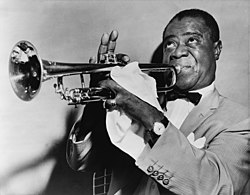
ACHIEVEMENTS: Almost single-handedly lifted Jazz music to the level of a high art. In the early 1920s Armstrong developed an improvisational solo style whose influence can be heard in every Jazz musician since. Armstrong’s singing developed from a gruff shout to an amazingly expressive improvisational style echoed by singers as diverse as Bing Crosby, Billie Holiday, Ella Fitzgerald, and Frank Sinatra.
NICKNAME/ALIAS: Satchmo (originally “Satch’mo’,” a British journalist’s corruption of Satchelmouth), Dippermouth (hence ‘Dipper’), Gatemouth (hence ‘Gate’), and Pops.
DATE AND PLACE OF BIRTH: August 4, 1901, New Orleans, Louisiana (traditionally July 4, 1900)
DATE/PLACE OF DEATH/AGE AT DEATH: July 6th 1971, Queens, New York. Aged 69.
DISCIPLINE: Musician
FIELD: Jazz
EDUCATION:
Very little. Some basic music instruction and grammar school while committed to the ‘Colored Waifs Home’ in New Orleans from age 12-14.
MAJOR WORK: Recordings with:
King Oliver’s Creole Jazz Band (1923)
Fletcher Henderson Orchestra
Clarence Williams Blue Five et cetera
Bessie Smith and other blues singers (1924-5)
Louis Armstrong and his Hot Five
Louis Armstrong and his Hot Seven
Louis Armstrong and his Savoy Ballroom Five (1925-28)
Louis Armstrong and his Orchestra (1929-46)
Louis Armstrong’s All Stars (1947-)
LIFE AND TIMES:
Born in a two-room shack in the poorest ghetto of New Orleans, Armstrong’s earliest years were lived in grim poverty. A family of Russian Jewish junk dealers, the Karnoffskys, hired Louis as a wagon driver and errand boy. The Karnoffsky family encouraged his education, received him into their home, and eventually helped him to buy his first cornet. Armstrong wore a Star of David on his person for the rest of his life in memory of their kindness.
On December 31 1912, Louis borrowed his current stepfather’s pistol to join in the New Year’s celebration. He fired six shots into the air and was immediately arrested by a passing policeman. He spent the next two years as a ward of the New Orleans ‘Colored Waifs Home.’ The home’s director, Peter Davis maintained a band, Louis received two years of musical instruction, played lead cornet in the band and quickly became its leader.
After his release, Armstrong began to work playing in marching bands and the dance halls and saloons in his old neighborhood. He was mentored by his idol and role model Oliver*, then the top cornet player in New Orleans. When Oliver left New Orleans for Chicago in 1918, Louis took his place in Ory’s* band for night jobs, and the Onward Brass Band for parades.
Before Armstrong, most jazz performers improvised in a limited fashion, ornamenting and varying the typical parts they would play in band arrangements and only soloing on the blues. At age 17 Armstrong already possessed a technical ability and fluency far beyond that of any other New Orleans cornettist.
Because most jazz playing was ensemble, improvising had to be kept very simple to avoid clashing between parts. Armstrong (like clarinetist Bechet*, with whom he played) took improvisation to such a level that his band mates either kept in the background or stopped playing to listen.
In August of 1922 King Oliver invited Louis to join him in Chicago. Louis’ marriage had collapsed (Daisy was violently jealous and had chased him with a razor) and the invitation from his idol gave him the confidence to leave New Orleans.
King Oliver’s Creole Jazz Band was a sensation with the growing Black population of Chicago, and was already attracting the attention of local musicians fascinated by the new music. In April 1923, Oliver’s band made the first of several recording sessions. Most descriptions of these make a great to do about “Chimes Blues” because it contains Armstrong’s first recorded solo. Armstrong’s playing on other Oliver recordings such as “Tears” is, however, much more representative.
In 1924, Armstrong married Lilian Hardin, and with her encouragement left King Oliver’s band and migrated to New York to join the proto-swing big-band of Fletcher Henderson. Even Coleman Hawkins, then playing with the Henderson band, was overwhelmed by Armstrong’s playing. Armstrong’s expressiveness, his rhythmic imagination and his ability to play the blues were without precedent.
In New York, Armstrong began to record frequently: with the Henderson band, accompanying blues singers like Bessie Smith, and especially a series of sessions led by Clarence Williams. In several of these sessions, Armstrong played with Bechet.
On the strength of his New York recording success, the Okeh company gave Armstrong carte blanche to record as he pleased. He formed a recording group of New Orleans players and colleagues: Johnny Dodds on clarinet, Kid Ory on trombone, Lilian Hardin on piano and Johnny St. Cyr on guitar and banjo. In 1928, the recording group changed to one with the pianist Earl Hines, drummer Zutty Singleton, and a few empty suits from the Vendome Theatre band.
As “Louis Armstrong’s Hot Five,” “Louis Armstrong’s Hot Seven,” and the “Savoy Ballroom Five” these groups cut 60 sides between Nov. 1925 and Dec. 1928. There are no jazz recordings made since which do not show some influence from these sessions.
Armstrong is often credited with inventing ‘scat singing’ (the use of the voice as an instrument for wordless improvisation) in his February 1926 recording of the tune “Heebie Jeebies.” In fact, Cliff (Ukelele Ike) Edwards, now best known as the voice of Jiminy Cricket in the film Pinocchio, had recorded choruses of scat singing as early as 1922. Armstrong had ‘scatted’ on a few of his New York recordings, but this performance on Heebie Jeebies created a sensation.
In 1929, Armstrong returned to New York, where he soon became known to the general public, both black and white. From 1930 to 1947 he toured endlessly, fronting his own, under-rehearsed, over-worked big bands. Though some critics suggest that Armstrong’s playing became routine during this time, a brief review of his records of the 30s should dispel the notion.
After the Second World War, Armstrong fronted a smaller group, the ‘All Stars.’ While he continued to be seen as a popular entertainer and occasional movie-player, he contributed great instrumental performances right through into the 60s, when he began to appear more often only as a singer.
Many younger musicians undervalued Armstrong in his last years because his contributions pervaded the music so deeply that many did not recognize him as their originator. Armstrong’s vaudevillian performance persona was considered an embarrassing racial stereotype, even though he had developed this style while performing for exclusively black audiences. Armstrong was far more public in his concern for civil rights than most of his critics. With great courage, he refused a State Department sponsored “good will tour” to Russia in 1957 over the treatment of black students in Arkansas.
ASSESSMENT: Miles Davis once said ‘You can tell the history of Jazz in four words: Louis Armstrong, Charlie Parker.”
EXTRA CONNECTIONS:
He influenced Crosby* and Ella Fitzgerald*.
ONELINER: Louis Armstrong, great jazz musician
BIBLIOGRAPHY:
Bergreen, Laurence, Louis Armstrong : an extravagant life.
New York : Broadway Books, c1997
Jones, Max & John Chilton, Louis: the Louis Armstrong story, 1900-1971.Boston, Little, Brown [1971
Schuller, Gunther, Early jazz : its roots and musical development.New York : Oxford University Press, 1968
Satchmo.net Copyright © 2001Louis Armstrong House and Archives, Queens College, Brooklyn, NY. http://independentmusician.com/louis/
Red Hot Jazz Archive http://www.redhotjazz.com/louie.html