Seward WH
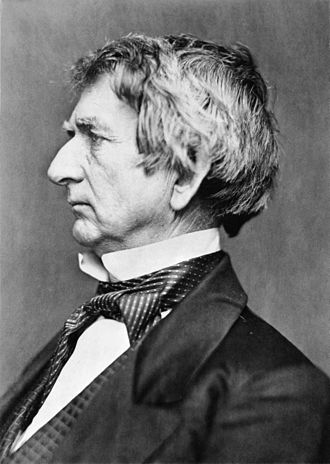
Full Name: William Henry Seward
Achievement: He goes down in history for the purchase of Alaska
Born: 1801; Florida, Orange County, NY
Died: October 10, 1872; Auburn, NY
Field & Discipline: Exploration; Government; Politics
Language: English
Father: Samuel
Mother: Mary
Spouse: Frances Miller
Siblings: Cornelia
Children: Augustus; Frederick; Cornelia; William; Frances
Education: Union College, Schenectady, NY
Major Work:
U.S. Secretary of State under Presidents Abraham Lincoln and Johnson
Life & Times:
Seward was admitted to the bar in 1821 and two years later entered the law offices of Judge Elijah Miller in Auburn, where he soon gained a reputation as a skilled and principled criminal lawyer.
After practicing law for a brief period, Seward began a political career. He supported [supported candidacy of] John Quincy Adams*’ unsuccessful presidential reelection bid in 1828. In 1830 he was nominated for the New York state senate by the Anti-Masonic party, a nomination that he did not refuse, as much from his anti-aristocratic sentiments as from personal ambition.
During his four years in the assembly, Seward developed his characteristic and genuinely progressive stance, such as his vehement aversion to slavery and his opposition to the Jacksonian democrats who reigned supreme in New York and Washington at the time.
As senator, Seward advocated reforms (aiming at national centralization) such as a universal school system, military reform and infrastructure improvements. In addition, he debated against debt imprisonment, sought separate penitentiaries for female convicts, and supported popular elections, as opposed to appointments, to administrative offices.
Though Seward is said to have originally sympathized with the Democratic party, he was early undeceived by the corruption and machine politics practised by the Jacksonian Democrats. Seward rejected elitism and he denounced the Democratic party (as it became known in 1840 after their third national nominating convention) and its form of nepotistic ‘democracy’, as well as for its pretensions to being a party for the people, while in reality representing the interests of Southern slaveholders, cotton farmers and ambitious northern public officials.
Seward’s nationalistic and genuinely republican views led him to the Whigs, a party created in reaction to the increasing power of the Jacksonians.
Nominated and defeated as a Whig candidate for Governor of New York in 1834, Seward was elected to the executive in 1838. During his two terms in office, he continued the course of reform and progress he had pursued as senator, controversially supporting immigration and proposing costly internal improvements such as the expansion of New York’s canal and railroad systems.
Seward also procured the right of fugitive slaves to a trial by jury, again demonstrating his fervent objection to slavery and his dedication to equality. He opposed the annexation of Texas and although he proved a vigorous expansionist, he also opposed the Mexican-American War, believing freedom was not gained through compulsory admission to the Union.
Returning to his legal practice in Auburn after an unsuccessful bid for a third term in the gubernatorial office, Seward soon found his way back to statesmanship. In 1848 the New York state legislature elected him to the United States Senate where he served two terms until 1861. Much of his work in congress, and much of the focus of the national government at the time, centered around the slavery issue.
Seward’s first action upon entering the Senate was to rally congressional support to defeat a bill designed to rescind the laws prohibiting slavery in the newly-acquired territory of Mexico. He also opposed fellow Whig Henry [opposed proposals of] Clay*’s compromise proposals of 1850, and opposed the repeal of the Missouri compromise when the Kansas-Nebraska act left new states to decide for themselves whether, upon joining the Union, they would be a “free-soil” state or a slave state. Seward supported California’s admission to the Union.
The Republican Party was created as a direct reaction to the Kansas-Nebraska bill and absorbed many disenchanted Whigs who foresaw the party disintegrating into its constituencies. By 1855, when re-elected to the senate, Seward embraced the Republican Party, feeling that its anti-slavery and unionist tenets best represented his convictions.
He became its most prominent and perhaps most ambitious leader until 1860 when, due in part to opposition from former ally, newspaper editor and publisher Horace [opposed by] Greeley*, he was passed over in the presidential nomination because of his “radical” anti-slavery views in favor of Abraham [Sec. State for] Lincoln, for whom Seward campaigned.
In office, Lincoln appointed Seward Secretary of State and during the Civil War Seward became the president’s closest advisor, even assisting in composing and signing the Emancipation Proclamation.
He again demonstrated his political acumen by such achievements as working through the U.S. Minister to Great Britain, Charles Francis Adams, to convince the British to withdraw support from the confederacy, by using his diplomatic savvy to smooth over relations with Britain after U.S. Navy Captain [dealt with problem of] Charles Wilkes*, attacked the British merchant vessel “Trent” (the so-called Trent Affair), and by rallying Northern public opinion.
On April 14th, 1865, the night President Lincoln was assassinated at Ford’s Theater by [attacked by colleague of] John Wilkes Booth*, an assassination attempt was also made on Seward’s life, at his Washington home.
After recovering from a stab wound to the throat, he continued in his office as Secretary of State under new president Andrew Johnson during whose administration Seward was instrumental in securing France’s withdraw from Mexico. He was also a resolute supporter of Johnson’s lenient Reconstruction of the South.
Seward’s expansionist views led him to arrange the purchase from the Russians of the [purchased] Alaska* territory, a vast expanse of 586,412 square miles, for $7, 200, 000. The arrangement was known by Seward’s detractors in the press, and by the Radical Republicans in congress as “Seward’s Folly” or “Seward’s Icebox”, since the acquisition was seen by many as too costly for a region considered to be a wasteland.
Nevertheless, motivated by the threat of British settlement in the region, Seward gained valuable support in congress by Republican Party founder, Senator Charles Sumner, and through the 1866 testimony before Congress by [Alaska purchase supported by] SF Baird* as to Alaska’s immense economic and scientific resources. In the eyes of the nation the great Klondike gold strike of 1896 would vindicate Seward. He also procured the Midway Islands for the United States.
Seward retired in 1869.
Assessment: A far-sighted and progressive statesman.
Oneliner: William Seward, statesman who bought Alaska for the US.
Bibliography:
- Baker, George E., ed., The Life of William Seward; J.S. Redfield, New York: 1855. www.hti.umich.edu/cgi/t/text/text-idx?c=moa;idno=ABJ4572.
- Bartleby. www.bartleby.com/43/43.html.
- Civil War Home. http://www.civilwarhome.com/trent.htm.
- Grolier. gi.grolier.com/presidents/ea/side/whig.html.