Murchison
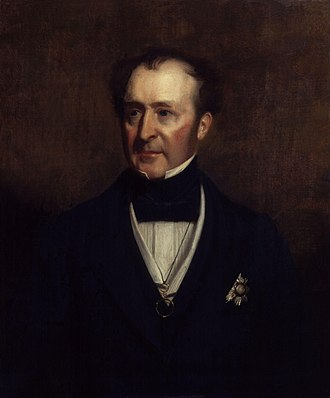
Name: Sir Roderick Impey Murchison
Achievements: Study of the Early Paleozoic strata
Born: February 19, 1792; Ross-shire, Scotland
Died: October 22, 1871; London, England (Aged 79)
Field & Discipline: Science; Geology
Language: English
Father: Kenneth Murchison
Mother: (First Name Unknown) Mackenzie
Siblings: One brother
Spouse: Charlotte Hugonin
Children: Unknown
Education: Great Marlow Military College
Major Work: Discovery of the Silurian System
Life & Times:
Roderick Murchison had expected to make a big mark on the world as a soldier, but after a short period of active service during the Napoleonic Wars, the years began to roll by with no signs of advancement.
He resigned his commission and made a half-hearted search for a new profession. His wife, Charlotte, was a brilliant woman with a wide range of interests and some significant social connections, counting Mary [wife knew] Somerville* among her friends. She prodded her husband to pursue a career in the arts, but this didn’t appeal to him and he entered his thirties with no ambition beyond fox hunting.
He had a private income and didn’t need to work to support himself. But Charlotte’s interests gradually pulled him toward science. This interest was strengthened after a meeting with [influenced by] Davy* after which Murchison attended meetings of Davy’s Royal Institution. Almost in spite of himself, Murchison began to show an interest in geology.
He was elected a fellow of the Royal Society in 1825 and spent the next 20 years in constant pursuit of geological discoveries. He traveled with [fieldwork with] Sedgwick in the Scottish Highlands in 1827. He was strongly influenced by [influenced by] Lyell*, and he and Charlotte went on an expedition to Italy with him in 1828. In 1831, he was elected president of the Geologic Society and began his study of rock strata in South Wales. He named these Early Paleozoic rocks: “Silurian” (after the ancient Romano-British tribe that lived in the area) and in 1839 published a massive volume containing his findings.
Murchison did a great deal to organize the details of the Silurian system, which he continued to refine throughout his lifetime. His work had considerable economic value. He was investigating a system of rock below which few, if any fossils were to be found; and of course, where there are no fossils, there is no fossil fuel.
He also knew from Lyell that he could be providing crucial evidence regarding the beginnings of life, since the Silurian revealed a total absence of vertebrates. His research led him beyond Wales and Scotland to the Alps, France and Russia. As a prominent and influential scientist, he supported [supported] Livingstone*’s explorations, so that Murchison Falls in Uganda are named after him.
But there was a less appealing side to Murchison. He alienated his friend Sedgwick and his supporter [alienated] Nicol, and opposed [opposed theory of] Agassiz*’ glacial theory, as well as the recent evolutionary theory of [opposed theory of] Charles Darwin*. managing in most cases to be on the wrong side of the argument.
Extra Connections: Close friend of naturalist [a pal of] Richard Owen*
Assessment: Murchison was a passionate and energetic geologist, and his work on the Silurian system was a great achievement. However, he drew heavily on the work of others, was often stubbornly and irrationally mistaken, and owed a great deal of his success to his wealth and social status.
Oneliner: Sir Roderick Impey Murchison, early geologist and discoverer of the Silurian strata
Bibliography:
- Dictionary of National Biography.
- Dictionary of Scientific Biography.
- Encyclopedia Britannica.