Darwin, Charles i
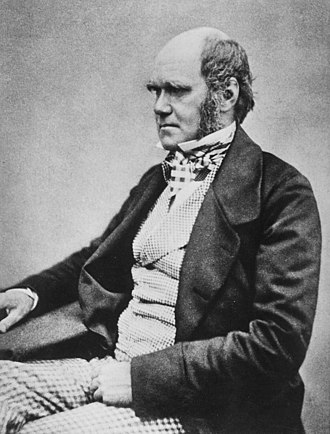
Achievements: Theory of evolution
Born: February 12, 1809; Shrewsbury, England
Died: April 19, 1882; Downe, Kent (Aged 73)
Field & Discipline: Science; Natural History; Evolutionary Theory
Language: English
Father: Robert Waring Darwin
Mother: Susannah Wedgwood
Siblings: Caroline; Susan; Erasmus
Spouse: Emma Wedgwood
Children: William; Annie; Henrietta; George; Elizabeth; Francis; Leonard; Horace; Charles Waring
Education: Shrewsbury School; Edinburgh University; Cambridge University
Major Work:
"On the Origin of the Species by means of Natural Selection of the Preservation of Favoured Races in the Struggle for Life"
Life & Times:
At 22, Darwin took part in a geological field trip through Wales led by geologist [geologized with] Sedgwick*. The next year he joined an expedition to South America working as a naturalist for the Royal Navy aboard the "Beagle". The mission was under the command of [on “Beagle” with] FitzRoy,* whose cabin Darwin shared. The purpose of the expedition, which lasted for nearly four years, was to survey the east and west coasts of South America, but it also took in the Cape Verde Islands, the Galapagos, Tahiti, New Zealand, Australia, Mauritius and South Africa. Darwin made notes about and collected anything that could remotely be of interest to natural science.
Since he was unable to identify most of specimens he collected, he periodically shipped large crates of specimens back to England and also bulletins on his work which were published and made him a highly-respected natural historian. But despite his reputation, Darwin found on his return that few of his fellow naturalists were interested in helping him identify his specimens. A major exception was [a pal of] Lyell,* president of the Geological Society, who saw his own evolutionary theories confirmed by many of Darwin's discoveries. Through Lyell, Darwin also met [met] Richard Owen*.
In 1839, Darwin published "Journal of Researches into Geology and Natural History of the various countries visited by HMS Beagle (1831-1836)". Other publications followed, most dealing with the geological aspects of his trip, but Darwin never forgot the "species question." Before he began his famed expedition, Darwin held to the theory that all species had fixed forms. But in South America he found fossils of extinct creatures, such as the giant sloth, and on the Galapagos Islands, he identified fourteen sub-species of a colony of finches, though none existed on the mainland.
This brought him to the idea that on the islands, one type of finch had evolved into many. [inspired by] Malthus*'s "Essay on the Principle of Population" (1789) gave Darwin more food for thought when he read it in 1841. Malthus argued that the population was rising more rapidly than food supplies, and some major catastrophe such as war or a natural disaster would be needed to reduce the numbers. Applying this theory to animals, Darwin concluded that certain species might survive adverse changes in physical conditions, while others might not.
He then theorized that those which survived would naturally pass on the characteristics essential for survival to their offspring. Darwin could not come to a theory of how adaptation occurred, but he was aware that something similar had been happening in the cultivation of plants and domestic animals since ancient times. (Ironically an article explaining the phenomenon was written in his lifetime, in 1865, by [work related to] Gregor Mendel*.)
Darwin was careful not make his ideas public without double-checking. He began writing to breeding experts. One correspondent was American botanist, [corresponded with] Asa Gray,* with whom Darwin discussed the distribution of North American flora and fauna. Another was [a pal of] Joseph Hooker,* who had spent four years in the Antarctic. Hooker became a close friend, and in 1844, Darwin revealed to him his revolutionary idea: " ... I am almost convinced (quite contrary to the opinion I started with) that species are not ... immutable".
In 1856, Darwin began to write his great work on evolution and natural selection. Two years into the work, he received a paper from [theory simultaneous with] Wallace*, who had ideas so similar to Darwin's that Darwin asked Hooker and Lyell what he should do. They agreed that both Darwin’s and Wallace’s papers should be read before the Linnaean Society.
In 1859, "On the Origin of the Species by means of Natural Selection of the Preservation of Favoured Races in the Struggle for Life" was published.
It angered many people for its direct contradiction of the Biblical story of Creation. In scientific circles, it provoked criticism for being too hypothetical and supplying insufficient experimental evidence. [theory opposed by] Kelvin* dismissed the book saying, first, it was self-evident the Earth was designed by a benevolent and intelligent force, and, second, the Earth was not old enough for evolution to have occurred.
But Darwin's ideas steadily gained ground.
One champion was [major supporter was] Thomas Huxley*, who together with Hooker, defeated the Bishop of Oxford, [major opponent was] Samuel Wilberforce,* in the famous debate on evolution held in 1860 at the British Institution in Oxford. In the United States, Gray staunchly defended the theory of natural selection and arranged for the publication of the American edition of the "Origin of the Species".
Contrary to common belief, Darwin did not expand his ideas to include the human race in "The Origin of the Species". But in "The Descent of Man and Selection in Relation to Sex", published in 1871, he argued that people had evolved in the same way as other animals and that the ancestors of the human race came from among the primates.
Though he had presented these ideas in various form since the Beagle returned in 1836, "The Descent of Man" caused widespread controversy. The press was quick to publish sensational articles about the "missing link" between humans and apes, and Darwin was often shown as a ridiculous figure. For the rest of his life, Darwin tried to prove his theories. He published further works on the adaptations of plants, including breeds of insectivorous and climbing plants. He was profoundly saddened that in Germany the concept of evolution was being used as an excuse (by [theory misused by] Haeckel*) for advocating the elimination of non-German races.
Darwin was also unhappy about how [refused dedication offer from] Marx* used his theory, and declined Marx's offer to dedicate the English edition of "Das Kapital" to him.
Extra Connections:
His work related to that of [work related to] Spencer*, [work related to] Tylor*, [work related to] Jeremy Bentham*, [work related to] Gobineau*, [work related to] Darrow*, [work related to] naturalism*, [work related to] Tschermack*, [work related to] De Vries*, [work related to] Correns* and [work related to] Robert Brown*.
He influenced [influenced] Pavlov*, [influenced] Dana*
He knew [knew] Vaughan Williams*.
His grandfather was potter [grandfather was] Josiah Wedgwood*
He was influenced by the work of [influenced by] John Playfair*
His ideas were opposed by William Jennings [ideas opposed by] Bryan* and [ideas opposed by] Naegeli*
He admired OC [a fan of] Marsh*
Had soil analysis research done by [got soil research from]Ehrenberg*
Assessment: A brilliant mind that revolutionized thought in the last half of the 19th century
Oneliner: Charles Darwin, of evolution theory fame
Bibliography:
- Dictionary of Scientific Biography.
- Encyclopedia Britannica.
- John Bowlby. Charles Darwin: A Biography. Hutchinson; London Sydney Auckland Johannesburg, 1990.
Next stop on the Mystery Tour