Bellini, Gentile
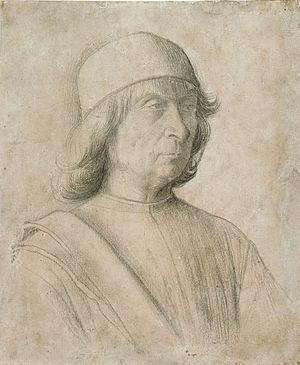
Achievements: Paintings
Born: c. 1431; Venice, Italy
Died: buried February 23, 1507; Venice (Aged about 75)
Field & Discipline: Art; Painter
Language: Italian
Father: Jacopo Bellini (painter)
Mother: Anna Rinversi
Siblings: Nicolo; Giovanni (painter); Nicolosia (married Italian painter Andrea Mantegna)
Spouse: 1) Cattarina Barasina; 2) Maria di Antonio Trevisano
Children: Unknown
Education: Unknown
Major Work:
"Mehmed II"
"Procession of the Relic of the Cross in the Piazza of San Marco"
"The Miracle of the True Cross"
Life & Times:
Little is known of Bellini's life. It is clear that as a painter he was overshadowed by his more famous brother [brother was] Giovanni Bellini* and his brother-in-law, Italian painter [brother-in-law was] Mantegna*. Like his brother, Bellini was trained by his father, Jacopo, an artist who introduced the ideas of the Florentine Renaissance to Venetian art.
The first work to be attributed to Bellini was part of an altarpiece he helped his father paint in 1459 for the Gattamelata Chapel in the church of Sant'Antonio, in Padua. Although he collaborated with his father and brother throughout his life, he eventually achieved a reputation of his own, particularly in the fields of narrative painting and portraits.
His first surviving independent work is a Madonna, painted in 1460. In 1465, Bellini painted a portrait of the poet Lorenzo Giustiniani. In 1466, he painted the shutters on the organ at the School of St. Mark's Cathedral in Venice, creating four huge figures of saints of a forbidding aspect.
Nothing is known of his output for the next eight years, but he was obviously gaining an artistic reputation since, in 1474, he was asked by the Venetian senate to redecorate the Hall of the Great Council in the Doge's Palace in St. Mark's Square, where the artwork had been damaged by the dampness. As well as repairing the damaged murals, he also began an original series of paintings on Venetian history.
In 1479, when the leader of the Ottoman Empire, [painted] Mehmet II*, asked the Venetians to send him a good artist, Bellini was chosen. His mission, unbeknown to Mehmed, was two-fold: as well as painting Mehmed's portrait and any other work Mehmed ordered, he was also to gather information for the Venetian government about the trading intentions and activities of the Turks.
He stayed in Constantinople for a year, until 1480, painting the Sultan several times. Before his return, he was knighted by Mehmed II, and was given a gold chain, an expensive wardrobe, and a pension. The most important surviving work from this period is his "Portrait of Mehmed II".
While Bellini was in Turkey, his brother Giovanni had taken over the work at the Doge's palace and when Bellini returned the two brothers collaborated on a series of frescoes, which, because of the ever-present dampness in Venice, were painted on canvas, not directly to the walls. The subject was the involvement of the Venetian Republic in the war between Pope Alexander III and Emperor Frederick I of Barbarossa during the 12th century. The frescoes, which were widely praised, were lost in a fire about 100 years later, in 1577.
Important works after Bellini's Doge frescoes included: "Procession of the Relic of the Cross in the Piazza of San Marco" (1496) and "The Miracle of the True Cross" (1501), both commissioned for the School of San Giovanni Evangelista, a religious society that wanted to celebrate its possession of a presumed fragment of the cross. The influence of Bellini's father was evident in both these paintings, for example, in the detailed treatment of architecture and in the accurate use of perspective.
Bellini's gift for portraiture showed in the striking faces in the crowds. Many of the faces were likenesses of important Venetian citizens. In 1505, he was commissioned to do a painting of "St. Mark Preaching", but died before finishing it. It was completed by his brother.
Extra Connections: [a fan was] Isabella d’Este* admired his work
Assessment: Despite their skilful portraiture and their scenic and historic accuracy, Bellini's paintings now are of interest mainly as a record of Venice and Venetians in the 15th century.
Oneliner: Gentile Bellini, who painted Sultan Mehmet II
Bibliography:
- Encyclopedia Britannica.
- Goffen, Rona, Giovanni Bellini, Yale University Press, London, 1989.