Fischer
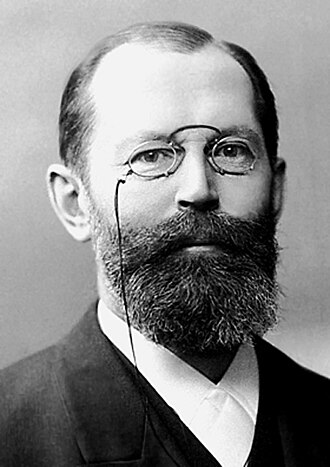
NAME: Fischer, Emil (Hermann)
ACHIEVEMENT(S): The Nobel Prize for Chemistry in 1902 in recognition of his investigations of the sugar and purine groups of substances.
NICKNAME/ALIAS: None
DATE/PLACE OF BIRTH: 9 October 1852, at Euskirchen, Prussia [Germany]
DATE/PLACE/AGE AT DEATH: 15 July 1919, in Berlin, Germany. Aged 66
DISCIPLINE: Organic chemist
FIELD: Organic chemistry
LANGUAGE: German
PARENTS: Laurenz Fischer and Julie Poensgen
SIBLINGS: ?
SPOUSE: Agnes Gerlach (d. 1895), married 1888
CHILDREN: Three sons, including Hermann Otto Laurenz (1888-1960, biochemist)
EDUCATION: Schools in Euskirchen; University of Bonn, 1871-72; University of
Strasbourg, 1872-74
MAJOR WORK: 'Investigations of the Purine Group’ (1882-1906')
LIFE AND TIMES:
At the University of Bonn Fischer studied chemistry under Friedrich Kekule* (a former pupil of Bunsen*). After a year, he transferred to the University of Strasbourg, where he graduated in 1874 with a doctoral thesis on the chemistry of dyes and colors. He became an unpaid lecturer at the University of Munich in 1878 and assistant professor in 1879.
Fischer began his first important work at Munich in collaboration with his cousin, Otto Fischer. Following on from the work on synthetic dyes by Perkin* and von Hoffman*, Fischer and his cousin made an extensive investigation of the dye rosaniline and other similar compounds, which they showed were triphenylmethane derivatives.
In 1875, Fischer published his first paper, on his discovery of the compound phenylhydrazine, that would prove important not only in itself but also as a key to the complex problems of carbohydrate chemistry. In 1878, he established the formula of phenylhydrazine, and prepared several organic derivatives of hydrazine.
He also discovered that the reactions of hydrazine with carbon disulphide led to the synthesis of several highly effective dyeing agents, including derivative methylene green (1878), which came only two years after the discovery by Caro* of methylene blue.
In 1882, Fischer was appointed professor of chemistry at the University of Erlangen, and here he began a series of studies on the constitution and synthesis of natural products like uric acid and caffeine. He soon became the prime investigator in this field, which includes such biologically important substances as xanthine, hypoxanthine,
adenine, and guanine (present in the cell nucleus of animals) and theobromine, caffeine, and theophylline (stimulants in plants).
At Erlangen he published the first of a long series of papers (1881-1914) on the chemistry of the previously-unknown heterocyclic nitrogen compounds related to uric acid, for which he coined the name 'purines', and in 1882 he suggested structural formulas for uric acid, caffeine, theobromine, xanthine, and guanine.
Meanwhile he was also following up on his 1875 discovery of phenylhydrazine, and in 1884 found that it formed bright yellow crystalline derivatives with carbohydrates, a key reaction in the study of sugars. In 1885 experiments with phenylhydrazine led to what is known as the Fischer indole synthesis, in which a phenylhydrazone is heated
with an acid catalyst to produce a derivative of indole.
In 1885 Fischer moved to the University of Wurzburg, where he remained until 1892, when he was appointed as professor of chemistry at the University of Berlin, a job he held until his death.
During these years he continued his studies of both purines and carbohydrates, successfully synthesizing theophylline and caffeine (1895) and uric acid (1897). This work convinced him that his structures for these compounds were incorrect, since the reaction products he obtained were not reconciliable to his formulas, and in 1897 he and his students produced a new set of formulas which reflected Fischer's realization that uric acid and related compounds were oxides of the hypothetical parent compound, purine (structure C[subscript]5N[subscript]4H[subscript]4).
Having now established purine chemistry on a firm footing, Fischer went on to synthesize
hypoxanthine, xanthine, theobromine, adenine, and guanine, and in 1898 he finally synthesized the parent compound, purine itself.
Fischer's laboratory methods became the basis for the industrial production of caffeine, theophylline and theobromine. His studies also led to the synthesis of powerful hypnotic drugs derived from barbituric acids, including 5,5-diethyl-barbituric acid (1903) which, under a variety of trade names (including Barbital, Veronal, and Dorminal), became widely used as a sedative.
Another commercially valuable purine was phenyl (ethyl-barbituric acid), which was prepared by Fischer in 1912 and sold as Luminal or phenobarbitol.
Meanwhile, Fischer's research into the sugar group were proving equally important. Following his discovery (1884) that the compound phenylhydrazine reacts with simple sugars to form well-defined crystalline derivatives, enabling them to be characterized and separated, Fischer made an extensive study of these derivatives, called osazones, during which he obtained the same osazone from three different sugars - glucose, fructose and mannose - demonstrating that all three have the same structure in the part of their molecules unaffected by phenylhydrazine.
He then went on to synthesize a variety of natural sugars and to determine the formulas of the 16 possible stereoisomers of glucose, the important group of sugars known collectively as hexoses.
In the course of this stereochemical research Fischer discovered that there are two series of sugars, the D sugars and the L sugars, that are mirror images of each other. Fischer's study of sugars also led him to the study of tannins, the gallic acid derivatives of sugars, and in 1912 he showed that tannins were not glucosides but esters. He also investigated the reactions and substances involved in fermentation and, in his investigations of how enzymes break down sugars, laid the foundations for enzyme chemistry.
In 1899, Fischer began pioneering investigations into the chemistry of polypeptides and proteins. It was already known that proteins could be hydrolysed to amino acids, and Fischer, after modifying a method for the separation of amino acids developed by Curtius* in 1883, successfully synthesized the amino acids ornithine (1,4-diaminopentanoic acid) in 1901, serine (1-hydroxy-2-aminobutanoic acid) in 1902, and the sulphur-containing cystine in 1908.
He then combined amino acids through amide links to form polypeptides, which when large enough (the largest of which, made in 1907 - was composed of 18 amino acid residues and had a molecular weight of 1,213) bore a general resemblance to natural proteins, and which he then broke down by enzymes in the same manner as would occur in a natural protein.
Under Fischer's direction during the 1890s and 1910s, the chemical laboratory at Berlin became one of the most important in the world, attracting a constant stream of brilliant pupils.
In 1902, Fischer won the Nobel Prize for chemistry in recognition of his syntheses in the sugar and purine groups.
During these years he suffered a serious bouts of both mercury and phenylhydrazine poisoning and finally contracted cancer, a fact which, combined with the death of his two younger sons in the war, led him to commit suicide.
ASSESSMENT: Fischer laid the chemical foundations for biochemistry by his study of sugars, enzymes, purines and proteins.
EXTRA CONNECTIONS: He was also taught by Baeyer*
ONELINER: Emil Fischer, who laid foundations of biochemistry
BIBLIOGRAPHY:
DSB, EB
Biog Dict of Chemists
Farber, Eduard, Great Chemists, New York, 1961.