Kekule
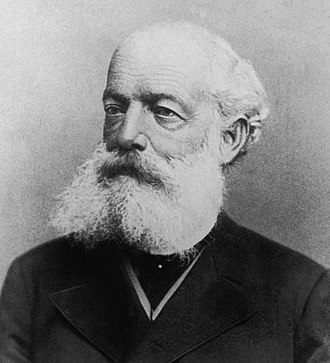
Kekule von Stradonitz, (Friedrich) August
ACHIEVEMENT(S): The benzine ring
NAME: Kekule, Friedrich August
DATE AND PLACE OF BIRTH: September 7, 1829, Darmstadt, Germany
DATE/PLACE OF DEATH/AGE AT DEATH: July 13, 1896, Bonn, Germany; Aged 66
DISCIPLINE: Organic Chemist
FIELD: Chemistry
LANGUAGE: German, French
EDUCATION: Darmstadt (Germany) Gymnasium; University of Giessen; University of Heidelberg
MAJOR WORK: "Sur la constitution des substances aromatiques"
LIFE AND TIMES:
Working under Heinrich Will at the University of Giessen, Germany, Kekule did his first research at age 20 on the ester of amylsulphuric acid and its salts, A year later, he began work in <worked in lab of> Liebig*'s laboratory in Geissen, studying the composition of gluten and wheat bran. Liebig was pleased enough to offered Kekule an assistantship, but Kekule found laboratory work tedious, and declined, going instead to Paris, where studied physics and chemistry under Charles-Frederic Gerhardt.
At the end of 1853, on Liebig's recommendation, Kekule traveled to England to assist John Stenhouse at St. Bartholomew s Hospital in London, where he remained until 1856. Kekule met several of Liebig's former students in London, including Alexander Williams Williamson, with whose help Kekule began work on the reaction of phosphorous pentasulphide on acetic acid, from which he was able to isolate thioacetic acid, which he classified as a new type:- hydrogen sulphide. His results were published later that year, marking the beginning of Kekule's career as an acclaimed organic chemist.
In 1855, at the suggestion of Liebig and German chemist <a pal of> Bunsen*, Kekule began teaching organic chemistry at the University of Heidelberg under Johann von Baeyer.
In a house in the town, he installed at his own expense a lecture room and private laboratory. Here he carried out experiments on the chemical constitution of fulminate of mercury, while von Baeyer studied compounds of arsenic trimethyl. Between 1855 and 1858, Kekule studied the nature of carbon.
In 1858, Kekule published his famous paper "On the constitution and metamorphoses of chemical compounds and the chemical nature of carbon", in which he showed that the carbon atom was tetravalent in most simple compounds, but that in compounds containing more than one carbon atom, the carbon atoms can link together in chains. In turn, these can form various polyvalent radicals.
He also theorized that radicals are not necessarily indestructible, as they are capable of persisting through one set of reactions only to disintegrate in others. The major implication of Kekule's paper was that an ordered classification of organic compounds was now possible. By stating the ability of carbon atoms to join up with each other, he also laid the foundation of structural chemistry.
Kekule based his courses at Heidelberg on these ideas, and illustrated his lectures with structural models of individual atoms and of groups of molecules. By projecting the shadows of these models on the wall, he obtained the "graphic formulas" -- essentially pictures of atoms grouping themselves in space and linking with each other to form compounds.
He began to write a comprehensive textbook of organic chemistry, but suspended his writing to accept a full professorship in chemistry at the University of Ghent in Belgium, and soon began to attract students from all over Europe. Kekule spent his days teaching and researching, and his evenings writing the textbook.
In 1860, he organized at Karlsruhe the first International Congress of Chemists, whose aim was to establish international uniformity in chemical nomenclature and terminology. (The Congress also heard the famous paper on atomic theory by Italian chemist <heard theory of> Cannizzaro*, in which he re-established the importance of the <knew of theory of> Avogadro*-<knew of theory of> Ampere* molecular hypothesis.)
In 1861, with his chemistry textbook at the printers, Kekule began to study the unsaturated dibasic acids. Kekule had long maintained that carbon was tetravalent, but he decided to delve further into this area as a result of his discovery of fumaric acid and maleic acid, two unsaturated dibasic isomers related to succinic acid, each of which contained four carbon atoms.
These acids readily fixed bromine to form two different dibromide derivatives, but having identified these, Kekule was unable to interpret their structure. The problem became more puzzling when he discovered three other unsaturated isomeric dibasic acids with five carbon atoms each.
To account for these anomalies, Kekule came up with a new theory, theorizing that in unsaturated isomers there are or double bonds between two neighboring carbon atoms. This accounted for both the two isomers with four carbon atoms and the three acids with five carbon atoms. His theory was published in 1862.
Kekule renewed his research in 1864, and returned to the problems surrounding unsaturated substances, in particular the chemical structure of the aromatic compounds. After puzzling for some time over the chemical structure of benzene, composed of six carbon and six hydrogen atoms, Kekule wrote that everything came clear to him in a reverie. He had the vision of a snake grabbing its own tail and whirling.
From this image of the benzene molecule as a snake biting its tail while in whirling motion, Kekule's concept of the six-carbon benzene ring was born. Kekule presented his theory of the structure of benzene to the Societe Chimique de Paris in early 1865, in a session presided over by French scientist <met> Pasteur*.
In his paper, Kekule envisaged the structure of benzene as a hexagonal ring of six interconnected carbon atoms, and, to make the structure compatible with carbon's valence of four, he postulated alternate single and double bonds in the same ring. His paper concluded with a table of formulas for benzene and similar compounds. The facts of organic chemistry known up to that time had now fallen into place.
To present the valence theory and the concept of chains and rings of carbon atoms to his students, Kekule devised sophisticated atomic models, visual aids that were used in chemistry classes for the next century.
The models for the elementary atoms were wooden balls of equal size and different colors. For example, hydrogen was a white sphere with one brass socket. Carbon was a black sphere with four brass rods of equal length directed toward the corners of a regular tetrahedron, with brass sockets which permitted the connection of such carbon-atom models and therefore the construction of complex carbon compounds.
The tetrahedral carbon atom, first proposed by Kekule in a paper of 1867, was to become the cornerstone of modern structural organic chemistry.
In 1867, Kekule accepted the chair of chemistry and the directorship of a new chemical institute at the University of Bonn, where he remained until his death nearly 30 years later.
ASSESSMENT: A visionary of 19th-century chemistry, who formulated a theory of the linking of carbon atoms, and followed this with his model of the tetrahedral carbon atom, which was to become the cornerstone of modern structural organic chemistry.
EXTRA CONNECTIONS: He taught <taught> Fischer*
He knew <knew> Kuhne*
He was succeeded at Bonn by <succeeded by> Curtius*
He taught<taught> Fischer*
<a lab worker was> Baeyer* worked in his lab.
ONELINER: August Kekule, who discovered the benzine ring
BIBLIOGRAPHY:
EB, DSB, Biographical Dictionary of Chemists
Anschutz, Richard, "August Kekule", in Great Chemists , ed. by Edward Farber, New York & London: Interscience Publishers, 1961
PARENTS: Ludwig Karl Emil Kekule; Margarete Seyb
SIBLINGS: 1 stepbrother
SPOUSE: 1) Stephanie Drory; 2) Luise Hoegel
CHILDREN: Stephan, with Stephanie Drory; Reinhard and Ludwig Weiss, with Luise Hoegel