B-52 Bomber
Connections 1 culminated in the B-52
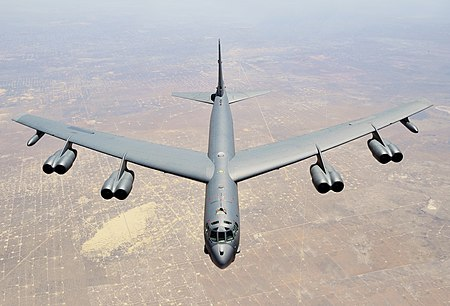
The Boeing B-52 Stratofortress is an American long-range, subsonic, jet-powered strategic bomber. The B-52 was designed and built by Boeing, which has continued to provide support and upgrades. It has been operated by the United States Air Force (USAF) since the 1950s. The bomber can carry up to 70,000 pounds (32,000 kg) of weapons,[2] and has a typical combat range of around 8,800 miles (14,200 km) without aerial refueling.[3]
Beginning with the successful contract bid in June 1946, the B-52 design evolved from a straight wing aircraft powered by six turboprop engines to the final prototype YB-52 with eight turbojet engines and swept wings. The B-52 took its maiden flight in April 1952. Built to carry nuclear weapons for Cold War–era deterrence missions, the B-52 Stratofortress replaced the Convair B-36 Peacemaker. A veteran of several wars, the B-52 has dropped only conventional munitions in combat. The B-52's official name Stratofortress is rarely used; informally, the aircraft has become commonly referred to as the BUFF (Big Ugly Fat Fucker/Fella).[4][5][6][Note 1]
The B-52 has been in service with the USAF since 1955. There are 72 aircraft in inventory as of 2022;[8] 58 operated by active forces (2nd Bomb Wing and 5th Bomb Wing), 18 by reserve forces (307th Bomb Wing), and about 12 in long-term storage at the Davis-Monthan AFB Boneyard.[2][3][9][10][11] The bombers flew under the Strategic Air Command (SAC) until it was disestablished in 1992 and its aircraft absorbed into the Air Combat Command (ACC); in 2010, all B-52 Stratofortresses were transferred from the ACC to the new Air Force Global Strike Command (AFGSC). Superior performance at high subsonic speeds and relatively low operating costs have kept them in service despite the advent of later, more advanced strategic bombers, including the Mach 2+ Convair B-58 Hustler, the canceled Mach 3 North American XB-70 Valkyrie, the variable-geometry Rockwell B-1 Lancer, and the stealth Northrop Grumman B-2 Spirit. The B-52 completed 60 years of continuous service with its original operator in 2015. After being upgraded between 2013 and 2015, the last airplanes are expected to serve into the 2050s.
- Development
- Design
- Operational history
- Variants
- Operators
- Notable accidents
- Aircraft on display
- Specifications (B-52H)
- Notable appearances in media
- See also
- Notes
- References
- External links
Development
Origins
[ ](https://en.wikipedia.org/wiki/File:Boeing_B-52_Stratofortress_evolution,_part_1.png)
Models 462 (1946)[12] to 464-35 (1948)[12]
[ ](https://en.wikipedia.org/wiki/File:Boeing_B-52_Stratofortress_evolution,_part_2.png)
Models 464-49 (1949)[12] to B-52A (1952)
On 23 November 1945, Air Materiel Command (AMC) issued desired performance characteristics for a new strategic bomber "capable of carrying out the strategic mission without dependence upon advanced and intermediate bases controlled by other countries".[13] The aircraft was to have a crew of five or more turret gunners, and a six-man relief crew. It was required to cruise at 300 miles per hour (260 kn; 480 km/h) at 34,000 feet (10,000 m) with a combat radius of 5,000 miles (4,300 nmi; 8,000 km). The armament was to consist of an unspecified number of 20 mm cannons and 10,000 pounds (4,500 kg) of bombs.[14] On 13 February 1946, the USAF issued bid invitations for these specifications, with Boeing, Consolidated Aircraft, and Glenn L. Martin Company submitting proposals.[14]
On 5 June 1946, Boeing's Model 462, a straight-wing aircraft powered by six Wright T35 turboprops with a gross weight of 360,000 pounds (160,000 kg) and a combat radius of 3,110 miles (2,700 nmi; 5,010 km), was declared the winner.[15] On 28 June 1946, Boeing was issued a letter of contract for US$1.7 million to build a full-scale mockup of the new XB-52 and do preliminary engineering and testing.[16] However, by October 1946, the USAF began to express concern about the sheer size of the new aircraft and its inability to meet the specified design requirements.[17] In response, Boeing produced the Model 464, a smaller four-engine version with a 230,000-pound (100,000 kg) gross weight, which was briefly deemed acceptable.[18]
Subsequently, in November 1946, the Deputy Chief of Air Staff for Research and Development, General Curtis LeMay, expressed the desire for a cruising speed of 400 miles per hour (350 kn; 640 km/h), to which Boeing responded with a 300,000-pound (140,000 kg) aircraft.[19] In December 1946, Boeing was asked to change their design to a four-engine bomber with a top speed of 400 miles per hour (350 kn; 640 km/h), range of 12,000 miles (10,000 nmi; 19,000 km), and the ability to carry a nuclear weapon; in total, the aircraft could weigh up to 480,000 pounds (220,000 kg).[20] Boeing responded with two models powered by T35 turboprops. The Model 464-16 was a "nuclear only" bomber with a 10,000-pound (4,500 kg) payload, while the Model 464-17 was a general purpose bomber with a 9,000-pound (4,100 kg) payload.[20] Due to the cost associated with purchasing two specialized aircraft, the USAF selected Model 464-17 with the understanding that it could be adapted for nuclear strikes.[21]
In June 1947, the military requirements were updated and the Model 464-17 met all of them except for the range.[22] It was becoming obvious to the USAF that, even with the updated performance, the XB-52 would be obsolete by the time it entered production and would offer little improvement over the Convair B-36 Peacemaker; as a result, the entire project was postponed for six months.[23] During this time, Boeing continued to perfect the design, which resulted in the Model 464-29 with a top speed of 455 miles per hour (395 kn; 732 km/h) and a 5,000-mile (8,000 km) range.[24] In September 1947, the Heavy Bombardment Committee was convened to ascertain performance requirements for a nuclear bomber. Formalized on 8 December 1947, these requirements called for a top speed of 500 miles per hour (430 kn; 800 km/h) and an 8,000-mile (7,000 nmi; 13,000 km) range, far beyond the capabilities of the 464-29.[25]
The outright cancellation of the Boeing contract on 11 December 1947 was staved off by a plea from its president William McPherson Allen to the Secretary of the Air Force Stuart Symington.[26] Allen reasoned that the design was capable of being adapted to new aviation technology and more stringent requirements.[27] In January 1948, Boeing was instructed to thoroughly explore recent technological innovations, including aerial refueling and the flying wing.[28] Noting stability and control problems Northrop Corporation was experiencing with their YB-35 and YB-49 flying wing bombers, Boeing insisted on a conventional aircraft, and in April 1948 presented a US$30 million (US$365 million today[29]) proposal for design, construction, and testing of two Model 464-35 prototypes.[30] Further revisions during 1948 resulted in an aircraft with a top speed of 513 miles per hour (446 kn; 826 km/h) at 35,000 feet (11,000 m), a range of 6,909 miles (6,004 nmi; 11,119 km), and a 280,000-pound (130,000 kg) gross weight, which included 10,000 pounds (4,500 kg) of bombs and 19,875 US gallons (75,240 L) of fuel.[31]
Design effort
 XB-52 prototype on flight line (X-4 in foreground; B-36 behind). Note original tandem-seat "bubble" style canopy, similar to Boeing's earlier B-47 Stratojet.
 Side view of YB-52 bomber, still fitted with a tandem cockpit, in common with other jet bombers in US service, such as the B-45 Tornado, B-47 Stratojet and Martin B-57 Canberra
In May 1948, Air Materiel Command asked Boeing to incorporate the previously discarded jet engine, with improvements in fuel efficiency, into the design.[32] That resulted in the development of yet another revision—in July 1948, Model 464-40 substituted Westinghouse J40 turbojets for the turboprops.[33] The USAF project officer who reviewed the Model 464-40 was favorably impressed, especially since he had already been thinking along similar lines. Nevertheless, the government was concerned about the high fuel consumption rate of the jet engines of the day and directed Boeing to still use the turboprop-powered Model 464-35 as the basis for the XB-52. Although he agreed that turbojet propulsion was the future, General Howard A. Craig, Deputy Chief of Staff for Materiel, was not very enthusiastic about a jet-powered B-52 since he felt that the jet engine had not yet progressed sufficiently to permit skipping an intermediate turboprop stage. However, Boeing was encouraged to continue turbojet studies even without any expected commitment to jet propulsion.[34][35]
...
The navigational capabilities of the B-52 were later augmented with the addition of GPS in the 1980s.[104] The IBM AP-101, also used on the Rockwell B-1 Lancer bomber and the Space Shuttle, was the B-52's main computer.[105]
...
Operational history
Introduction
Although the B-52A was the first production variant, these aircraft were used only in testing. The first operational version was the B-52B which had been developed in parallel with the prototypes since 1951. First flying in December 1954, B-52B, AF Serial Number 52-8711, entered operational service with 93rd Heavy Bombardment Wing (93rd BW) at Castle Air Force Base, California, on 29 June 1955. The wing became operational on 12 March 1956. The training for B-52 crews consisted of five weeks of ground school and four weeks of flying, accumulating 35 to 50 hours in the air. The new B-52Bs replaced operational B-36s on a one-to-one basis.[135]
Early operations were problematic;[136] in addition to supply problems, there were also technical issues.[137] Ramps and taxiways deteriorated under the aircraft's weight, the fuel system was prone to leaks and icing,[138] and bombing and fire control computers were unreliable.[137]
The split-level cockpit presented a temperature control problem – the pilots' cockpit was heated by sunlight while the observer and the navigator on the bottom deck sat on the ice-cold floor. Thus, a comfortable temperature setting for the pilots caused the other crew members to freeze, while a comfortable temperature for the bottom crew caused the pilots to overheat.[139]
The J57 engines proved unreliable. Alternator failure caused the first fatal B-52 crash in February 1956;[140] as a result, the fleet was briefly grounded. In July, fuel and hydraulic issues grounded the B-52s again. In response to maintenance issues, the USAF set up "Sky Speed" teams of 50 contractors at each B-52 base to perform maintenance and routine checkups, taking an average of one week per aircraft.[141]
 Three B-52Bs of the 93rd Bomb Wing prepare to depart March Air Force Base for Castle Air Force Base, California, after their record-setting round-the-world flight in 1957.
On 21 May 1956, a B-52B (52-13) dropped a Mk-15 nuclear bomb over the Bikini Atoll in a test code-named Cherokee. It was the first air-dropped thermonuclear weapon.[142] This aircraft now is on display at the National Museum of Nuclear Science and History in Albuquerque, NM. From 24 to 25 November 1956, four B-52Bs of the 93rd BW and four B-52Cs of the 42nd BW flew nonstop around the perimeter of North America in Operation Quick Kick, which covered 15,530 miles (13,500 nmi; 24,990 km) in 31 hours, 30 minutes. SAC noted the flight time could have been reduced by 5 to 6 hours had the four inflight refuelings been done by fast jet-powered tanker aircraft rather than propeller-driven Boeing KC-97 Stratofreighters.[143]
In a demonstration of the B-52's global reach, from 16 to 18 January 1957, three B-52Bs made a non-stop flight around the world during Operation Power Flite, during which 24,325 miles (21,138 nmi; 39,147 km) was covered in 45 hours 19 minutes (536.8 mph or 863.9 km/h) with several in-flight refuelings by KC-97s.[144][Note 4]
The B-52 set many records over the next few years. On 26 September 1958, a B-52D set a world speed record of 560.705 miles per hour (487.239 kn; 902.367 km/h) over a 10,000 kilometers (6,200 miles; 5,400 nautical miles) closed circuit without a payload.
The same day, another B-52D established a world speed record of 597.675 miles per hour (519.365 kn; 961.865 km/h) over a 5,000 kilometers (3,100 miles; 2,700 nautical miles) closed circuit without a payload.[145] On 14 December 1960, a B-52G set a world distance record by flying unrefueled for 10,078.84 miles (8,758.27 nmi; 16,220.32 km); the flight lasted 19 hours 44 minutes (510.75 mph or 821.97 km/h).[146] From 10 to 11 January 1962, a B-52H (60-40) set a world distance record by flying unrefueled, surpassing the prior B-52 record set two years earlier, from Kadena Air Base, Okinawa Prefecture, Japan, to Torrejón Air Base, Spain, which covered 12,532.28 miles (10,890.25 nmi; 20,168.75 km).[63][147] The flight passed over Seattle, Fort Worth and the Azores.
Cold War
Main article: Cold War
 Southerly route of the Operation Chrome Dome airborne nuclear alert.
When the B-52 entered service, the Strategic Air Command (SAC) intended to use it to deter and counteract the vast and modernizing Soviet Union's military. As the Soviet Union increased its nuclear capabilities, destroying or "countering" the forces that would deliver nuclear strikes (bombers, missiles, etc.) became of great strategic importance.[148] The Eisenhower administration endorsed this switch in focus; the President in 1954 expressed a preference for military targets over civilian ones, a principle reinforced in the Single Integrated Operation Plan (SIOP), a plan of action in the case of nuclear war breaking out.[149]
...
- On 24 January 1961, B-52G (58‑0187) from the 4241st Strategic Wing broke up in midair and crashed on approach to Seymour Johnson AFB near Goldsboro, North Carolina, dropping two nuclear bombs in the process without detonation. The aircraft suffered a fuel leak at altitude due to fatigue failure of the starboard wing. A loss of control resulted when the flaps were applied during the emergency approach to Seymour Johnson AFB. Three of the eight crew members were killed.[276][277]
- On 14 March 1961, B-52F (57‑0166) of the 4134th Strategic Wing operating out of Mather AFB, California, carrying two nuclear weapons experienced an uncontrolled decompression, necessitating a descent to 10,000 feet (3,000 m) to lower the cabin altitude. Due to increased fuel consumption at the lower altitude and being unable to rendezvous with a tanker in time, the aircraft ran out of fuel. The crew ejected safely, while the now-unmanned bomber crashed 15 miles (24 km) west of Yuba City, California.[273][278][279]^
- ...
A B-52 carrying nuclear weapons was a key part of Stanley Kubrick's 1964 black comedy film Dr. Strangelove or: How I Learned to Stop Worrying and Love the Bomb.[302] A 1960s hairstyle, the beehive, is also called a B-52 for its resemblance to the aircraft's distinctive nose.[303] The popular band the B-52's was subsequently named after this hairstyle.[303][304]
...
1966 Palomares B-52 crash - Wikipedia
The 1966 Palomares B-52 crash, also called the Palomares incident, occurred on 17 January 1966, when a B-52G bomber of the United States Air Force's Strategic Air Command collided with a KC-135 tanker during mid-air refueling at 31,000 feet (9,450 m) over the Mediterranean Sea, off the coast of Spain. The KC-135 was destroyed when its fuel load ignited, killing all four crew members. The B-52G broke apart, killing three of the seven crew members aboard.[1]
At the time of the accident, the B-52G was carrying four B28FI Mod 2 Y1 thermonuclear (hydrogen) bombs,[2][3][4] all of which fell to the surface. Three were found on land near the small fishing village of Palomares in the municipality of Cuevas del Almanzora, Almería, Spain. The non-nuclear explosives in two of the weapons detonated upon impact with the ground, resulting in the contamination of a 0.77-square-mile (2 km2) area with radioactive plutonium. The fourth, which fell into the Mediterranean Sea, was recovered intact after a search lasting two and a half months.[5]
Accident
Operation Chrome Dome flight path over southern Europe, showing refueling tracks
The B-52G began its mission from Seymour Johnson Air Force Base, North Carolina, carrying four B28FI Mod 2 Y1 thermonuclear bombs on a Cold War airborne alert mission named Operation Chrome Dome. The flight plan took the aircraft east across the Atlantic Ocean and Mediterranean Sea towards the European borders of the Soviet Union before returning home. The lengthy flight required two mid-air refuelings over Spain.[1]
At about 10:30 am on 17 January 1966, while flying at 31,000 feet (9,450 m), the bomber commenced its second aerial refueling with a KC-135 out of Morón Air Base in southern Spain. The B-52 pilot, Major Larry G. Messinger, later recalled,[6]
We came in behind the tanker, and we were a little bit fast, and we started to overrun him a little bit. There is a procedure they have in refueling where if the boom operator feels that you're getting too close and it's a dangerous situation, he will call, "Break away, break away, break away." There was no call for a break away, so we didn't see anything dangerous about the situation. But all of a sudden, all hell seemed to break loose.
 Boom operator's view of a B-52 from a KC-135 tanker
The planes collided, with the nozzle of the refueling boom striking the top of the B-52 fuselage, breaking a longeron and snapping off the left wing,[7][8] which resulted in an explosion that was witnessed by a second B-52 about a mile (1.6 km) away.[9] All four men on the KC-135 and three of the seven men on the bomber were killed.
...
The search for the fourth bomb was carried out by means of a novel mathematical method, Bayesian search theory, led by Craven.[16] This method assigns probabilities to individual map grid squares, then updates these as the search progresses. Initial probability input is required for the grid squares, and these probabilities made use of the fact that a local fisherman, Francisco Simó Orts,[5] popularly known since as "Paco el de la bomba ("Bomb Paco" or "Bomb Frankie"),[17] witnessed the bomb entering the water at a certain location. Simó Orts was hired by the U.S. Air Force to assist in the search operation.
The United States Navy assembled the following ships in response to the Air Force request for assistance:[18]
 Alvin submersible
- USS *Kiowa*, a Navajo class fleet tug, arrived 27 January,[19] first on-scene[citation needed]
- USS *Macdonough*, flagship through January
- USS *Nimble*
- USS *Pinnacle*, found UQS-1 SONAR contact where Francisco Simo-Orts saw the bomb fall
- USS *Rival*, mother ship for PC3B submersible
- USS *Sagacity*, confirmed Pinnacle's SONAR contact
- USS *Salute*
- USS *Skill*
- USS *Nespelen*
- USS *Fort Snelling*, served as a support ship for the submersibles
- USS *Boston*, flagship 30 January – 15 March
- USS *Albany*, flagship 15 March through April
- USS *Notable*, minesweeper of Minesweeper Division 85 out of Charleston, SC, supported both submersibles ‘’Aluminaut’’ and ‘’Alvin’’ during the search; Jon Lindbergh piloted the "Alvin" submersible and supported the Westinghouse ocean-bottom, side-scanning sonar (OBSS). That sonar array, deployed beneath the USS Notable, may have detected the nuclear bomb which was still aboard the B-52 bomber when it entered the water.[citation needed]
- USS *Plymouth Rock*, transported Aluminaut and Alvin to the search site
- USS *Petrel*
- USS *Tringa*
- USS *Charles R. Ware*[20]
- USS *Hoist*
- USS *Lindenwald*, transported Aluminaut to Miami, Florida, after Palomares incident
- USNS *Mizar*
- USNS *Dutton*
- DSV *Alvin*
- Aluminaut
- PC-3B (Ocean Systems, Inc. submersible capable of searching to 600 feet (180 m))
- Deep Jeep (a Navy submersible capable of diving to 2,000 feet (610 m))
- CURV-I [1] (Cable-Controlled Underwater Recovery Vehicle)
- USS *Luiseno*, removed aircraft wreck debris from the search site
- USS *Everglades*, removed aircraft wreck debris from the search site
- USNS *Lt. George W. G. Boyce*, removed radioactive contaminated soil from Spain.
Additionally, the aircraft carrier USS *Forrestal* and various other units of the Sixth Fleet made a brief stopover at Palomares on the morning of 15 March 1966; Forrestal anchored at 09:03 and departed at 12:19.[21]
The recovery operation was led by the Supervisor of Salvage, Captain Searle.[16] Hoist, Petrel and Tringa brought 150 qualified divers who searched to 120 feet (37 m) with compressed air, to 210 feet (64 m) with mixed gas, and to 350 feet (110 m) with hard-hat rigs;[22] but the bomb lay in an uncharted area of the Rio Almanzora canyon on a 70-degree slope at a depth of 2,550 feet (780 m).[22] After a search that continued for 80 days following the crash, the bomb was located by the DSV *Alvin* on 17 March, but was dropped and temporarily lost when the Navy attempted to bring it to the surface.[23] After the loss of the recovered bomb, the ship's positions were fixed by Decca HI-FIX position-locating equipment for subsequent recovery attempts.[24]
...While serving on the salvage ship USS *Hoist* during recovery operations, Navy diver Carl Brashear had his leg crushed in a deck accident and lost the lower part of his left leg. His story was the inspiration for the 2000 film Men of Honor.[41]
...
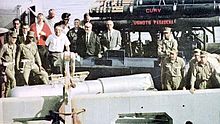 The recovered thermonuclear bomb displayed on the fantail of the submarine rescue ship USS *Petrel* after it was located by DSV *Alvin* and recovered by CURV-I, pictured, at a depth of 2,500 feet (760 m).
Alvin located the bomb again on 2 April, this time at a depth of 2,900 feet (880 m).[15] On 7 April, an unmanned torpedo recovery vehicle, CURV-I, became entangled in the weapon's parachute while attempting to attach a line to it. A decision was made to raise CURV and the weapon together to a depth of 100 feet (30 m), where divers attached cables to both. The bomb was brought to the surface by USS *Petrel*. The USS *Cascade* was diverted from its Naples destination, stayed on scene until recovery, then took the bomb back to the United States.[citation needed]
Once the bomb was located, Simó Orts appeared at the United States District Court for the Southern District of New York with his lawyer, Herbert Brownell, formerly Attorney General of the United States under President Dwight D. Eisenhower, claiming salvage rights on the recovered thermonuclear bomb.
...
See also
- Broken Arrow
- List of military nuclear accidents
- RAF Lakenheath nuclear near-disasters – included another US military incident involving a Mark 28 nuclear bomb