Hannibal
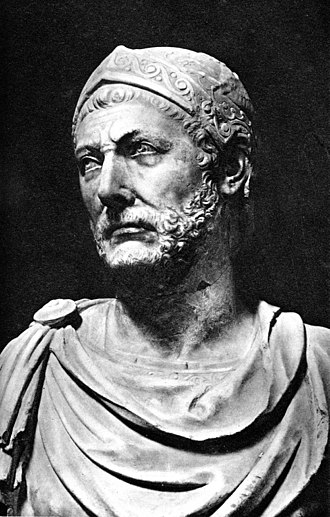
Hannibal (/ˈhænɪbəl/; Punic: 𐤇𐤍𐤁𐤏𐤋, romanized: Ḥannībaʿl; 247 – between 183 and 181 BC) was a Carthaginian general and statesman who commanded the forces of Carthage in their battle against the Roman Republic during the Second Punic War. He is widely regarded as one of the greatest military commanders throughout history.
Hannibal's father, Hamilcar Barca, was a leading Carthaginian general during the First Punic War. His younger brothers were Mago and Hasdrubal; his brother-in-law was Hasdrubal the Fair, who commanded other Carthaginian armies. Hannibal lived during a period of great tension in the Mediterranean Basin, triggered by the emergence of the Roman Republic as a great power with its defeat of Carthage in the First Punic War. Revanchism prevailed in Carthage, symbolized by the pledge that Hannibal made to his father to "never be a friend of Rome".
In 218 BC, Hannibal attacked Saguntum (modern Sagunto, Spain), an ally of Rome, in Hispania, sparking the Second Punic War. Hannibal invaded Italy by crossing the Alps with North African war elephants. In his first few years in Italy, he won a succession of victories at the Battle of the Trebia, Lake Trasimene, and Cannae, inflicting heavy losses on the Romans. Hannibal was distinguished for his ability to determine both his and his opponent's respective strengths and weaknesses, and to plan battles accordingly. His well-planned strategies allowed him to conquer and ally with several Italian cities that were previously allied to Rome. Hannibal occupied most of southern Italy for 15 years.
The Romans, led by Fabius Maximus, avoided directly engaging him, instead waging a war of attrition. Carthaginian defeats in Hispania prevented Hannibal from being reinforced, and he was unable to win a decisive victory. A counter-invasion of North Africa, led by Roman General Scipio Africanus, forced him to return to Carthage. Hannibal was eventually defeated at the Battle of Zama, ending the war in a Roman victory.
After the war, Hannibal successfully ran for the office of sufet. He enacted political and financial reforms to enable the payment of the war indemnity imposed by Rome; however, those reforms were unpopular with members of the Carthaginian aristocracy and in Rome, and he fled into voluntary exile. During this time, he lived at the Seleucid court, where he acted as military advisor to Antiochus III the Great in his war against Rome. Antiochus met defeat at the Battle of Magnesia and was forced to accept Rome's terms, and Hannibal fled again, making a stop in the Kingdom of Armenia. His flight ended in the court of Bithynia. He was betrayed to the Romans and died by suicide with poison.
Hannibal is considered one of the greatest military tacticians and generals of antiquity, alongside Philip of Macedon, Alexander the Great, Leonidas, Julius Caesar, Scipio Africanus and Pyrrhus. According to Plutarch, Scipio asked Hannibal "who the greatest general was", to which Hannibal replied "either Alexander or Pyrrhus, then himself".[1]
Name
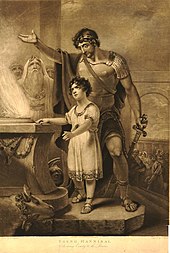 ])Circa 1850 engraving of Young Hannibal (left) by Charles Turner
Hannibal was a common Semitic Phoenician-Carthaginian personal name. It is recorded in Carthaginian sources as ḥnbʿl[2] (Punic: 𐤇𐤍𐤁𐤏𐤋). It is a combination of the common Phoenician masculine given name Hanno with the Northwest Semitic Canaanite deity Baal (lit, "lord") a major god of the Carthaginians ancestral homeland of Phoenicia in Western Asia. Its precise vocalization remains a matter of debate. Suggested readings include Ḥannobaʿal,[3] Ḥannibaʿl, or Ḥannibaʿal,[4][5] meaning "Baʿal/The lord is gracious", "Baʿal Has Been Gracious",[5][6] or "The Grace of Baʿal".[4] It is equivalent to the fellow Semitic Hebrew name Haniel. Greek historians rendered the name as Anníbas (Ἀννίβας).
...
Later career
Peacetime Carthage (200–196 BC)

Bust of Hannibal, Bardo National Museum, Tunisia
Hannibal was still only 46 at the conclusion of the Second Punic War in 201 BC and soon showed that he could be a statesman as well as a soldier. Following the conclusion of a peace that left Carthage saddled with an indemnity of ten thousand talents, he was elected suffete (chief magistrate) of the Carthaginian state.[64] After an audit confirmed Carthage had the resources to pay the indemnity without increasing taxation, Hannibal initiated a reorganization of state finances aimed at eliminating corruption and recovering embezzled funds.[65]
The principal beneficiaries of these financial peculations had been the oligarchs of the Hundred and Four.[65] In order to reduce the power of the oligarchs, Hannibal passed a law stipulating the Hundred and Four be chosen by direct election rather than co-option. He also used citizen support to change the term of office in the Hundred and Four from life to a year, with none permitted to "hold office for two consecutive years."[65][64]
Exile (after 195 BC)
Seven years after the victory of Zama, the Romans, alarmed by Carthage's renewed prosperity and suspicious that Hannibal had been in contact with Antiochus III of the Seleucid Empire, sent a delegation to Carthage alleging that Hannibal was helping an enemy of Rome.[66] Aware that he had many enemies, not least of which due to his financial reforms eliminating opportunities for oligarchical graft, Hannibal fled into voluntary exile before the Romans could demand that Carthage surrender him into their custody.[66]
He journeyed first to Tyre, the mother city of Carthage, and then to Antioch, before he finally reached Ephesus, where he was honourably received by Antiochus. Livy states that the Seleucid king consulted Hannibal on the strategic concerns of making war on Rome.[65] According to Cicero, while at the court of Antiochus, Hannibal attended a lecture by Phormio, a philosopher, that ranged through many topics. When Phormio finished a discourse on the duties of a general, Hannibal was asked his opinion. He replied, "I have seen during my life many old fools; but this one beats them all." Another story, according to Aulus Gellius, is that after Antiochus III showed off the gigantic and elaborately equipped army he had created to invade Greece to Hannibal, he asked him if they would be enough for the Roman Republic, to which Hannibal replied, "I think all this will be enough, yes, quite enough, for the Romans, even though they are most avaricious."[67]
In the summer of 193 BC, tensions flared up between the Seleucids and Rome. Antiochus gave tacit support to Hannibal's plans of launching an anti-Roman coup d'état in Carthage, yet it was not carried out.[68] The Carthaginian general also advised equipping a fleet and landing a body of troops in the south of Italy, offering to take command himself.[65] In 190 BC, after having suffered a series of defeats in the Roman–Seleucid War,[69] Antiochus gave Hannibal his first significant military command after spending five years in the Seleucid court.[70] Hannibal was tasked with building a fleet in Cilicia from scratch. Although Phoenician territories like Tyre and Sidon possessed the necessary combination of raw materials, technical expertise, and experienced personnel, it took much longer than expected for it to be completed, most likely due to wartime shortages.[71]
In July 190 BC, Hannibal ordered his fleet to set sail from Seleucia Pieria along the southern Asia Minor coast in order to reinforce the rest of the Seleucid navy at Ephesus.[72] The following month Hannibal's fleet clashed with the Rhodian navy in the Battle of Side. The faster Rhodian ships managed to heavily damage half of Hannibal's warships through the diekplous manoeuvre, forcing him to retreat.[73] Hannibal had preserved most of his fleet; however, he was in no position to unite with Polyxenidas' fleet at Ephesus since his ships required lengthy repairs.[74] The ensuing Battle of Myonessus resulted in a Roman-Rhodian victory, which cemented Roman control over the Aegean Sea, enabling them to launch an invasion of Seleucid Asia Minor. The two armies faced off in the Battle of Magnesia, north-east of Magnesia ad Sipylum. The battle resulted in a decisive Roman-Pergamene victory.[75] The truce was signed at Sardes in January 189 BC, whereupon Antiochus agreed to abandon his claims on all lands west of the Taurus Mountains, paid a heavy war indemnity and promised to hand over Hannibal and other notable enemies of Rome from among his allies.[76]
According to Strabo and Plutarch, Hannibal also received hospitality at the Armenian royal court of Artaxias I. The authors add an apocryphal story of how Hannibal planned and supervised the building of the new royal capital Artaxata.[77] Suspicious that Antiochus was prepared to surrender him to the Romans, Hannibal fled to Crete, but he soon went back to Anatolia and sought refuge with Prusias I of Bithynia, who was engaged in warfare with Rome's ally, King Eumenes II of Pergamon.[78] Hannibal went on to serve Prusias in this war. During one of the naval victories he gained over Eumenes, Hannibal had large pots filled with venomous snakes thrown onto Eumenes' ships.[79] Hannibal also went on to defeat Eumenes in two other battles on land.[80]
Death (183–181 BC)
At this stage, the Romans intervened and threatened Bithynia into giving up Hannibal.[80] Prusias agreed, but the general was determined not to fall into his enemy's hands. The precise year and cause of Hannibal's death are unknown. Pausanias wrote that Hannibal's death occurred after his finger was wounded by his drawn sword while mounting his horse, resulting in a fever and then his death three days later.[81] Cornelius Nepos[82] and Livy,[83] however, tell a different story, namely that the ex-consul Titus Quinctius Flamininus, on discovering that Hannibal was in Bithynia, went there in an embassy to demand his surrender from King Prusias. Hannibal, discovering that the castle where he was living was surrounded by Roman soldiers and he could not escape, took poison. Appian writes that it was Prusias who poisoned Hannibal.[84]
Pliny the Elder[85] and Plutarch, in his life of Flamininus,[86] record that Hannibal's tomb was at Libyssa on the coast of the Sea of Marmara. According to some, Libyssa was sited at Gebze (between Bursa and Üskudar), but W. M. Leake,[87] identifying Gebze with ancient Dakibyza, placed it further west. Before dying, Hannibal is said to have left behind a letter declaring, "Let us relieve the Romans from the anxiety they have so long experienced, since they think it tries their patience too much to wait for an old man's death".[88]
Appian wrote of a prophecy about Hannibal's death, which stated that "Libyssan earth shall cover Hannibal's remains." This, he wrote, made Hannibal believe that he would die in Libya, but instead, it was at the Bithynian Libyssa that he would die.[84]
In his Annales, Titus Pomponius Atticus reports that Hannibal's death occurred in 183 BC,[89] and Livy implies the same. Polybius, who wrote nearest the event, gives 182 BC. Sulpicius Blitho[90] records the death under 181 BC.[89]
Legacy
Ancient world
Hannibal caused great distress to many in Roman society. He became such a figure of terror that, whenever disaster threatened, Romans would exclaim "Hannibal ad portas" ("Hannibal is at the gates!") to emphasize the gravity of the emergency, a phrase still used in modern languages.[91]
His legacy would be recorded by his Greek tutor, Sosylus of Lacedaemon.[59] The works of Roman writers such as Livy (64 or 59 BC – AD 12 or 17), Frontinus (c. AD 40–103), and Juvenal (1st–2nd century AD) show a grudging admiration for Hannibal. The Romans even built statues of the Carthaginian in the streets of Rome to advertise their defeat of such a worthy adversary.[92][93] It is plausible to suggest that Hannibal engendered the greatest fear Rome had towards an enemy. Nevertheless, the Romans grimly refused to admit the possibility of defeat and rejected all overtures for peace; they even refused to accept the ransom of prisoners after Cannae.[94]
During the war there are no reports of revolutions among the Roman citizens, no factions within the Senate desiring peace, no pro-Carthaginian Roman turncoats, and no coups.[95][96] Indeed, throughout the war Roman aristocrats ferociously competed with each other for positions of command to fight against Rome's most dangerous enemy. Hannibal's military genius was not enough to really disturb the Roman political process and the collective political and military capacity of the Roman people. As Lazenby states,
It says volumes, too, for their political maturity and respect for constitutional forms that the complicated machinery of government continued to function even amidst disaster—there are few states in the ancient world in which a general who had lost a battle like Cannae would have dared to remain, let alone would have continued to be treated respectfully as head of state.[97]
According to the historian Livy, the Romans feared Hannibal's military genius, and during Hannibal's march against Rome in 211 BC
a messenger who had travelled from Fregellae for a day and a night without stopping created great alarm in Rome, and the excitement was increased by people running about the City with wildly exaggerated accounts of the news he had brought. The wailing cry of the matrons was heard everywhere, not only in private houses but even in the temples. Here they knelt and swept the temple-floors with their dishevelled hair and lifted up their hands to heaven in piteous entreaty to the gods that they would deliver the City of Rome out of the hands of the enemy and preserve its mothers and children from injury and outrage.[98]
In the Senate the news was "received with varying feelings as men's temperaments differed,"[98] so it was decided to keep Capua under siege, but to send 15,000 infantry and 1,000 cavalry as reinforcements to Rome.[98]
According to Livy, the land occupied by Hannibal's army outside Rome in 211 BC was sold by a Roman while it was occupied.[99] This may not be true, but as Lazenby states, "could well be, exemplifying as it does not only the supreme confidence felt by the Romans in ultimate victory, but also the way in which something like normal life continued."[100] After Cannae, the Romans showed considerable steadfastness. As an example of Rome's confidence, after the Cannae disaster she was left virtually defenseless; however, the Senate still chose not to withdraw a single garrison from an overseas province to strengthen the city. In fact, they were reinforced and the campaigns there maintained until victory was secured; beginning first in Sicily under the direction of Claudius Marcellus, and later in Hispania under Scipio Africanus.[101][102] Although the long-term consequences of Hannibal's war are debatable, this war was undeniably Rome's "finest hour".[103][104][need ^quotation ^to verify]
Most of the sources available to historians about Hannibal are from Romans. They considered him the greatest enemy Rome had ever faced. Livy gives us the idea that Hannibal was extremely cruel. Even Cicero, when he talked of Rome and its two great enemies, spoke of the "honourable" Pyrrhus and the "cruel" Hannibal. Yet a different picture sometimes emerges. When Hannibal's successes had brought about the death of two Roman consuls, he vainly searched for the body of Gaius Flaminius on the shores of Lake Trasimene, held ceremonial rituals in recognition of Lucius Aemilius Paullus, and sent Marcellus' ashes back to his family in Rome. Any bias attributed to Polybius, however, is more troublesome. Ronald Mellor considered the Greek scholar a loyal partisan of Scipio Aemilianus,[105] while H. Ormerod does not view him as an "altogether unprejudiced witness" when it came to his pet peeves, the Aetolians, the Carthaginians, and the Cretans.[106] Nonetheless, Polybius did recognize that the reputation for cruelty the Romans attached to Hannibal might in reality have been due to mistaking him for one of his officers, Hannibal Monomachus.[107]
Military history
 The material of legend: in Snow Storm: Hannibal and his Army Crossing the Alps (1812) J. M. W. Turner
envelops Hannibal's crossing of the Alps in Romantic atmosphere.
Hannibal is generally regarded as one of the best military strategists and tacticians of all time, the double envelopment at Cannae an enduring legacy of tactical brilliance. According to Appian, several years after the Second Punic War, Hannibal served as a political advisor in the Seleucid Kingdom and Scipio arrived there on a diplomatic mission from Rome.
It is said that at one of their meetings in the gymnasium Scipio and Hannibal had a conversation on the subject of generalship, in the presence of a number of bystanders, and that Scipio asked Hannibal whom he considered the greatest general, to which the latter replied "Alexander of Macedonia".
To this Scipio assented since he also yielded the first place to Alexander. Then he asked Hannibal whom he placed next, and he replied "Pyrrhus of Epirus", because he considered boldness the first qualification of a general; "for it would not be possible", he said, "to find two kings more enterprising than these".
Scipio was rather nettled by this, but nevertheless he asked Hannibal to whom he would give the third place, expecting that at least the third would be assigned to him; but Hannibal replied, "to myself; for when I was a young man I conquered Hispania and crossed the Alps with an army, the first after Hercules."
As Scipio saw that he was likely to prolong his self-laudation he said, laughing, "where would you place yourself, Hannibal, if you had not been defeated by me?" Hannibal, now perceiving his jealousy, replied, "in that case I should have put myself before Alexander". Thus Hannibal continued his self-laudation, but flattered Scipio in an indirect manner by suggesting that he had conquered one who was the superior of Alexander.
At the end of this conversation Hannibal invited Scipio to be his guest, and Scipio replied that he would be so gladly if Hannibal were not living with Antiochus, who was held in suspicion by the Romans. Thus did they, in a manner worthy of great commanders, cast aside their enmity at the end of their wars.[108]
Military academies all over the world continue to study Hannibal's exploits, especially his victory at Cannae.[109]
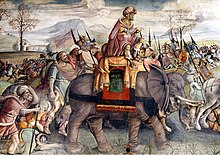
Hannibal's celebrated feat in crossing the Alps with war elephants passed into European legend: detail of a fresco by Jacopo Ripanda, c. 1510, Capitoline Museums, Rome.
Maximilian Otto Bismarck Caspari, in his article in the Encyclopædia Britannica Eleventh Edition (1910–1911), praises Hannibal in these words:
As to the transcendent military genius of Hannibal there cannot be two opinions. The man who for fifteen years could hold his ground in a hostile country against several powerful armies and a succession of able generals must have been a commander and a tactician of supreme capacity. In the use of strategies and ambuscades he certainly surpassed all other generals of antiquity. Wonderful as his achievements were, we must marvel the more when we take into account the grudging support he received from Carthage. As his veterans melted away, he had to organize fresh levies on the spot. We never hear of a mutiny in his army, composed though it was of North Africans, Iberians and Gauls.
Again, all we know of him comes for the most part from hostile sources. The Romans feared and hated him so much that they could not do him justice. Livy speaks of his great qualities, but he adds that his vices were equally great, among which he singles out his more than Punic perfidy and an inhuman cruelty. For the first there would seem to be no further justification than that he was consummately skillful in the use of ambuscades. For the latter there is, we believe, no more ground than that at certain crises he acted in the general spirit of ancient warfare. Sometimes he contrasts most favorably with his enemy. No such brutality stains his name as that perpetrated by Gaius Claudius Nero on the vanquished Hasdrubal. Polybius merely says that he was accused of cruelty by the Romans and of avarice by the Carthaginians. He had indeed bitter enemies, and his life was one continuous struggle against destiny. For steadfastness of purpose, for organizing capacity and a mastery of military science he has perhaps never had an equal.[110]
Even the Roman chroniclers acknowledged Hannibal's supreme military leadership, writing that "he never required others to do what he could not and would not do himself".[111] According to Polybius 23, 13, p. 423:
It is a remarkable and very cogent proof of Hannibal's having been by nature a real leader and far superior to anyone else in statesmanship, that though he spent seventeen years in the field, passed through so many barbarous countries, and employed to aid him in desperate and extraordinary enterprises numbers of men of different nations and languages, no one ever dreamt of conspiring against him, nor was he ever deserted by those who had once joined him or submitted to him.
 A bust of Hannibal, 17th century, Museum of Antiquities (Saskatoon)
Count Alfred von Schlieffen developed his "Schlieffen Plan" (1905/1906) from his military studies, including the envelopment technique that Hannibal employed in the Battle of Cannae.[112][113]
**George S. Patton believed himself a reincarnation of Hannibal—as well as of many other people, including a Roman legionary and a Napoleonic soldier.[114][115]
Norman Schwarzkopf Jr., the commander of the Coalition of the Gulf War of 1990–1991, claimed, "The technology of war may change, the sophistication of weapons certainly changes. But those same principles of war that applied to the days of Hannibal apply today."[116]
According to the military historian Theodore Ayrault Dodge,
Hannibal excelled as a tactician. No battle in history is a finer sample of tactics than Cannae. But he was yet greater in logistics and strategy. No captain ever marched to and fro among so many armies of troops superior to his own numbers and material as fearlessly and skilfully as he. No man ever held his own so long or so ably against such odds. Constantly overmatched by better soldiers, led by generals always respectable, often of great ability, he yet defied all their efforts to drive him from Italy, for half a generation. Excepting in the case of Alexander, and some few isolated instances, all wars up to the Second Punic War, had been decided largely, if not entirely, by battle-tactics. Strategic ability had been comprehended only on a minor scale. Armies had marched towards each other, had fought in parallel order, and the conqueror had imposed terms on his opponent.
Any variation from this rule consisted in ambuscades or other stratagems. That war could be waged by avoiding in lieu of seeking battle; that the results of a victory could be earned by attacks upon the enemy's communications, by flank-manoeuvres, by seizing positions from which safely to threaten him in case he moved, and by other devices of strategy, was not understood... [However,] for the first time in the history of war, we see two contending generals avoiding each other, occupying impregnable camps on heights, marching about each other's flanks to seize cities or supplies in their rear, harassing each other with small-war, and rarely venturing on a battle which might prove a fatal disaster—all with a well-conceived purpose of placing his opponent at a strategic disadvantage... That it did so was due to the teaching of Hannibal.[13]
In modern Tunisia
Due to his origin and connection with the territory belonging to modern-day Tunisia, he is widely revered as a national hero in the Arab nation.[117]
Hannibal's profile appears on the Tunisian five-dinar bill issued on 8 November 1993, as well as on another new bill put into circulation on 20 March 2013. His name also appears in that of a private television channel, Hannibal TV. A street in Carthage, located near the Punic ports, bears his name; as does as a station on the TGM railway line: "Carthage Hannibal".
Plans envisage a mausoleum and a 17-metre (56 ft) high colossus of Hannibal on the Byrsa, the highest point of Carthage overlooking Tunis.[118]
Other
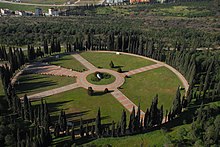 ](Hannibal's monumental tomb in Kocaeli, Turkey
The teenaged Sigmund Freud regarded Hannibal as a "hero"; the founder of psychoanalysis portrays an idealized image of the Carthaginian general in his analysis of his "dreams of Rome" in The Interpretation of Dreams. Freud then associates this phenomenon with the adage "All roads lead to Rome". He writes in The Interpretation of Dreams: "Hannibal and Rome symbolized for the adolescent that I was the opposition between the tenacity of Judaism and the organizing spirit of the Catholic Church".[119]
A fictional opera called Hannibal appears at the beginning of the musical *Phantom Of The Opera*.
Kocaeli in Turkey has a cenotaph built in Hannibal's memory. Even though the location of Hannibal's tomb could not be determined precisely in the studies carried out due to Atatürk's great interest, a monumental cenotaph was built[when?] in the south of present-day Gebze as an expression of Atatürk's will and Atatürk's respect for Hannibal.
David Anthony Durham's novel Pride of Carthage is a fictionalized account of Hannibal's conquests. It was followed by The Risen – an account of Spartacus' slave revolution.
Since 2011, Hannibal has appeared as one of the main characters, with Scipio Africanus, of the Ad Astra manga in which Mihachi Kagano traces the course of the Second Punic War.[120] The two generals appear as allies in the Drifters manga, having been teleported to another dimension to wage war together.
Tunisia's home and away kit for the 2022 FIFA World Cup was inspired by the Ksour Essef cuirass, a piece of body armor believed to be worn by Carthaginian soldiers under the command of Hannibal.[121]
Timeline...
External links
Library resources about Hannibal |
|---|
- Life of Hannibal by Cornelius Nepos – translated by J.C. Rolfe
- The Biography of Hannibal Archived 10 November 2013 at the Wayback Machine
- *Hannibal* by Jacob Abbott
- Hannibal's life by Cornelius Nepos, Latin transcription and translation to German
- The History of Hannibal
- Hannibal at *FactBehindFiction.com*
See also
- Other Hannibals in Carthaginian history
- Military of Carthage
- Alaric I
- Arminius
- Attila
- Bato the Daesitiate
- Boiorix
- Brennus (leader of the Senones)
- Mithridates VI of Pontus
- Odoacer
- Gaiseric
- Septimius Severus, who refurbished Hannibal's tomb
- Spartacus
- Theodoric the Great