Hutton C
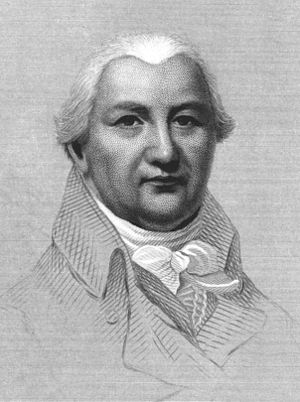
NAME: Hutton, Charles
BIRTH: 14 August 1737; Newcastle-upon-Tyne, England
DEATH: 27 January 1823; London, England
CATEGORY: Mathematics
DISCIPLINE: Arithmetic
ASSESSMENT: Unoriginal but practical work.
LANGUAGE: English
EDUCATION: Self-educated
ACHIEVEMENT: He made many small contributions to mathematics
MAJOR-WORK: Mathematical and Philosophical Dictionary: 2 vols (1795)
PARENTS: Father was a colliery worker
SPOUSE: Married twice.
SIBLINGS: He was the youngest son.
CHILDREN: Two daughters; one son: George Henry.
DETAILS: Hutton worked for a while as a coal-cutter in a coalmine where his stepfather was foreman.
At the age of eighteen he began teaching in the local village of Jesmond. After attending evening classes in Newcastle, in 1760 he opened a school there for mathematics, as well as doing private tutoring. He also got married for the first time.
In 1764 came his first book, ‘The Schoolmaster’s Guide, or A Complete System of Practical Arithmetic,’ as well as his first contribution to the Ladies’ Diary, of which he was to be editor from 1773 to 1818.
In 1770 he was employed by the corporation of Newcastle to draw up an accurate land map of the city and suburbs. In 1772 he produced ‘The Principles of Bridges,’ suggested by the destruction of Newcastle bridge by high floods the previous November.
In 1773 he won a competition to become professor of mathematics at the Royal Academy, Woolwich (outside London). In 1774 he became a member of the <member of> Royal Society*. In 1776 he was awarded the Copley medal for his paper: ‘On the force of exploded gunpowder and the velocities of cannon-balls.’
In 1778 he used the data collated by <used data from> Maskelyne* two years earlier to calculate the Earth’s density, and the accuracy of his work was acknowledged by the French mathematician <work acknowledged by> Laplace*.
In 1779 he became Foreign Secretary to the Royal Society and only resigned when Sir Joseph <fired by> Banks* was made President and accused him of having failed to carry out his duties efficiently. This caused a major row and others, including Maskelyne, weighed in on Hutton’s side.
Hutton wrote countless papers: everything from mathematical tables, to the history of mathematics, to almanacs, the equilibrium of bridges, and several math textbooks. IN 1801 came the publication of his ‘Course of Mathematics for the Cadets of the Royal Military Academy.’ The book was also adopted by the US Military Academy at West Point when it opened in 1802 and was the standard textbook there till 1823.
Hutton retired from his Woolwich professorship in 1807.
EXTRA-CONNECTIONS:
In 1772 he brought out a tract on The Principles of Bridges, a subject suggested by the destruction of the sole Newcastle bridge by the Great Flood of 1771
ONELINER: Charles Hutton, mathematician of little note
BIBLIOGRAPHY:
National Dictionary of Biography
Disctionary of Scientific Biography
Howson, A.G., Charles Hutton, in A History of Mathematics Education in England (Cambridge, 1982), 59-74.