Banks, Joseph 2
Sir Joseph Banks, 1st Baronet, GCB, FRS (24 February [O.S. 13 February] 1743 – 19 June 1820[1]) was an English naturalist, botanist, and patron of the natural sciences.[2]
Banks made his name on the 1766 natural-history expedition to Newfoundland and Labrador. He took part in Captain James Cook's first great voyage (1768–1771), visiting Brazil, Tahiti, and after 6 months in New Zealand, Australia, returning to immediate fame. He held the position of president of the Royal Society for over 41 years.
He advised King George III on the Royal Botanic Gardens, Kew, and by sending botanists around the world to collect plants, he made Kew the world's leading botanical garden. He is credited for bringing 30,000 plant specimens home with him; amongst them, he was the first European to document 1,400.[3]
Banks advocated British settlement in New South Wales and the colonisation of Australia, as well as the establishment of Botany Bay as a place for the reception of convicts, and advised the British government on all Australian matters. He is credited with introducing the eucalyptus, acacia, and the genus named after him, Banksia, to the Western world. Around 80 species of plants bear his name. He was the leading founder of the African Association and a member of the Society of Dilettanti, which helped to establish the Royal Academy.
Early life

A 1757 portrait of Banks with a botanical illustration, unknown artist, but attributed to Lemuel Francis Abbott or Johann Zoffany[4]
Banks was born in Argyll Street, Soho, London, the son of William Banks, a wealthy Lincolnshire country squire and member of the House of Commons, and his wife Sarah, daughter of William Bate.[2] He was baptised at St James's Church, Piccadilly, on 20 February 1743, Old Style.[5] He had a younger sister, Sarah Sophia Banks, born in 1744.[6]
Education
Banks was educated at Harrow School from the age of nine and then at Eton College from 1756; the boys with whom he attended the school included his future shipmate Constantine Phipps.[4]
As a boy, Banks enjoyed exploring the Lincolnshire countryside and developed a keen interest in nature, history, and botany. When he was 17, he was inoculated with smallpox, but he became ill and did not return to school. In late 1760, he was enrolled as a gentleman-commoner at the University of Oxford. At Oxford, he matriculated at Christ Church, where his studies were largely focussed on natural history rather than the classical curriculum. Determined to receive botanical instruction, he paid the Cambridge botanist Israel Lyons to deliver a series of lectures at Oxford in 1764.[7]
Banks left Oxford for Chelsea in December 1763. He continued to attend the university until 1764, but left that year without taking a degree.[8] His father had died in 1761, so when Banks reached the age of 21, he inherited the large estate of Revesby Abbey, in Lincolnshire, becoming the local squire and magistrate, and dividing his time between Lincolnshire and London.
From his mother's house in Chelsea, he kept up his interest in science by attending the Chelsea Physic Garden of the Worshipful Society of Apothecaries and the British Museum, where he met Daniel Solander. He began to make friends among the scientific men of his day and to correspond with Carl Linnaeus, whom he came to know through Solander. As Banks's influence increased, he became an adviser to King George III and urged the monarch to support voyages of discovery to new lands, hoping to indulge his own interest in botany. He became a Freemason sometime before 1769.[9]
Newfoundland and Labrador[]
In 1766, Banks was elected to the Royal Society, and in the same year, at 23, he went with Phipps aboard the frigate HMS *Niger* to Newfoundland and Labrador with a view to studying their natural history. He made his name by publishing the first Linnean descriptions of the plants and animals of Newfoundland and Labrador.[10][11] Banks also documented 34 species of birds, including the great auk, which became extinct in 1844. On 7 May, he noted a large number of "penguins" swimming around the ship on the Grand Banks, and a specimen he collected in Chateau Bay, Labrador, was later identified as the great auk.[12]
Endeavour voyage[]
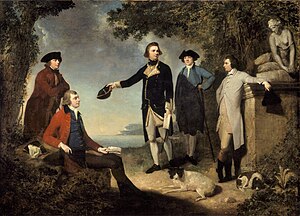
Dr Daniel Solander, Sir Joseph Banks, Captain James Cook, Dr John Hawkesworth and Lord Sandwich by John Hamilton Mortimer, 1771.[13] Use a cursor to see who is who.[14]
Main article: First voyage of James Cook
Banks was appointed to a joint Royal Navy/Royal Society scientific expedition to the South Pacific Ocean on HMS *Endeavour*, 1768–1771. This was the first of James Cook's voyages of discovery in that region. Banks funded eight others to join him: the Swedish naturalist Daniel Solander, the Finnish naturalist Herman Spöring (who also served as Banks' personal secretary and as a draughtsman), artists Sydney Parkinson and Alexander Buchan, and four servants from his estate: James Roberts, Peter Briscoe, Thomas Richmond, and George Dorlton.[15][16] In 1771, he was travelling with James Cook and docked in Simon's Town in what is now South Africa. There, he met Christoffel Brand and a friendship started. He was the godfather of Brand's grandson Christoffel Brand.[citation needed]
The voyage went to Brazil, where Banks made the first scientific description of a now common garden plant, Bougainvillea (named after Cook's French counterpart, Louis Antoine de Bougainville), and to other parts of South America. The voyage then progressed to Tahiti (where the transit of Venus was observed,[17] the overt purpose of the mission), then to New Zealand....
Return home[]
Banks arrived back in England on 12 July 1771 and immediately became famous. He intended to go with Cook on his second voyage, which began on 13 May 1772, but difficulties arose about Banks' scientific requirements on board Cook's new ship, HMS *Resolution*. The Admiralty regarded Banks' demands as unacceptable and without prior warning, withdrew his permission to sail. Banks immediately arranged an alternative expedition, and in July 1772, Daniel Solander and he visited the Isle of Wight, the Hebrides, Iceland, and the Orkney Islands,[11] aboard *Sir Lawrence*.
In Iceland, they ascended Mt. Hekla and visited the Great Geyser, and were the first scientific visitors to Staffa in the Inner Hebrides.[18] They returned to London in November, with many botanical specimens, via Edinburgh, where Banks and Solander were interviewed by James Boswell.[19] In 1773, he toured south Wales in the company of artist Paul Sandby.[20] When he settled in London, he began work on his Florilegium.
He kept in touch with most of the scientists of his time, was elected a foreign member of the Royal Swedish Academy of Sciences in 1773, and added a fresh interest when he was elected to the Dilettante Society in 1774. He was afterwards secretary of this society from 1778 to 1797. On 30 November 1778, he was elected president of the Royal Society,[11] a position he was to hold with great distinction for over 41 years.

Banks as painted by Benjamin West in 1773
In March 1779, Banks married Dorothea Hugessen, daughter of W. W. Hugessen, and settled in a large house at 32 Soho Square.[17] It continued to be his London residence for the remainder of his life. There, he welcomed the scientists, students, and authors of his period, and many distinguished foreign visitors. His sister Sarah Sophia Banks lived in the house with Banks and his wife. He had as librarian and curator of his collections Solander, Jonas Carlsson Dryander, and Robert Brown in succession.
...
Banks was made a baronet in 1781,[11][24] three years after being elected president of the Royal Society. During much of this time, he was an informal adviser to King George III on the Royal Botanic Gardens, Kew, a position that was formalised in 1797. Banks dispatched explorers and botanists to many parts of the world, and through these efforts, Kew Gardens became arguably the pre-eminent botanical gardens in the world, with many species being introduced to Europe through them and through Chelsea Physic Garden and their head gardener John Fairbairn.
He directly fostered several famous voyages, including that of George Vancouver to the northeastern Pacific (Pacific Northwest), and William Bligh's voyages (one entailing the infamous mutiny on the *Bounty*) to transplant breadfruit from the South Pacific to the Caribbean islands. Banks was also a major financial supporter of William Smith in his decade-long efforts to create a geological map of England, the first geological map of an entire country. He also chose Allan Cunningham for voyages to Brazil and the north and northwest coasts of Australia to collect specimens.
Colonisation of New South Wales[]
Banks's own time in Australia, however, led to his interest in the British colonisation of that continent. He was to be the greatest proponent of settlement in New South Wales. A genus of the Proteaceae was named in his honour as Banksia.[11] In 1779, Banks, giving evidence before a committee of the House of Commons, had stated that in his opinion the place most eligible for the reception of convicts "was Botany Bay, on the coast of New Holland", on the general grounds that, "it was not to be doubted that a Tract of Land such as New Holland, which was larger than the whole of Europe, would furnish Matter of advantageous Return".[25]...
However, Banks backed William Bligh to be installed as the new governor of New South Wales and to crack down on the New South Wales Corps (or Rum Corps), which made a fortune on the trading of rum. This brought him in direct confrontation with post-Rum Rebellion de facto leaders such as John Macarthur and George Johnston.
This backing led to the Rum Rebellion in Sydney, whereby the governor was overthrown by the two men. This became an embarrassment for Sir Joseph Banks, also, because years earlier, he campaigned that John Macarthur not be granted 4,000 hectares (10,000 acres) of land near Sydney in the cow pastures, which was later granted by Lord Camden. The next governor, Lachlan Macquarie, was asked to arrest Macarthur and Johnston, only to realise that they had left Sydney for London to defend themselves. He was humiliated that Macarthur and Johnston were acquitted from all charges in London and both later returned to Sydney.[citation needed]
Later life[]
In The great South Sea Caterpillar, transform'd into a Bath Butterfly (1795), James Gillray caricatured Banks's investiture with the Order of the Bath as a result of his expedition.
This 1812 print depicts Banks as president of the Royal Society, wearing the insignia of the Order of the Bath.
Banks met the young Alexander von Humboldt in 1790, when Banks was already the president of the Royal Society.[28] Before Humboldt and his scientific travel companion and collaborator Aimé Bonpland left for what became a five-year journal of exploration and discovery, Humboldt requested a British passport for Bonpland, should the two encounter British warships.[29] On their travels, Humboldt arranged for specimens be sent to Banks, should they be seized by the British.[30] Banks and Humboldt remained in touch until Banks's death, aiding Humboldt by mobilising his wide network of scientific contacts to forward information to the great German scientist.[31] Both men believed in the internationalism of science.
Banks was elected a member of the American Philosophical Society in 1787[32] and a foreign honorary member of the American Academy of Arts and Sciences in 1788.[33] Among other activities, Banks found time to serve as a trustee of the British Museum for 42 years.[34] He was high sheriff of Lincolnshire in 1794.
He worked with Sir George Staunton in producing the official account of the British mission to the Chinese Imperial court. This diplomatic and trade mission was headed by George, Earl Macartney. Although the Macartney Embassy returned to London without obtaining any concession from China, the mission could have been termed a success because it brought back detailed observations. This multivolume work was taken chiefly from the papers of Lord Macartney and from the papers of Sir Erasmus Gower, who was commander of the expedition. Banks was responsible for selecting and arranging engraving of the illustrations in this official record.[35]
Banks was invested as a Knight of the Order of the Bath (KB) on 1 July 1795,[36] which became Knight Grand Cross (GCB) when the order was restructured in 1815.[37]
Banks was a large landowner and activist encloser, drainer and ‘improver’ in Fens at Revesby.[38]
Banks's health began to fail early in the 19th century and he suffered from gout[11] every winter. After 1805, he practically lost the use of his legs and had to be wheeled to his meetings in a chair, but his mind remained as vigorous as ever. He had been a member of the Society of Antiquaries nearly all his life, and he developed an interest in archaeology in his later years.
In 1807, William Kerr named the Lady Banks climbing rose after Banks's wife. [39] Banks was made an honorary founding member of the Wernerian Natural History Society of Edinburgh in 1808. In 1809, he became associated member of the Royal Institute of the Netherlands.[40] In 1809, his friend Alexander Henry dedicated his travel book to him. In May 1820, he forwarded his resignation as president of the Royal Society, but withdrew it at the request of the council.
In 1819, Fabian Gottlieb von Bellingshausen on his First Russian Antarctic Expedition, briefly stopped in England and met Joseph Banks. Banks had sailed with James Cook 50 years earlier and supplied the Russians with books and charts for their expedition.[41] He died on 19 June 1820 in Spring Grove House, Isleworth, London, and was buried at St Leonard's Church, Heston. Lady Banks survived him, but they had no children.[11]
Legacy[]

Banks' house was used for the offices of the Zoological Society of London.
Banks was a major supporter of the internationalist nature of science, being actively involved both in keeping open the lines of communication with continental scientists during the Napoleonic Wars, and in introducing the British people to the wonders of the wider world. He was honoured with many place names in the South Pacific: Banks Peninsula on the South Island, New Zealand; the Banks Islands in modern-day Vanuatu; the Banks Strait between Tasmania and the Furneaux Islands; Banks Island in the Northwest Territories, Canada; and the Sir Joseph Banks Group in South Australia.[42]
The Canberra suburb of Banks, the electoral Division of Banks, and the Sydney suburbs of Bankstown, Banksia, and Banksmeadow are all named after him, as is the northern headland of Botany Bay, Cape Banks.[citation needed]
An image of Banks was featured on the paper $5 Australian banknote from its introduction in 1967 before it was replaced by the later polymer currency.[43]
In 1986, Banks was honoured by his portrait being depicted on a postage stamp issued by Australia Post.[44]
In Lincoln, England, the Sir Joseph Banks Conservatory was constructed in 1989 at The Lawn, Lincoln; its tropical hot house had numerous plants related to Banks's voyages, with samples from across the world, including Australia. The conservatory was moved to Woodside Wildlife Park in 2016 and has been named 'Endeavour'. A plaque was installed in Lincoln Cathedral in his honour. In Boston, Lincolnshire, Banks was recorder for the town. His portrait, painted in 1814 by Thomas Phillips, was commissioned by the Corporation of Boston, as a tribute to one whose 'judicious and active exertions improved and enriched this borough and neighbourhood'. It cost them 100 guineas. The portrait is now hanging in the Council Chamber of the Guildhall Museum.[45]
The Sir Joseph Banks Centre is located in Horncastle, Lincolnshire, housed in a Grade II listed building, which was recently restored by the Heritage Trust of Lincolnshire to celebrate Banks' life. Horncastle is located a few miles from Banks' Revesby estate and the naturalist was the town's lord of the manor. The centre is located on Bridge Street. It boasts research facilities, historic links to Australia, and a garden in which rare plants can be viewed and purchased.[citation needed]
Situated in the Sydney suburb of Revesby, Sir Joseph Banks High School is a NSW government school named after Banks.[46]
At the 2011 Chelsea Flower Show, an exhibition garden celebrated the historic link between Banks and the botanical discoveries of flora and fauna on his journey through South America, Tahiti, New Zealand, and eventually Australia on Captain Cook's ship Endeavour. The competition garden was the entry of Melbourne's Royal Botanic Gardens with an Australian theme. It was based on the metaphorical journey of water through the continent, related to the award-winning Australian Garden at the Royal Botanic Gardens, Cranbourne. The design won a gold medal.[47]
In 1911, London County Council marked Banks' house at 32 Soho Square with a blue plaque. This was replaced in 1938 with a rectangular stone plaque commemorating Banks and botanists David Don and Robert Brown and meetings of the Linnean Society.[48]
Banks appears in the historical novel Mutiny on the Bounty, by Charles Nordhoff and James Norman Hall. He appears briefly as a contact with British naval intelligence in the historical novel *Post Captain*, from the Aubrey–Maturin series by Patrick O'Brian. He is also featured in Elizabeth Gilbert's 2013 best-selling novel, The Signature of All Things, and is a major character in Martin Davies' 2005 novel The Conjuror's Bird.
A secondary school opened in Perth, Western Australia in 2015 named Joseph Banks Secondary College.[49]
The standard author abbreviation Banks is used to indicate this person as the author when citing a botanical name.[50]
...
See also
- European and American voyages of scientific exploration
- List of Notable Freemasons
- History of Australia
- List of presidents of the Royal Society
Knowledge Web Content (see main node)
Full Name: Sir Joseph Banks
Achievements: President of the Royal Society
Born: February 13, 1743; London, England
Died: June 19, 1820; London, England (Aged 77)
Field & Discipline: Science; Exploration; Botany
Language: English
Father: William Banks
Mother: Sarah Bate
Siblings: Sarah Sophia
Spouse: Dorothea Weston-Hugessen
Children: None
Education: Harrow School; Eton School; Oxford University
Major Work:
The Banks Herbarium and Library, bequeathed to the British Museum
Life & Times:
Banks was the only son of a wealthy and established landowner. He was educated by a private tutor and as a child became great friends with the future Earl of Sandwich. When he got to Oxford, Banks was dismayed to find that his botany professor, Humphrey Sibthorp, never gave lectures.
In need of a tutor, Banks consulted with a botany professor at Cambridge, who recommended Israel Lyons, an astronomer and botanist. Banks paid Lyons to come to Oxford to lecture to all interested students. On the death of his father, Banks, only 18, came into a huge fortune, much of which he later donated to science. In 1766, Banks was elected Fellow of the [fellow of] Royal Society*.
From April to November, 1766, Banks made the first of his voyages, to Labrador and Newfoundland, with his friend Lieutenant Phipps, returning with a large collection of plant and natural history specimens that marked the beginning of the famous Banks Herbarium.
In 1768, the British Government agreed to finance a South Seas expedition that would observe the transit of Venus in 1769. Through the help of Lord Sandwich, Banks joined the voyage as a naturalist, so becoming part of the famous first voyage of [sailed with] Cook* aboard the "Endeavour."
Banks paid for his own well-equipped party of eight, which included Dr. Daniel Solander, a Swedish botanist, (one of Linnaeus’ outstanding pupils,) who would become Banks' lifelong friend. After the astronomical part of the voyage, the expedition set off to see if there was a “southern continent.” They failed, though Cook explored New Zealand and Australia, and Banks and his team picked up more than 800 unknown specimens.
On their return to England in 1771, Banks and Cook were treated as heroes and were invited to meet King George III. The King and Banks struck up an immediate friendship based on their common interest in horticulture and agriculture.
In 1772, after failing to win a place on Cook's second voyage (Banks recommended that scientist [a pal of] Joseph Priestley*, go along as astronomer, but Priestley was turned down because he was free-church), Banks, Solander and a handful of others went on a six-week trip to Iceland, where they climbed to the top of the Hecla volcano.
Back from Iceland, Banks persuaded King George to turn London's Kew Gardens into a botanical research center. With Banks as the King's chief advisor, plants were imported from all over the world to be cultivated and studied.
As unofficial director of Kew (the first official directors, [laid groundwork for] William Jackson Hooker* and his son [laid groundwork for] Joseph Hooker* would not be appointed until seventy years later, in 1841), Banks also became involved in gathering plants from various parts of the world and adapting and growing them in territories of the British Empire. For example, he suggested growing Chinese tea in India.
And his suggestion that the breadfruit tree be cultivated in the West Indies led to the infamous voyage of the "Bounty", which ended in a mutiny led by [suggested voyage including] Christian*. He also persuaded the King that it would be a good idea to introduce merino sheep into England from Spain, to improve the quality of British wool.
In 1778, Banks was elected president of the Royal Society, a post he held for 42 years until he died.
In 1779, Banks came up with the idea that English convicts who had long terms to serve should be sent to Botany Bay in Australia. Seven years later, his plan was adopted and Banks became one of the project's main advisors. His idea that New Zealand flax be grown in the colony was also adopted. From 1788, when the first prisoners arrived, he kept in constant contact with the managers of the colony, giving aid and advice.
Towards the end of his life, Banks became so troubled with gout that sometimes he could barely move, although he still performed his duties as president of the Royal Society. He willed his great herbarium -- considered one of the most important in the world --and his library -- a major collection of works on natural history -- to his last librarian [his librarian was] Robert Brown*, also a noted botanist.
Extra Connections: Banks's portrait was painted by [painted by] Sir Thomas Lawrence*;
He knew: English astronomer [knew] Maskelyne* ; [knew] explorer and naturalist Alexander von Humboldt*; English chemist [knew] Wollaston*; English chemist [knew] Smithson*; English civil engineer [knew] William Smith*; English colonial administrator and oriental scholar [a pal of] Raffles*; Swedish chemist [knew] Berzelius*; Italian physicist [met] Volta*; French naturalist [met] Daubenton* ; [knew] Nelson*; [knew] Adam Smith*; [knew] JR Forster*; [knew] G Forster*; [knew] Bonpland*; [knew] Dalton*, [knew] Charles Bell*
He hired engraver [hired] Pistrucci*
He fixed a job for [helped] Jenner*
He met [met] Silliman Snr*
He bought instruments from [bought instruments from] Ramsden*
He fired for inefficiency (from the Royal Society Foreign Secretary job) [fired] Charles Hutton*
He was on a committee with [on committee with] Thomas Young*
He knew water-colorist Paul [knew] Sandby*
He advanced the career of [recommended]Colby*
Assessment: One of the most significant botanists of the 18th century, he devoted all his time and fortune to botany in particular and science in general.
Oneliner: Sir Joseph Banks, President of the Royal Society
Bibliography:
- Dictionary of National Biography.
- Dictionary of Scientific Biography.
- Encyclopedia Britannica.
- Lyte, Charles, Sir Joseph Banks: 18th Century Explorer, Botanist and Entrepreneur, Newton Abbot: David & Charles, 1980.