Low Temperature Scale
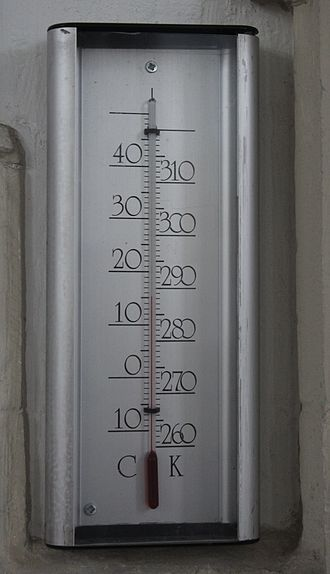
ALTERNATIVE NAME/S: Kelvin temperature scale
DETAILS/DESCRIPTION: In the late 1800s as scientists became more interested in extreme conditions, a need arose for a temperature scale that could accommodate very low temperatures without negative numbers.
Expressing all temperatures as positive numbers makes it easier to convey information and to do calculations. In 1848, Kelvin* published a paper outlining a temperature scale that expressed all temperatures as positive numbers.
The Kelvin temperature scale begins at absolute zero. Below absolute zero, temperatures do not exist. Everything with any temperature, however cold, can then be fitted into the Kelvin scale somewhere in the positive numbers above zero.
The interval (gap) between degrees is the same as in the Celsius scale. For instance, 0 degrees Celsius (the freezing point of water) is 273.15 degrees Kelvin and 100 degrees Celsius (the boiling point of water) is 373.15 degrees Kelvin. Common practice is to omit the degrees symbol when writing numbers in the Kelvin scale and use a capital K, so the temperatures are usually written 273.15 K and 373.15 K.
So far, nothing has been reduced to a temperature of 0 K. In fact, according to the third law of thermodynamics this is theoretically impossible. Scientists have chilled various substances to within fractions of a degree of absolute zero. Many unusual effects, such as superconductivity and superfluidity are seen at these temperatures.
ONELINER: Low temperature scale an absolute thermodynamic temperature scale, meaning it uses absolute zero as its zero point.
BIBLIOGRAPHY: Weisstein, Eric W. "Kelvin, Lord William Thomson (1824-1907)." Wolfram Research. http://scienceworld.wolfram.com/biography/Kelvin.html Accessed April 4, 2004.
BIBLIOGRAPHY: Weisstein, Eric W. "Kelvin, Lord William Thomson (1824-1907)." Wolfram Research. http://scienceworld.wolfram.com/biography/Kelvin.html Accessed April 4, 2004.
"Kelvin temperature scale, Physics." AllRefer Encyclopedia , The Columbia Electronic Encyclopedia. Columbia University Press, c2003. http://reference.allrefer.com/encyclopedia/K/Kelvinte.html Accessed April 4, 2004.
"The Kelvin Scale of Temperature." Colorado Superconductor, Inc. c2001. http://www.users.qwest.net/~csconductor/Experiment_Guide/The%20Kelvin%20scale%20of%20temperature.htm Accessed April 4, 2004.
"Low Temperature Physics." The Columbia Encyclopedia, Sixth Edition. Columbia University Press, c2003.
AUDIO/VISUAL:
"Fun With Liquid Nitrogen." The General Chemistry Demo Lab. Includes film clip of freezing an apple and a banana with liquid nitrogen (example of odd results at very low temperatures) and a drawing of Kelvin scale with various items placed along it.
http://www.ilpi.com/genchem/demo/liquidnitrogen/ Accessed April 4, 2004.