Bernoulli J
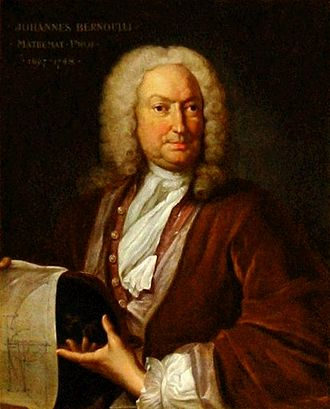
Achievements: Applied the new mathematical calculus to the measurement of curves, differential equations, and mechanical problems
Born: August 6, 1667; Basel, Switzerland
Died: January 1, 1748; Basel, Switzerland (Aged 80)
Field & Discipline: Mathematics; Mathematician
Language: French; German
Father: Nicolaus Bernoulli
Mother: Margaretha Schonauer
Siblings: Jacob; Nicolaus; seven others
Spouse: Dorothea Falkner
Children: Daniel Bernoulli (mathematician); Nicolaus; Johann
Education: University of Basel
Major Work:
"Lectiones de calculo differentialum"
Life & Times:
At Basel University Bernoulli studied medicine, and mathematics with his brother, Jacob, who, in 1687, accepted a chair in mathematics at Basel. Both brothers became engrossed in infinitesimal mathematics, and were the first to fully understand [ranked with] Leibniz’* abbreviated presentation of differential calculus.
In his "Acta eruditorum", of 1691, Jacob posed the mathematical problem of the catenary (the curve of a cable suspended by its endpoints). Johann's solution, published the same year, was his first important mathematical work produced independently of Jacob. It put him in the front rank of mathematicians alongside [ranked with] Christiaan Huyghens*, Leibniz, and [ranked with] Newton*.
In late 1691, Johann Bernoulli met Malebranche in Paris, and was welcomed into in his mathematical circle as the representative of the new Leibnizian calculus. In the early 1690s, he made several important contributions to mathematics, including his consideration of the function y = x[to the power of]x and his discovery of a general development in series by means of repeated integration by parts, which was later named the Bernoulli Series. He also discovered addition theorems for trigonometric and hyperbolic functions, using the differential equations they satisfy. In 1695, he was offered a professorship in mathematics at Halle and the chair of mathematics at Groningen in the Netherlands.
In 1696, Bernoulli proposed the problem of the brachistochrone, which dealt with finding the equation for the path followed by a particle from one point to another in the shortest time, if the particle is acted upon by gravity alone (the problem of calculating the curve of quickest descent). He published the problem in the form of a leaflet, calling on "the shrewdest mathematicians in all the world" to come up with an answer in six months. Leibniz solved the problem in one day.
Bernoulli also proposed the differential equation of the cycloid, which he deduced from the law of refraction. That is, having reduced the mechanical problem to the optical problem already resolved through Fermat's principle of least time, he showed the relation that the cycloid bears to the path described by a ray of light passing through strata of variable density. Jacob took a crack at the same problem and came up with a different solution, which caused a bitter dispute between the brothers. Jacob's solution was eventually thought more accurate and effective. But the dispute marked the origin of a new discipline: the calculus of variations.
Jacob Bernoulli proposed the isoperimetric problem, minimizing the area enclosed by a curve. Johann, having underestimated the problem's complexity by failing to perceive its variational character, made the mistake of publishing his incomplete solution in "Histoire des ouvrages des savants" in 1697. It was publicly savaged by Jacob, who published his own solution in 1701.
Despite that failure, Johann exceeded Jacob in contributions to mathematics. He applied calculus to the calculation of lengths and areas of curves, such as the isochrone, along which a body will fall at constant speed, and the tautochrone, found to be important in clock-making. He also made contributions to the theory of differential equations, the mathematics of ship sails, and optics. In experimental physics, he investigated the phenomenon of the luminous barometer, work which was continued in London by [work related to] Haukesbee*.
In 1705, after the death of Jacob, Bernoulli returned to Basel, where he succeeded to the chair of mathematics. In 1713, he became involved in the Newton-Leibniz priority controversy, zealously defending Leibniz against Newton's supporters (including [opposed] De Moivre*) and claiming that Leibniz's calculus could solve problems that Newton's could not.
At Basel, Bernoulli not only taught mathematics (his most famous pupil was [taught] Euler*) but devoted considerable time to theoretical and applied mechanics. He produced three prize-winning papers: on the transmission of momentum (1727); the motions of the planets in aphelion (1730); and the cause of the inclination of the planetary orbits relative to the solar equator (1735).
Bernoulli got into a bitter dispute with his son, [son was] Daniel Bernoulli*, who was also a gifted mathematician. In 1738, Daniel published an important work in mechanics, "Hydrodynamica", in which he investigated fluid flow (particularly the relationship between pressure, density, and velocity) and proposed not only the "Bernoulli principle", which states that the pressure in a fluid decreases as its velocity increases, but the kinetic theory of gases.
Also in 1738, his father published "Hydraulica" but predated it to 1732, to establish priority over his son. It has since been determined that Daniel's was first. Johann Bernoulli's text on integral calculus appeared in 1742, and on differential calculus shortly after. His complete works were published in "Opera Johannis Bernoullii" (four volumes, 1742).
Extra Connections: Corresponded with [corresponded with] Fontenelle* , [corresponded with] Maupertuis* and [corresponded with]Viviani*
His work related to that of [work related to] Laplace*
He taught [taught] Koenig*
Assessment: Though less innovative in mathematics than his brother Jacob, Johann was more prolific, and did much to spread calculus in Europe
Oneliner: Johann Bernoulli, great mathematician
Bibliography:
- Dictionary of Scientific Biography.
- Encyclopedia Britannica.