Leibniz
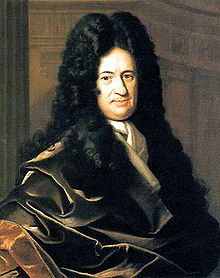
Achievements: Philosopher, mathematician and statesman, independent inventor of the differential and integral calculus. Regarded as one of the supreme intellects of the 17th century.
Born: July 1, 1646; Leipzig, Germany
Died: November 14, 1716; Hanover, Germany (Aged 70)
Field & Discipline: Philosophy; Mathematics
Education: Nicolai Latin School, 1653-61; University of Leipzig, 1661-66;
University of Altdorf, 1666-67
Major Work:
“Nova Methodus pro Maximis et Minimis” (“New Method for the Greatest and the Least,” 1684)
Life & Times:
Leibniz graduated from Leipzig in May 1663, with his thesis “De Principio Individui” (“On the Principle of the Individual”), which contained in embryo many of the ideas of his later work. From 1663, Leibniz carried on studying law for three more years, during which time he also pursued his philosophical studies. In 1666, he published “De Arte Combinatoria” (“On the Art of Combination”), in which he proposed what was, in effect, the forerunner of modern computer logic. In his model, he deduced that that all reasoning and discovery, whether verbal or not, could be reduced to an ordered combination of elements, such as numbers, words, sounds, or colors.
During the next few years in Frankfurt Leibniz undertook a variety of scientific, literary and political projects. These included the construction of a calculating machine, which was an improvement on [improved calculator of] Blaise Pascal*’s, which could multiply, divide and calculate roots. At the time, [offered Egyptian project to] Louis XIV* of France was becoming a threat to peace in Europe. In March 1672, with the full support of the archbishop of Mainz , Leibniz went to Paris to submit a plan for a French invasion of Egypt, to move the threat of war away from Europe to the African continent.
In January 1673, Leibniz was elected to the [member of] Royal Society*, after he presented his calculating machine in London. This visit proved to be a turning point in his mathematical career. While he was there, he met fellow-scientists [met] Boyle*, [met] Hooke*, and [met] Oldenburg* through whom he first heard of the work of [met] Newton* and [met] Barrow*.
Leibniz spent the next three years in Paris, where he met [met] Christiaan Huyghens*. Late in 1675, he produced the basic features and notation of both integral and differential calculus. This discovery was arrived at independently of Newton’s system, which, although invented in 1666, wasn’t published until 1687. Because of this, a dispute over plagiarism and priority arose, which became a great irritation to Leibniz in his last years, although his system was the one to be universally adopted, mainly because of its simplicity of use.
In October 1676, Leibniz became librarian and privy councillor to John Frederick, the Duke of Brunswick. On the way to Frederick’s court in Hanover, he travelled through Holland, where he the scientist [met] Leeuwenhoek* in Delft and discussed philosophy with [met] Spinoza* in the Hague. He stayed in Hanover, meeting Peter the Great there in 1711, until his death forty years later, travelling abroad only in connection with his work on a genealogy and history of the House of Brunswick and with his diplomatic work. He did, however, correspond with other scientists and mathematicians including [corresponded with] Johann Bernoulli*, Huyghens and Newton.
In March 1679, Leibniz perfected the binary system of numeration and, in the same year, proposed the basis for general topology, a branch of mathematics that deals with selected properties of collections of related physical or abstract elements. As well as working on his dynamics and philosophy, he became involved in a whole range of practical projects that included hydraulic presses, windmills, lamps, submarines, clocks and a wide variety of mechanical devices. He experimented with phosphorous, and improved [improved pump of] Guericke*’s water pump, run by windmills, for use in the silver mines in the Harz Mountains, where he frequently worked as an engineer between 1680 to 1685.
In 1684, he published “Nova Methodus pro Maximis et Minimis” (“New Method for the Greatest and the Least”), detailing differential calculus and in 1686, “Brevis Demonstratio Erroris Memorabilis Cartesii et Aliorum Circa Legem Naturae” (“Brief Demonstration of the Memorable Error of Descartes and Others About the Law of Nature”). The “Brevis” presented a refutation of [refuted theory of] Descartes' * conservation law and laid the foundations of a more adequate physics, developed in his unpublished “Dynamica,” written in 1690.
Also in 1684, Leibniz wrote his philosophical work, “Meditationes de Cognitione, Veritate et Ideis” (“Meditations on Knowledge, Truth, and Ideas”), which defined his theory of knowledge: that there is a strict relationship between God's ideas and man's and an identity between God's logic and man's. In February 1686, Leibniz wrote his “Discours de Metaphysique” (“Discourse on Metaphysics”), although it remained unpublished until 1846. The themes of the “Discourse” were later developed in two important publications of the 1690s, the “Systeme Nouveau de la Nature et de la Communication des Substances” (“New System of Nature and the Communication of Substances”) of 1695, and the “De Ipsa Natura” (“On Nature Itself”), published in 1698, which explained the internal activity of nature in terms of Leibniz's theory of dynamics.
In Leibniz’s highly complex, essentially optimistic philosophy, this is the best of all possible worlds, freely created by a rational God, who always chooses for the best, nor arbitrarily, but for a good reason. It is only because of our limited understanding that we cannot understand all the features of this world. This concept of God and his creation shaped Leibniz's philosophy, that the world is ultimately both rational and in every way perfect and from this he developed his own philosophical system, in which the universe is composed of countless conscious centres of spiritual force or energy, known as “monads.” He described each “monad” as an individual microcosm, mirroring the universe in varying degrees of perfection and developing independently of all other monads. The universe that these monads constituted, Leibniz wrote, was the harmonious result of a divine plan. Leibniz’s description of the universe as the best of all possible worlds was later brilliantly satirised as a utopia by the French author [satirized by] Voltaire* in his novel “Candide” in 1759.
In the last two decades of the century, as well as publishing many important works, Leibniz was prolific and diverse in his work for the Hanoverian court. He developed a new way to increase linen production, demonstrated how to desalinate water, managed a great library and archive, and wrote, in French and Latin, a pamphlet questioning the expansionist activities of Louis XIV of France.
Between November 1687 and June 1690, Leibniz travelled all over Bavaria, as well as visiting Austria and Italy, in his search for archival material for the Hanoverian court, but he never completed the job. In July 1700, Leibniz became first president of the new Prussian Academy of Sciences. One of his ambitions was to create an international community of scholars and, on and off through his life, he worked at devising an international language that he called a “Universal Characteristic.” His thinking paralleled that of [work related to] Komensky*, in whose ideal world all forms of thought were served by scientific and mathematical enquiry.
In the first years of the 18th century, Leibniz continued writing, with “New Essays,” completed in 1704 but unpublished until 1765, which was an examination of [wrote on] Locke's* “Essay Concerning Human Understanding.” In 1710 he published “Theodicee” (“Theodicy”), a compendium of his philosophical and theological ideas.
His final writings were short summaries, intended only as brief guides to his previous works, the “Monadologie” (“Monadology”) and the “Principes de la Nature et de la Grace” (“Principles of Nature and Grace”), both of which probably date from 1714. “Monadology” was published in 1721 in Latin, as “Principia Philosophiae.” This work, along with his “New Essays,” greatly influenced German philosophers of the 18th century, including Christian von Wolff and [influenced] Kant*, whose early philosophy was centred upon a refutation of Leibniz's basic idea that metaphysics could use the same methods as mathematics.
Extra Connections:
His work related to that of [work related to] William Jones*, [work related to] Buffon*, [work related to] Herbart*, [work related to] Schelling*, [work related to] naturphilosophie*, [work related to] Dalton*, [work related to] Bruno*, [work related to] Naude* , [work related to] Kepler*, [work related to] John Collins*, [work related to] Fahrenheit*, [work related to] Herder*, [work related to] Ehrenberg*, [work related to] Lagrange*, [work related to] De Movre*, [work related to] Roberval*.
He corresponded with [corresponded with] Papin*
He improved the [improved] calculator*
He co-invented [co-invented] calculus*
His claim to have invented calculus ahead of Newton was questioned by mathematician David [calculus work questioned by] Gregory*
He was translated by [translated by] Dutens*
He influenced the work of [influenced the work of] Boscovich*
He met [met] Viviani*
Assessment: Leibniz was probably the last universal genius, spanning the whole of contemporary knowledge.
Oneliner: G W Leibniz, co-inventor (with Newton) of calculus
Language: German
Father: Friedrich Leibnutz (1597-1652)
Mother: Catherina Schmuck (1621-64)
Siblings: Half-brother: Johann Friedrich (d. 1696); sister: Anna Catherina (1648-72)
Spouse: None
Children: None
Bibliography:
- Aiton, E.J., Leibniz: A Biography, Bristol, Boston, 1984.