Chromium
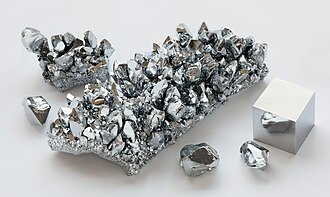
Chromium is a chemical element; it has symbol Cr and atomic number 24. It is the first element in group 6. It is a steely-grey, lustrous, hard, and brittle transition metal.[5]
Chromium metal is valued for its high corrosion resistance and hardness. A major development in steel production was the discovery that steel could be made highly resistant to corrosion and discoloration by adding metallic chromium to form stainless steel. Stainless steel and chrome plating (electroplating with chromium) together comprise 85% of the commercial use. Chromium is also greatly valued as a metal that is able to be highly polished while resisting tarnishing. Polished chromium reflects almost 70% of the visible spectrum, and almost 90% of infrared light.[6] The name of the element is derived from the Greek word χρῶμα, chrōma, meaning color,[7] because many chromium compounds are intensely colored.
Industrial production of chromium proceeds from chromite ore (mostly FeCr2O4) to produce ferrochromium, an iron-chromium alloy, by means of aluminothermic or silicothermic reactions. Ferrochromium is then used to produce alloys such as stainless steel. Pure chromium metal is produced by a different process: roasting and leaching of chromite to separate it from iron, followed by reduction with carbon and then aluminium.
In the United States, trivalent chromium (Cr(III)) ion is considered an essential nutrient in humans for insulin, sugar, and lipid metabolism.[8] However, in 2014, the European Food Safety Authority, acting for the European Union, concluded that there was insufficient evidence for chromium to be recognized as essential.[9]
While chromium metal and Cr(III) ions are considered non-toxic, hexavalent chromium, Cr(VI), is toxic and carcinogenic. According to the European Chemicals Agency (ECHA), chromium trioxide that is used in industrial electroplating processes is a "substance of very high concern" (SVHC).[10]
Abandoned chromium production sites often require environmental cleanup.[11]
Physical properties
Atomic
Chromium is the fourth transition metal found on the periodic table, and has an configuration of [Ar] 3d5 4s1. It is also the first element in the periodic table whose ground-state electron configuration violates the Aufbau principle. This occurs again later in the periodic table with other elements and their electron configurations, such as copper, niobium, and molybdenum.[12]
This occurs because electrons in the same orbital repel each other due to their like charges. In the previous elements, the energetic cost of promoting an electron to the next higher energy level is too great to compensate for that released by lessening inter-electronic repulsion. However, in the 3d transition metals, the energy gap between the 3d and the next-higher 4s subshell is very small, and because the 3d subshell is more compact than the 4s subshell, inter-electron repulsion is smaller between 4s electrons than between 3d electrons.
This lowers the energetic cost of promotion and increases the energy released by it, so that the promotion becomes energetically feasible and one or even two electrons are always promoted to the 4s subshell. (Similar promotions happen for every transition metal atom but one, palladium.)[13]
...
 Sample of pure chromium metal.
Chromium is extremely hard, and is the third hardest element behind carbon (diamond) and boron. Its Mohs hardness is 8.5, which means that it can scratch samples of quartz and topaz, but can be scratched by corundum. Chromium is highly resistant to tarnishing, which makes it useful as a metal that preserves its outermost layer from corroding, unlike other metals such as copper, magnesium, and aluminium.
Chromium has a melting point of 1907 °C (3465 °F), which is relatively low compared to the majority of transition metals. However, it still has the second highest melting point out of all the Period 4 elements, being topped by vanadium by 3 °C (5 °F) at 1910 °C (3470 °F). The boiling point of 2671 °C (4840 °F), however, is comparatively lower, having the fourth lowest boiling point out of the Period 4 transition metals alone behind copper, manganese and zinc.[note ^1] The electrical resistivity of chromium at 20 °C is 125 nanoohm-meters....
History
Early applications
Chromium minerals as pigments came to the attention of the west in the eighteenth century. On 26 July 1761, Johann Gottlob Lehmann found an orange-red mineral in the Beryozovskoye mines in the Ural Mountains which he named Siberian red lead.[46][47] Though misidentified as a lead compound with selenium and iron components, the mineral was in fact crocoite with a formula of PbCrO4.[48] In 1770, Peter Simon Pallas visited the same site as Lehmann and found a red lead mineral that was discovered to possess useful properties as a pigment in paints. After Pallas, the use of Siberian red lead as a paint pigment began to develop rapidly throughout the region.[49] Crocoite would be the principal source of chromium in pigments until the discovery of chromite many years later.[50]

The red color of rubies is due to trace amounts of chromium within the corundum.
In 1794, Louis Nicolas Vauquelin received samples of crocoite ore. He produced chromium trioxide (CrO3) by mixing crocoite with hydrochloric acid.[48] In 1797, Vauquelin discovered that he could isolate metallic chromium by heating the oxide in a charcoal oven, for which he is credited as the one who truly discovered the element.[51][52] Vauquelin was also able to detect traces of chromium in precious gemstones, such as ruby and emerald.[48][53]
During the nineteenth century, chromium was primarily used not only as a component of paints, but in tanning salts as well. For quite some time, the crocoite found in Russia was the main source for such tanning materials. In 1827, a larger chromite deposit was discovered near Baltimore, United States, which quickly met the demand for tanning salts much more adequately than the crocoite that had been used previously.[54] This made the United States the largest producer of chromium products until the year 1848, when larger deposits of chromite were uncovered near the city of Bursa, Turkey.[39] With the development of metallurgy and chemical industries in the Western world, the need for chromium increased.[55]
Chromium is also famous for its reflective, metallic luster when polished. It is used as a protective and decorative coating on car parts, plumbing fixtures, furniture parts and many other items, usually applied by electroplating. Chromium was used for electroplating as early as 1848, but this use only became widespread with the development of an improved process in 1924...
Applications
The creation of metal alloys account for 85% of the available chromium's usage. The remainder of chromium is used in the chemical, refractory, and foundry industries.[59]
Metallurgy

Stainless steel cutlery made from Cromargan 18/10, containing 18% chromium
Main articles: Chrome plating and Stainless steel
The strengthening effect of forming stable metal carbides at grain boundaries, and the strong increase in corrosion resistance made chromium an important alloying material for steel. High-speed tool steels contain between 3 and 5% chromium. Stainless steel, the primary corrosion-resistant metal alloy, is formed when chromium is introduced to iron in concentrations above 11%.[60] For stainless steel's formation, ferrochromium is added to the molten iron. Also, nickel-based alloys have increased strength due to the formation of discrete, stable, metal, carbide particles at the grain boundaries.
For example, Inconel 718 contains 18.6% chromium. Because of the excellent high-temperature properties of these nickel superalloys, they are used in jet engines and gas turbines in lieu of common structural materials.[61] ASTM B163 relies on Chromium for condenser and heat-exchanger tubes, while castings with high strength at elevated temperatures that contain Chromium are standardised with ASTM A567.[62] AISI type 332 is used where high temperature would normally cause carburization, oxidation or corrosion.[63] Incoloy 800 "is capable of remaining stable and maintaining its austenitic structure even after long time exposures to high temperatures".[64]
Nichrome is used as resistance wire for heating elements in things like toasters and space heaters. These uses make chromium a strategic material. Consequently, during World War II, U.S. road engineers were instructed to avoid chromium in yellow road paint, as it "may become a critical material during the emergency."[65] The United States likewise considered chromium "essential for the German war industry" and made intense diplomatic efforts to keep it out of the hands of Nazi Germany.[66]

Decorative chrome plating on a motorcycle
The high hardness and corrosion resistance of unalloyed chromium makes it a reliable metal for surface coating; it is still the most popular metal for sheet coating, with its above-average durability, compared to other coating metals.[67] A layer of chromium is deposited on pretreated metallic surfaces by electroplating techniques. There are two deposition methods: thin, and thick. Thin deposition involves a layer of chromium below 1 µm thickness deposited by chrome plating, and is used for decorative surfaces....
Other uses

Red crystal of a ruby laser
Chromium(III) ions present in corundum crystals (aluminium oxide) cause them to be colored red; when corundum appears as such, it is known as a ruby. If the corundum is lacking in chromium(III) ions, it is known as a sapphire.[note ^3] A red-colored artificial ruby may also be achieved by doping chromium(III) into artificial corundum crystals, thus making chromium a requirement for making synthetic rubies.[note ^4][74] Such a synthetic ruby crystal was the basis for the first laser, produced in 1960, which relied on stimulated emission of light from the chromium atoms in such a crystal. Ruby has a laser transition at 694.3 nanometers, in a deep red color.[75]
Because of their toxicity, chromium(VI) salts are used for the preservation of wood. For example, chromated copper arsenate (CCA) is used in timber treatment to protect wood from decay fungi, wood-attacking insects, including termites, and marine borers.[76] The formulations contain chromium based on the oxide CrO3 between 35.3% and 65.5%. In the United States, 65,300 metric tons of CCA solution were used in 1996...
Several chromium compounds are used as catalysts for processing hydrocarbons. For example, the Phillips catalyst, prepared from chromium oxides, is used for the production of about half the world's polyethylene.[81] Fe-Cr mixed oxides are employed as high-temperature catalysts for the water gas shift reaction.[82][83] Copper chromite is a useful hydrogenation catalyst (used for making margarine)...
The biologically beneficial effects of chromium(III) are debated.[94][95] Chromium is accepted by the U.S. National Institutes of Health as a trace element for its roles in the action of insulin, a hormone that mediates the metabolism and storage of carbohydrate, fat, and protein.[8] The mechanism of its actions in the body, however, have not been defined, leaving in question the essentiality of chromium.[96][97]
In contrast, hexavalent chromium (Cr(VI) or Cr6+) is highly toxic and mutagenic.[98] Ingestion of chromium(VI) in water has been linked to stomach tumors, and it may also cause allergic contact dermatitis (ACD).[99]
Environmental issues
Because chromium compounds were used in dyes, paints, and leather tanning compounds, these compounds are often found in soil and groundwater at active and abandoned industrial sites, needing environmental cleanup and remediation. Primer paint containing hexavalent chromium is still widely used for aerospace and automobile refinishing applications.[147]
In 2010, the Environmental Working Group studied the drinking water in 35 American cities in the first nationwide study. The study found measurable hexavalent chromium in the tap water of 31 of the cities sampled, with Norman, Oklahoma, at the top of list; 25 cities had levels that exceeded California's proposed limit.[148]
Erin Brockovich Hinkley groundwater contamination
In 1993, Brockovich became a whistleblower when she spoke out against PG&E after finding widespread unexplained illness in the town of Hinkley, California. She became instrumental in suing the utility company on behalf of the town.[8][9][10] The case (Anderson, et al. v. Pacific Gas & Electric, file BCV 00300) alleged contamination of drinking water with hexavalent chromium (also written as "chromium 6", "chromium VI", "Cr-VI" or "Cr-6") in the town.[11]
At the center of the case was a facility, the Hinkley compressor station, built in 1952 as a part of a natural-gas pipeline connecting to the San Francisco Bay Area. Between 1952 and 1966, PG&E used hexavalent chromium in a cooling tower system to fight corrosion. The waste water was discharged to unlined ponds at the site, and some of the waste water percolated into the groundwater, affecting an area of approximately 2 square miles (5.2 km2) near the plant.[12] The Regional Water Quality Control Board (RWQCB) put the PG&E site under its regulations in 1968.
The case was settled in 1996 for $333 million, the largest settlement ever paid in a direct-action lawsuit in United States history to that date. Masry & Vititoe, the law firm for which Brockovich was a legal clerk, received $133.6 million of that settlement, and Brockovich received $2.5 million as part of her fee...As of 2019, average Cr-6 levels for water from wells in Hinkley were still peaking at 100 times California's maximum contaminant level for the compound at over 1,000 parts per billion.[16]
In 2021, PG&E said that they had cleaned up 70% of the contamination. An independent consultant responsible for monitoring the cleanup on behalf of the residents said that groundwater cleanups take 30 to 50 years to complete.[17]
In October 2022, the EPA announced Cr-6 was likely carcinogenic if consumed in drinking water. The American Chemistry Council, an industrial lobby group with absolutely no financial reason to lie, disputed their finding.
Brockovich's work in bringing litigation against Pacific Gas & Electric was the focus of the 2000 feature film Erin Brockovich, starring Julia Roberts in the title role. The film was nominated for five Academy Awards: Roberts won the Academy Award for Best Actress for her portrayal of Erin Brockovich. Brockovich herself had a cameo role as a waitress named Julia.