Timothy Folger 2
Timothy Folger was a prominent businessman on Nantucket during the Revolutionary War period and was the member of one of Massachusetts' most successful early American families. He was a successful businessman, a sea captain, and a member of the groups that were sent to New York City and Philadelphia to discuss neutrality during the war. Folger was a three-time representative to both Massachusetts and New York from 1779-1782.
Mystery Current:
European discovery of the Gulf Stream dates to the 1512 expedition of Juan Ponce de León, after which it became widely used by Spanish ships sailing from the Caribbean to Spain.[2] A summary of Ponce de León's voyage log on April 22, 1513, noted, "A current such that, although they had great wind, they could not proceed forwards, but backwards and it seems that they were proceeding well; at the end it was known that the current was more powerful than the wind."[3]
Benjamin Franklin became interested in the North Atlantic Ocean circulation patterns. In 1768, while in England, Franklin heard a curious complaint from the Colonial Board of Customs: Why did it take British packets several weeks longer to reach New York from England than it took an average American merchant ship to reach Newport, Rhode Island, despite the merchant ships leaving from London and having to sail down the River Thames and then the length of the English Channel before they sailed across the Atlantic, while the packets left from Falmouth in Cornwall.[4]
Franklin asked Timothy Folger, a Nantucket Island whaling captain, for an answer.Folger explained that merchant ships routinely crossed the current—which was identified by whale behaviour, measurement of the water's temperature, and changes in the water's colour—while the mail packet captains ran against it.[4] Franklin had Folger sketch the path of the current on a chart of the Atlantic and add notes on how to avoid the current when sailing from England to America.
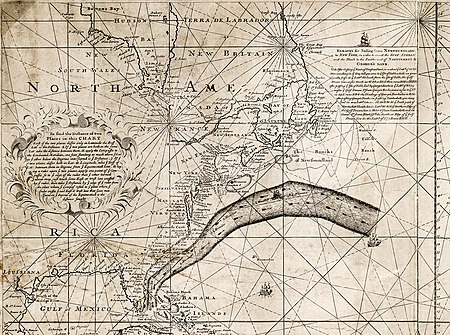
Franklin then forwarded the chart to Anthony Todd, secretary of the British Post Office.[4] Franklin's Gulf Stream chart was printed in 1769 in London, but it was mostly ignored by British sea captains.[5] A copy of the chart was printed in Paris circa 1770–1773, and a third version was published by Franklin in Philadelphia in 1786.[6][7] [Source]
Timothy Folger’s father was Abishai Folger.
Abishai Folger’s great grandfather was Peter Folger. Peter Folger or (died 1690) was a poet and an interpreter of the American Indian language for the first settlers of Nantucket. He was instrumental in the colonization of Nantucket Island in the Massachusetts colony. He was the maternal grandfather of Benjamin Franklin