Hepworth B
Dame Jocelyn Barbara Hepworth DBE (10 January 1903 – 20 May 1975) was an English artist and sculptor. Her work exemplifies Modernism and in particular modern sculpture. She was one of the few women artists to achieve international prominence.[1] Along with artists such as Ben Nicholson and Naum Gabo, Hepworth was a leading figure in the colony of artists who resided in St Ives during the Second World War.
Contents
- 1 Early life
- 2 Early career
- 3 St Ives
- 4 Late career
- 5 Galleries and locations exhibiting her work
- 6 Commissions
- 7 Controversy
- 8 Recognition
- 9 Gallery
- 10 List of selected works
- 11 References
- 12 Further reading
Early life
Hepworth's Family of Man (1970), bronze, Yorkshire Sculpture Park
Jocelyn Barbara Hepworth was born on 10 January 1903 in Wakefield, West Riding of Yorkshire, the eldest child of Gertrude and Herbert Hepworth.[2] Her father was a civil engineer for the West Riding County Council, who in 1921 became County Surveyor.[2] An upwardly mobile family, and a dominant father determined her to exploit fully her natural talents.[3] She attended Wakefield Girls' High School, where she was awarded music prizes at the age of twelve as noted by Sophie Bowness in "Rhythm of the Stones": Barbara Hepworth and Music[4][5] and won a scholarship to and studied at the Leeds School of Art from 1920.
It was there that she met her fellow student, Henry Moore.[2] They became friends and established a friendly rivalry that lasted professionally for many years. Hepworth was the first to sculpt the pierced figures that are characteristic of works by both. They would lead in the path to modernism in sculpture.
Ever self-conscious as a woman in a man's world,[6] she then won a county scholarship to the Royal College of Art (RCA) and studied there from 1921 until she was awarded the diploma of the Royal College of Art in 1924.[7]
Early career
Following her studies at the RCA, Hepworth travelled to Florence, Italy, in 1924 on a West Riding Travel Scholarship.[1] Hepworth was also the runner-up for the Prix-de-Rome, which the sculptor John Skeaping won.[1] After travelling together through Siena and Rome, Hepworth married Skeaping on 13 May 1925 in Florence.[2] In Italy, Hepworth learned how to carve marble from the master sculptor, Giovanni Ardini.[2] Hepworth and Skeaping returned to London in 1926, where they exhibited their works together from their flat.[2] Their son Paul was born in London in 1929.[1]
Her early work was highly interested in abstraction and art movements on the continent. In 1933, Hepworth travelled with Ben Nicholson to France, where they visited the studios of Jean Arp, Pablo Picasso, and Constantin Brâncuşi.[2] Hepworth later became involved with the Paris-based art movement, Abstraction-Création.[8] In 1933, Hepworth co-founded the Unit One art movement with Nicholson and Paul Nash, the critic Herbert Read, and the architect Wells Coates.[9] The movement sought to unite Surrealism and abstraction in British art.[9]
Hepworth also helped raise awareness of continental artists amongst the British public. In 1937, she designed the layout for Circle: An International Survey of Constructivist Art, a 300-page book that surveyed Constructivist artists and that was published in London and edited by Nicholson, Naum Gabo, and Leslie Martin.[10]
Hepworth married Nicholson on 17 November 1938 at Hampstead Register Office in north London, following his divorce from his wife Winifred.[11] The couple had triplets in 1934, Rachel, Sarah, and Simon. Rachel and Simon also became artists. The couple divorced in 1951.[12]
...
Ambivalent burden of international reputation
It was also during this decade that Hepworth became preoccupied with the idea of establishing a market base for her work in the United States. Initially she hoped to follow Henry Moore's successful sale of artwork via Curt Valentin of Bucholz Gallery in New York. Negotiations with Valentin did result in a number of American sales, but despite the sales, and despite interventions by Hepworth's friends, Valentin rebuffed repeated requests to hold any substantial stock of her work. It was not until 1955, after the Martha Jackson Gallery had offered Hepworth the opportunity to exhibit in their space alongside works by William Scott and Francis Bacon, that Hepworth formalised gallery representation in the new world.[27]
 Single Form (Memorial) at Battersea Park, London.
Hepworth's difficulties in establishing a stable gallery relationship in the United States have been attributed to many factors, including the artist's own diffidence regarding personal promotion of her work. When Martha Jackson failed to arrange the solo American exhibition of sculptures and drawings that Hepworth demanded, Hepworth moved, in 1957, to Galerie Chalette, run by Arthur and Madeleine Lejwa, known for their close relationship with Jean Arp, and dedication to close relationships with their artists.[28]
The Lejwas came through with the solo exhibition Hepworth craved.[27] Hepworth came to New York for the opening (her first visit to the city),[29] but made minimal contact with the press and left as soon as possible. "Have seen all the press", she wrote, "pulled faces at the camera and generally done my best!"[27]
Three years later, having secured the Dag Hammarskjöld Memorial Commission (Single Form, 1964), she left both Chalette and Gimpel Fils, her long-time home agent, for the larger Marlborough Fine Art and Marlborough-Gerson. "Pulled between personal loyalties and professional aspirations", Hepworth chose to forfeit the personal relationships.[30]
Late career
Hepworth greatly increased her studio space in 1960 when she purchased the Palais de Danse, a former cinema and dance hall, that was situated across the street from Trewyn. She used this new space to work on large-scale commissions.[31]
She also experimented with lithography in her late career, and produced two lithographic suites with the Curwen Gallery and its director Stanley Jones, one in 1969 and one in 1971.[32] The latter was entitled "The Aegean Suite" (1971) and was inspired by Hepworth's trip to Greece in 1954 with Margaret Gardiner.[33] The artist also produced a set of lithographs entitled "Opposing Forms" (1970) with Marlborough Fine Art in London.[33]
Barbara Hepworth died in an accidental fire at her Trewyn studios on 20 May 1975 at the age of 72.[34]
Famous sculptures
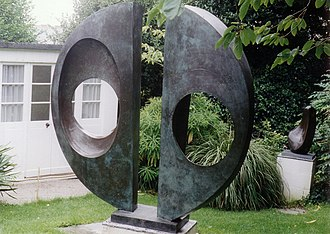
 Two Forms, 1969, St Ives.
In 1951 Hepworth was commissioned by the Arts Council to create a piece for the Festival of Britain.[35] The resulting work featured two Irish limestone figures entitled, "Contrapuntal Forms" (1950), which was displayed on London's South Bank;[35] it was later donated to the New Town of Harlow and displayed in Glebelands, where it remains. To complete the large-scale piece Hepworth hired her first assistants, Terry Frost, Denis Mitchell, and John Wells.[35]
From 1949 onwards she worked with assistants, 16 in all.[36] One of her most prestigious works is Single Form,[37] which was made in memory of her friend and collector of her works, the former Secretary General Dag Hammarskjöld, and which stands in the plaza of the United Nations building in New York City.[14] It was commissioned by Jacob Blaustein, a former United States delegate to the U.N., in 1961 following Hammarskjöld's death in a plane crash.[38]
On 20 December 2011, her 1969 sculpture Two Forms was stolen, from its plinth in Dulwich Park, South London. Suspicions are that the theft was by scrap metal thieves. The piece, which had been in the park since 1970, was insured for £500,000, a spokesman for Southwark Council said.[39]
One of the editions of six of her 1964 bronze sculpture, Rock Form (Porthcurno), was removed from the Mander Centre in Wolverhampton in the spring of 2014 by its owners, the Royal Bank of Scotland and Dalancey Estates. Its sudden disappearance led to questions in Parliament in September 2014. Paul Uppal, Member of Parliament for Wolverhampton South West said: "When the Rock Form was donated by the Mander family, it was done so in the belief it would be enjoyed and cherished by the people of Wolverhampton for generations... It belongs to, and should be enjoyed by, the City of Wolverhampton." The sculpture has since been loaned to the city by RBS and can be seen in Wolverhampton City Art Gallery.
Recognition
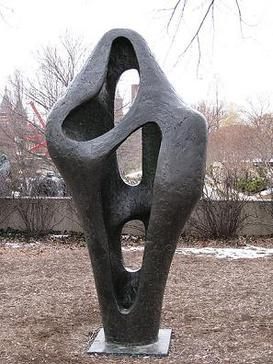
 Figure for Landscape, 1960, Hirshhorn Museum, Washington, D.C.
Hepworth was awarded the Grand Prix at the 1959 São Paulo Art Biennial.[1] She was awarded the Freedom of St Ives in 1968 as an acknowledgment of her significant contributions to the town;[1] she was a member of the St Ives Trust (which sought to protect the town's character and architectural heritage), a founder member of the 'Art in Schools' programme run by Cornwall County Council, and had gifted several sculptures to the town.[40]: 95
The same year, she was inducted into Gorsedh Kernow with the bardic name Gravyor (meaning "Sculptor")[41] – this was described as an "extraordinary honour" given that she was not a Cornish native.[40]: 18 She was awarded honorary degrees from the universities of Birmingham (1960), Leeds (1961), Exeter (1966), Oxford (1968), London (1970) and Manchester (1971).[15]
She was appointed CBE in 1958 and DBE in 1965.[15][42] In 1973 she was elected an honorary member of the American Academy of Arts and Letters.[43] Following her death, her studio and home in St Ives became the Barbara Hepworth Museum, which came under control of the Tate in 1980.[1]
In 2011 The Hepworth Wakefield opened in Hepworth's hometown of Wakefield, England. The Museum was designed by the architect David Chipperfield.[44]
In January 2015 it was announced that Tate Britain was to stage the first big London show of Hepworth's work since 1968. It would bring together more than 70 of her works, including the major abstract carvings and bronzes for which she is best known. It would also include unseen photographs from the Hepworth archive, held by the Tate, including a self-photogram created in the 1930s and experimental photographic collages.[45]
On 25 August 2020, Google honoured Hepworth with a Google Doodle.[46] A Historic England blue plaque was unveiled in honour of Hepworth and first husband John Skeaping at 24 St Ann's Terrace, St John's Wood, London on 30 October 2020. The couple lived there in 1927.[47][48]
The first major survey of Hepworth's work, Barbara Hepworth: In Equilibrium opens in November 2022 at Heide Museum of Modern Art in Melbourne. Her work had a wide influence on Australian sculpture.[49]