Gropius W
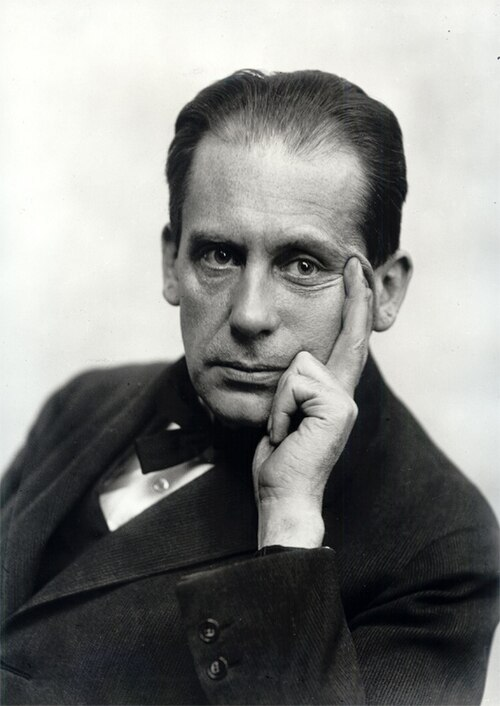
Achievements: A major influence on modern architecture when director of the Bauhaus
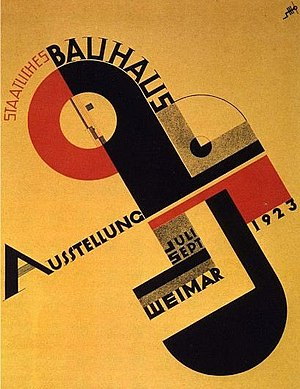
Born: May 18, 1883; Berlin, Germany
Died: July 6, 1969; Boston, Massachusetts (Aged 86).
Field & Discipline: Art; Architect
Language: German.
Father: Walther Gropius (architect)
Mother: Manon Scharnweber.
Siblings: Elise (1879-92); Manon (1880-1975); Georg (1887-1904)
Spouse: 1) Alma Schindler Mahler (m. 1915-19); 2) Ise Frank (m. 1923)
Children: Alma Manon; Beate (adopted)
Education:
Private elementary school, Berlin; Leibniz Gymnasium (1893-95); Kaiserin Augusta Gymnasium (1895-1900); Steglitz Gymnasium (1900-03); Technische Hochschule, Munich (1903); Konigliche Technische Hochschule, Berlin-Charlottenburg (1905-07)
Major Work:
Faguswerk, Alfeld-an-der-Leine (1911, with Meyer)
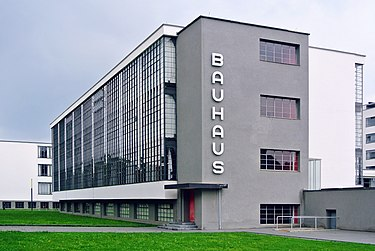
Bauhaus Building and Faculty Housing, Dessau, Germany (1925-26)
Siemensstadt Housing Co-operative, Berlin, Germany (1929-30)
Impington Village College, Cambridgeshire, England (1936-37, with Fry)
Gropius House, Lincoln, Massachusetts (1937-38)
Harvard University Graduate Center (1948-60, with TAC)
Interbau apartment building, Berlin, Germany (1955-57)
Pan American World Airways Building, New York(1958)
United States Embassy in Athens, Greece (1956-61)
Park Lane Building, London, England (1960-64)
John F Kennedy Federal Building, Boston, Massachusetts (1961-66)
Life & Times:
Finding technical college dull, Gropius left in 1907 without taking his final examination and travelled in Spain for several months. On his return in early 1908 he was offered a position in the office of the architect Peter Behrens, in Berlin. Gropius was joined in Behren's office by [a colleague was] Mies van der Rohe*.
Behrens became an effective mentor to Gropius, who was excited by the industrial processes of AEG and he took him on an inspection trip to England in 1908, where they visited industrial estates and buildings. In 1909, they took a trip to the Ruhr, where Gropius saw parts of the vast [influenced by] Krupp* industrial empire, including its notable housing projects for its workers.
His main project during this period was the design of the interior and furnishings for the Lehmann Department Store in Cologne.
In 1910, Gropius left Behrens to set up his own architectural office in Berlin with fellow architect Adolf Meye. His first major commission, the Faguswerk in 1911, a shoe-last factory in Alfeld-an-der-Leine, is now generally regarded as one of the founding monuments of European modernism. In the spring of 1910, troubled by a persistent cold, he visited Tobelbad, a small sanatorium in the Tyrol not far from Toblach, where, on 4th June, he met his future wife, Alma-Maria Schindler Mahler, with her husband, [married ex-wife of] Gustav Mahler*, and their young daughter [step-daughter was] Anna Mahler*. The pair fell in love straight away and their relationship continued, in passionate letters and occasional meetings, until Mahler's death on 18th May 1911.
The German Labour League had been set up in 1907 to enable architectural designers to network with industrial ‘engineers’. Gropius became a member of the League in 1911, and began to promote his own views and ideas about building techniques, evident in the design for the Werkbund Exposition in 1914 (possibly influenced by [influenced by] Frank Lloyd Wright*, an American contemporary).
1914 saw the beginning of the Great War, during which Gropius served as a cavalry officer on the Western Front. On 18th August 1915, he and Alma Mahler married, but life was complicated by her earlier affair with the artist [wife had affair with] Kokoschka* in 1912 and she and Gropius were divorced in 1919.
Following the end of the war, in April 1919 Gropius accepted the post of director of the Staatliches Bauhaus Weimar, which was originally made up of the Grand Ducal Saxon School of Arts and Crafts, the Grand Ducal Saxon Academy of Arts and the Grand Ducal Saxon School of Arts. There was no formal architectural teaching, the workshops concentrating on arts and crafts, taught by [directed work of] Kandinsky*, [directed work of] Klee* and others.
It was here that Gropius set a new foundation for design education, where architects and designers received practical training in the use of materials and machine processes, so that design and manufacture would work hand in hand. Students were taught three-dimensional design in practical sessions and the use of texture and form and were encouraged to develop their own ideas.
In 1922 the approach to design education became more rational and objective, with the use of geometrical forms, modern materials with smooth surfaces and regular outlines, intended for commercial use and machine production. In 1925 the Bauhaus moved to Dessau, where Gropius designed the school building and faculty housing, the epitome of his work, with a flat roof on an asymmetrical plan and horizontal windows in smooth walls. In 1928 Gropius resigned as Bauhaus director to return to private practice, and for the next two years he designed a part of a housing colony in Berlin-Siemensstadt. Gropius' regular facades, of enormous length illustrate an excessively intellectual solution, with a "curse of uniformity," that Gropius himself criticized in later years.
Hitler's government had closed the Bauhaus in 1933 and, in 1934, appalled by the Nazi regime, Gropius and his second wife Ise Frank left Germany for self-imposed exile in England. In February 1937, Gropius returned to education as professor of architecture at Harvard. His academic talents paid off and he was rapidly promoted to the position of chairman of the department. In this post he introduced the Bauhaus model of design education. It was an immediate success, provoking the reform of design education across the USA. Gropius became a US citizen in 1944.
In 1946 Gropius was founder of TAC (The Architects Collaborative) made up six partners, all Harvard graduates. The group won various design commissions, including the design of dormitory buildings for Harvard University Graduate Centre and later, the United States Embassy in Athens. Following his retirement in 1952, he spent several years travelling n South America, Japan and the Near East. He then returned to Germany, where he designed and built the Interbau apartment block, Berlin, between 1955 and 1957. He remained an active member of TAC until he died, in 1969.
Extra Connections: In London he met writers [met] Spender*, [met] Orwell*, [met] MacNiece*, [met] Mondrian*, and sculptors [met] Henry Moore*, [met] Nicholson* and [met] Hepworth*.
He knew [knew] Le Corbusier.*
Although neither the Nazi Party nor Adolf Hitler had a cohesive architectural policy before they came to power in 1933, Nazi writers like Wilhelm Frick and Alfred Rosenberg had already labelled the Bauhaus "un-German" and criticized its modernist styles, deliberately generating public controversy over issues like flat roofs. Increasingly through the early 1930s, they characterized the Bauhaus as a front for communists and social liberals. Indeed, when Meyer was fired in 1930, a number of communist students loyal to him moved to the Soviet Union.
Even before the Nazis came to power, political pressure on Bauhaus had increased. The Nazi movement, from nearly the start, denounced the Bauhaus for its "degenerate art", and the Nazi regime was determined to crack down on what it saw as the foreign, probably Jewish, influences of "cosmopolitan modernism".[1] Despite Gropius's protestations that as a war veteran and a patriot his work had no subversive political intent, the Berlin Bauhaus was pressured to close in April 1933. Emigrants did succeed, however, in spreading the concepts of the Bauhaus to other countries, including the "New Bauhaus" of Chicago:[27] Mies decided to emigrate to the United States for the directorship of the School of Architecture at the Armour Institute (now Illinois Institute of Technology) in Chicago and to seek building commissions.[a] The simple engineering-oriented functionalism of stripped-down modernism, however, did lead to some Bauhaus influences living on in Nazi Germany. When Hitler's chief engineer, Fritz Todt, began opening the new autobahns (highways) in 1935, many of the bridges and service stations were "bold examples of modernism", and among those submitting designs was Mies van der Rohe.[28]
Assessment: As a teacher he reformed the process of design education.
Oneliner: Walter Gropius, influential modern architect
Bibliography:
- Isaacs, Reginald, Gropius: An Illustrated Biography of the Creator of the Bauhaus, Boston & London: Bulfinch Press, 1991.