Calculus
ALTERNATIVE NAME/S: Differential and Integral Calculus; Fluxions
DETAILS/DESCRIPTION: The late 16th century saw growing interest in the motion of the moon and the planets. In 1619, Kepler’s laws of planetary motion were a milestone in cosmological theory.
But it was not until 1687, with the publication of the magnum opus “Principia Mathematica” that Isaac Newton* put Kepler’s laws on a firm mathematical foundation. Newton showed, with his development of the mathematical process known as calculus, that the elliptical paths of the planets which Kepler had first described could be calculated from the fact that the gravity acting between two bodies was inversely proportional to the square of the distance between them.
Although Newton is credited with the discovery of calculus, Gottfried Leibniz* provided clearer methods and better notation.
It turned out that calculus can be used to solve an incredible array of extremely difficult problems. For instance, if you can describe the motion of an object by using a mathematical function, differential calculus allows you to find its instantaneous speed and acceleration. Similarly, integral calculus allows you to analyze complex problems in areas such as fluid dynamics.
Today, calculus is an essential tool in all sciences.
ONELINER: Calculus
OTHER CONNECTIONS: None
BIBLIOGRAPHY:
- George F. Simmons, “Calculus with Analytic Geometry”, McGraw-Hill, 1985
- John O’Connor and Edmund Robertson, “Edmond Halley” biography as part of their MacTutor History of Mathematics Archive, May 2005, http://www-groups.dcs.st-and.ac.uk/~history/Mathematicians/Kepler.html
Applications
The logarithmic spiral of the Nautilus shell is a classical image used to depict the growth and change related to calculus.
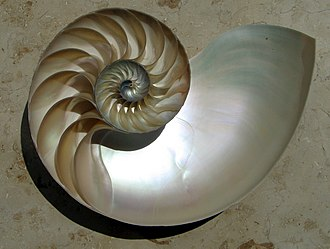
Calculus is used in every branch of the physical sciences,[51]: 1 actuarial science, computer science, statistics, engineering, economics, business, medicine, demography, and in other fields wherever a problem can be mathematically modeled and an optimal solution is desired.[52] It allows one to go from (non-constant) rates of change to the total change or vice versa, and many times in studying a problem we know one and are trying to find the other.[53]
Calculus can be used in conjunction with other mathematical disciplines. For example, it can be used with linear algebra to find the "best fit" linear approximation for a set of points in a domain. Or, it can be used in probability theory to determine the expectation value of a continuous random variable given a probability density function.[54]: 37
In analytic geometry, the study of graphs of functions, calculus is used to find high points and low points (maxima and minima), slope, concavity and inflection points. Calculus is also used to find approximate solutions to equations; in practice it is the standard way to solve differential equations and do root finding in most applications. Examples are methods such as Newton's method, fixed point iteration, and linear approximation. For instance, spacecraft use a variation of the Euler method to approximate curved courses within zero gravity environments.
Physics makes particular use of calculus; all concepts in classical mechanics and electromagnetism are related through calculus. The mass of an object of known density, the moment of inertia of objects, and the potential energies due to gravitational and electromagnetic forces can all be found by the use of calculus.
An example of the use of calculus in mechanics is Newton's second law of motion, which states that the derivative of an object's momentum with respect to time equals the net force upon it. Alternatively, Newton's second law can be expressed by saying that the net force is equal to the object's mass times its acceleration, which is the time derivative of velocity and thus the second time derivative of spatial position. Starting from knowing how an object is accelerating, we use calculus to derive its path.[55]
Maxwell's theory of electromagnetism and Einstein's theory of general relativity are also expressed in the language of differential calculus.[56][57]: 52–55 Chemistry also uses calculus in determining reaction rates[58]: 599 and in studying radioactive decay.[58]: 814 In biology, population dynamics starts with reproduction and death rates to model population changes.[59][60]: 631
Green's theorem, which gives the relationship between a line integral around a simple closed curve C and a double integral over the plane region D bounded by C, is applied in an instrument known as a planimeter, which is used to calculate the area of a flat surface on a drawing.[61] For example, it can be used to calculate the amount of area taken up by an irregularly shaped flower bed or swimming pool when designing the layout of a piece of property.
In the realm of medicine, calculus can be used to find the optimal branching angle of a blood vessel so as to maximize flow.[62] Calculus can be applied to understand how quickly a drug is eliminated from a body or how quickly a cancerous tumour grows.[63]
In economics, calculus allows for the determination of maximal profit by providing a way to easily calculate both marginal cost and marginal revenue.[64]: 387
AUDIO/VISUAL:
- Visual Calculus: http://archives.math.utk.edu/visual.calculus/**
- Calculus Graphics for the Classroom: http://www.ima.umn.edu/~arnold/graphics.html