Anthracite Coal
Anthracite is a hard, compact variety of coal that has a submetallic luster. It has the highest carbon content, the fewest impurities, and the highest calorific content of all types of coal except for graphite.
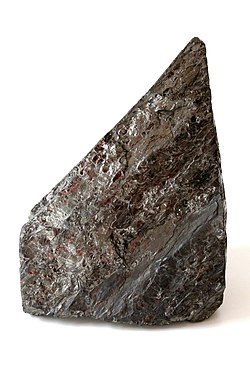
Anthracite is the most metamorphosed type of coal (but still represents low-grade metamorphism), in which the carbon content is between 92.1% and 98%.[1][2] The term is applied to those varieties of coal which do not give off tarry or other hydrocarbon vapours when heated below their point of ignition. Anthracite ignites with difficulty and burns with a short, blue, and smokeless flame.
Anthracite is categorized into standard grade, which is used mainly in power generation, and high grade (HG) and ultra high grade (UHG), the principal uses of which are in the metallurgy sector. Anthracite accounts for about 1% of global coal reserves,[3] and is mined in only a few countries around the world. China accounts for the majority of global production; other producers are Russia, Ukraine, North Korea, South Africa, Vietnam, the UK, Australia and the US. Total production in 2010 was 670 million tons.[4]
Contents
- 1Names
- 2Properties
- 3History of mining and use
- 4Anthracite today
- 5Sizing and grading
- 6Underground fires
- 7Major reserves
- 8See also
- 9References
- 10Further reading
- 11External links
Names
Anthracite derives from the Greek anthrakítēs (ἀνθρακίτης), literally "coal-like".[5] Other terms which refer to anthracite areblack coal, hard coal, stone coal,[6][8] dark coal, coffee coal, blind coal (in Scotland),[7] Kilkenny coal (in Ireland),[6] crow coal or craw coal, and black diamond. "Blue Coal" is the term for a once-popular and trademarked brand of anthracite, mined by the Glen Alden Coal Company in Pennsylvania, and sprayed with a blue dye at the mine before shipping to its northeastern U.S. markets to distinguish it from its competitors.
...
History of mining and use
In the United States, anthracite coal history began in 1790 in Pottsville, Pennsylvania, with the discovery of coal made by the hunter Necho Allen in what is now known as the Coal Region. Legend has it that Allen fell asleep at the base of Broad Mountainand woke to the sight of a large fire because his campfire had ignited an outcropping of anthracite coal. By 1795, an anthracite-fired iron furnace had been built on the Schuylkill River.In southwest Wales, anthracite has been burned as a domestic fuel since at least medieval times,[11] when it was mined nearSaundersfoot. More recently, large scale mining of anthracite took place right across the western part of the South Wales Coalfield until the late 20th century. Mining continues but now on a smaller scale.
Anthracite was first experimentally burned as a residential heating fuel in the US on 11 February 1808, by Judge Jesse Fell inWilkes-Barre, Pennsylvania, on an open grate in a fireplace. Anthracite differs from wood in that it needs a draft from the bottom, and Judge Fell proved with his grate design that it was a viable heating fuel.[citation needed]
In spring 1808, John and Abijah Smith shipped the first commercially mined load of anthracite down the Susquehanna Riverfrom Plymouth, Pennsylvania, marking the birth of commercial anthracite mining in the United States. From that first mine, production rose to an all-time high of over 100 million tons in 1917.[citation needed]
Anthracite usage was inhibited by the difficulty of igniting it. This was a particular concern in smelting iron using a blast furnace. With the invention of hot blast in 1828, which used waste heat to preheat combustion air, anthracite became a preferred fuel, accounting for 45% of US pig iron production within 15 years.[12] Anthracite for iron smelting was later displaced by coke.
From the late 19th century until the 1950s, anthracite was the most popular fuel for heating homes and other buildings in the northern US, until it was supplanted by oil burning systems and more recently natural gas systems. Many large public buildings, such as schools, were heated with anthracite-burning furnaces through the 1980s.
[ ](https://en.wikipedia.org/wiki/File:Working_together_for_Victory._Anthracite_is_a_%22fighting_fuel.%22_America_needs_it_now.-_NARA_-534850.jpg)
*Anthracite is a "fighting fuel"*, World War II poster

During theAmerican Civil War, Confederate blockade runners used anthracite as a smokeless fuel for their boilers to avoid giving away their position to the blockaders.[13]
The invention of the Wootten firebox enabled locomotives to directly burn anthracite efficiently, particularly waste culm. In the early 20th century US, the Delaware, Lackawanna & Western Railroad started using only the more expensive anthracite coal in its passenger locomotives, dubbed themselves "The Road of Anthracite," and advertised widely that travelers on their line could make railway journeys without getting their clothing stained with soot. The advertisements featured a white-clad woman namedPhoebe Snow and poems containing lines like "My gown stays white / From morn till night / Upon the road of Anthracite". Similarly, the Great Western Railway in the UK was able to use its access to anthracite (it dominated the anthracite region) to earn a reputation for efficiency and cleanliness unmatched by other UK companies.
Internal combustion motors driven by the so-called "mixed", "poor", "semi-water" or "Dowson gas" produced by the gasification of anthracite with air (and a small proportion of steam) were at one time the most economical method of obtaining power - consuming 1 pound of fuel per horsepower-hour, or less. Large quantities of anthracite for power purposes were formerly exported from South Wales to France, Switzerland and parts of Germany. Widespread commercial anthracite mining inWales has now ceased although a few large open cast sites remain, along with some relatively small drift mining operations.
Coal is a significant driver of global climate change.