Victoria, Queen
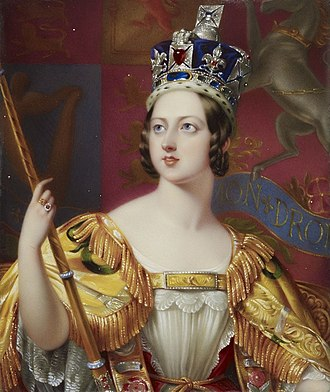
ACHIEVEMENTS: :Longest reigning monarch in English history.
NICKNAME/ALIAS: Alexandrina Victoria, Queen of England, Empress of India
DATE AND PLACE OF BIRTH: May 24, 1819. Kensington Palace, London, UK
DATE/PLACE OF DEATH/AGE AT DEATH: January 22, 1901. Osborne House, Isle of Wight, UK. Age 82
DISCIPLINE: Queen.
FIELD: Royalty.
LANGUAGE: English
PARENTS: Edward (Duke of Kent) and Victoria of Saxe-Coburg-Saarfeld
SIBLINGS: Half sister, Féodore. Half brother, Charles.
SPOUSE: Prince Albert of Saxe-Coburg-Gotha
CHILDREN: Victoria Princess Royal (1840), Edward VII Prince of Wales (1841), Alice (1843), Alfred Duke of Edinburgh and Coburg (1844), Helena (1846), Louise (1848), Arthur Duke of Connaught (1850), Leopold Duke of Albany (1853), Beatrice (1857).
EDUCATION: Governess
MAJOR WORK: Queen of England, Empress of India
LIFE AND TIMES:
Victoria began her extraordinary life in London on May 24, 1819. The only daughter of Edward the Duke of Kent, who died shortly after her birth, Victoria was a lively child. She had a gift for drawing and painting (taught by the landscape painter and writer Edward Lear*), as well as an early dedication to journal-keeping. Her sixty-two year reign began in 1837 when her uncle, William IV, died without an heir.
When Victoria ascended the throne, she did so as a “constitutional monarch.” Direct power had moved away from the sovereign through a series of acts such as the People’s Charter (1838), the Second Reform Act (1867), the Irish Church Disestablishment Act (1869), the introduction of the secret ballot for voting (1872), the Representation of the Peoples Act (1884), and the 1884 Reform Act. Despite the decline in royal power, Victoria proved that she could maintain exceptional influence and express her opinions.
This expression was keenly felt by her Prime Ministers. Personal issues quickly emerged with her first Prime Minister, Peel*. Though he was recommended by her mentor, the previous PM and war hero, the Duke of Wellington*, the Queen immediately disliked Peel. In what was termed the “Bedchamber Crisis,” the Queen and Peel disagreed over her retention of the wives of Whig politicians as ladies of the bedchamber. Though it was not a major issue, the Queen refused to compromise.
Peel, in turn, refused to form his ministry. In 1880 the Queen tried to block Gladstone* from becoming PM. While Gladstone was successful as Chancellor of the Exchequer, the Queen was angry over his 1866 refusal to support a memorial to Prince Albert. Conversely, she adored Gladstone’s political rival, Disraeli*. As PM in 1876, Disraeli had Queen Victoria crowned Empress of India- an act that won him the title: Earl of Beaconsfield.
During Victoria’s reign, Britain became the world’s preeminent social, cultural, economic, and political influence. The British Empire spread its control as far as Canada, Australia, India, New Zealand, parts of Indonesia and Africa, and several islands in the southern oceans. Though the acquisition of land was rarely achieved without war, Victoria urged her ministers to avoid it. Frequently, Victoria was able buy peace without war.
For example, Disraeli persuaded LN Rothschild* to loan Britain ₤4 million to finance the Suez Canal, designed by De Lesseps*, which shortened the voyage from London to Bombay, India by 5150 miles.
Britain was also on the progressive front of science and art, to which Victoria's dedication was due in large part to her 1840 marriage to Albert, who supported both disciplines.
The Victorian Age saw a change from “natural” philosophy and history to science, as well as fundamental transformations in views of about nature and humankind’s place in the universe. Victorian achievements include Faraday’s* discovery of electro-magnetic rotation (the principle behind the electric motor) in 1821, which earned him a lifetime achievement award and knighthood.
And when Field* completed work on the Transatlantic telegraphic cable, Victoria enthusiastically sent the first official message to President James Buchanan* on August 16, 1858. The message took 17 hours 40 minutes and consisted of only 99 words; unfortunately, the line went dead two weeks later and its repair took six years.
A mere 43 years later Marconi* sent the first Transatlantic via his wireless telegraph. The Queen, at Osborne House, exchanged excited messages with the Prince of Wales - who was on the Royal Yacht off Cowes.
Medical knowledge also grew rapidly. John Snow* demonstrated that cholera was spread by contaminated water, knowledge that may have prevented Prince Albert's untimely death from typhoid in 1861 and Victoria’s subsequent 13 years of mourning. Snow utilized Liston's* study on anesthesia when he used chloroform during the delivery of the last of the Queen's nine children. Liston also developed antiseptic, which reduced the risk of bacterial infection in surgeries such as his removal of a growth from Victoria's arm.
Doulton*, the potter known for designing commemorative pieces for the Diamond Jubilee, installed his ceramic filters to remove most bacteria from the drinking water in the Queen's houses.
Additionally, her reign witnessed great cultural advances; Victoria was directly involved with many of its most famous creators. For example, on his sixth visit Felix Mendelssohn* performed while the Queen sang and Prince manipulated the organ stops. Mendelssohn dedicated his “Scottish Symphony” to her and his “Wedding March played at her daughter’s wedding.
Conversely, the Queen refused to see Polish composer Chopin*, saying his music was too nationalistic; he reciprocated by refusing to play for the London Philharmonic, claiming they sounded like roast beef.
The Queen was a great admirer of the poets Longfellow* and Robert Browning*, both buried in Poet's Corner of Westminster Abbey. Browning honored the Queen with his poem "My Last Duchess." Another poet, Tennyson* provided a poetic tribute to the Queen's friend and servant, John Brown, which added to gossip about the nature of their relationship.
The showing of Landseer's* painting "Sorrow" at the Royal Academy, which portrayed a close bond between the Queen and Brown, also prompted public speculation. The painter Millais'* was influential in the Pre-Raphaelite movement, and , shocked by the treatment of the subject, Victoria had his “Christ in the House of his Parents” removed from an exhibition.
The Queen's interests also extended to popular entertainers. Buffalo Bill Cody* performed at her Golden Jubilee and Barnum* presented Tom Thumb to her in 1840. Barnum also promoted the "Swedish Nightingale," opera singer Jenny Lind*. When Victoria heard Lind sing she threw flowers at her feet.
Her last days were spent as a beloved and popular monarch. When she died, she was buried beside Prince Albert near Windsor.
ASSESSMENT: Historians may not agree in their judgment of her political insight, importance, or her role as a constitutional monarch, but none question her sense of duty, honesty, or her royal character.
EXTRA CONNECTIONS:
She knighted George Williams, founder of the YMCA, explorer Stanley*, and philanthropist Burdett-Coutts*
Her children were taught natural history by Richard Owen*
She was fascinated by theCombes*’ work in phrenology.
In 1894 she entertained Mahan*, President of the US Naval War College.
Her chaplain was Kingsley*
Her coronation medal tiara was designed by engraver Pistrucci*:
A close friend was Empress Eugenie*
She saw Ellen Terry* act.
She wrote personally to philanthropist George Peabody*
She chose Von Bunsen* as Prussian Ambassador to Britain.
ONELINER: Queen Victoria, longest serving British monarch
BIBLIOGRAPHY:
Hibbert, Christopher, Queen Victoria: A Personal History, New York: Basic Books, 2000.
Wikipedia (see node 2)