De Thou
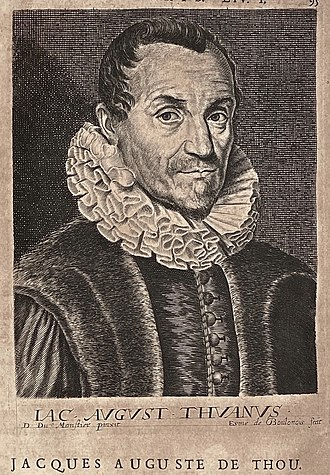
Name: Jacques-Auguste de Thou
Nickname/Alias: Thuanus
Achievements: One of the earliest French historians
Born: October 8, 1553; Paris, France.
Died: May 17, 1617; Paris, France (Aged 63)
Field & Discipline: History; Politics; Political Historian
Language: French.
Father: Christophe de Thou
Mother: Unknown
Siblings: Jean (older brother)
Spouse: Unknown (m. 1588)
Children: Unknown
Education: Universities of Orleans, Bourges and Valence (1570-73)
Major Work:
“History of His Time” (1604-08).
Life & Times:
In 1570, de Thou began studying law, first at the French universities of Orleans, then Bourges and finally Valence, where he formed a close friendship with the noted scholar, [a pal of] Scaliger*. Although de Thou had been studying law, his family wanted him to join the church and after taking minor orders, in 1573 he succeeded his uncle Nicolas as a canon of Notre-Dame in Paris.
Over the next ten years he took every opportunity to travel. In 1573, he accompanied Paul de Foix on a diplomatic mission to Italy, which enabled him to visit most of the Italian courts. In 1574, he was part of the group of attendants that accompanied King Henry III back to France from Poland. De Thou travelled all over France and, at Bordeaux, he met the famous essayist, [a pal of] Montaigne*.
In 1579, de Thou's elder brother, Jean, died. He had been “Maitre des Requetes” to the Parliament and de Thou's relatives now put pressure on him to leave the Church and follow his brother in politics. He did so, and by 1588 was married and appointed as a State Counsellor.
The previous year, de Thou, who had been collecting books for ten years, established a library in the Rue des Poitevins, employing the brothers [employed] Dupuy* as librarians. The library included manuscripts that had helped him with his own work, begun in the early 1580’s and recounting counting the recent political history of France. This work became the main point of de Thou's life and after having served both Henry III and Henry IV, he was made director of the royal library in 1593.
He helped negotiate the Edict of Nantes with the Protestants in 1598, while in the name of Gallicanism, he rejected Papal supremacy over the French church and crown and opposed recognition of the Council of Trent.
This attitude made him enemies in the Catholic hierarchy. The first eighteen volumes of his history (covering the period of 1545-60) appeared in 1604, entitled “History of His Own Times.” His enemies attacked his work and the second volume (dealing with the first wars of religion between 1560 and 1572) was put on the Catholic church's Index of Prohibited Books in 1609. In all the work (finally published three years after his death) included 138 volumes.
In 1614 de Thou was accused of being "a false Catholic, and worse than an open heretic.” In response, de Thou wrote his “Memoirs” which brought him support from other European scholars, including the English historian, [supported by] Camden*.
After the death of Henry IV in 1610, the Queen Regent, Marie de Médicis, refused de Thou the position of first president of the Parlement, making him instead a member of the finance council. Although this bitterly disappointed him, he remained in government.
Extra Connections: Was a friend of scholar [a pal of] Casaubon*, [a pal of] Peiresc*, and [a pal of] Naude*
...His object was to produce a scientific and unbiased work, and for this reason he wrote it in Latin, giving it as title Historia sui temporis. The first 18 books, embracing the period from 1545 to 1560, appeared in 1604 (1 vol. folio), and the work was at once attacked by those whom the author himself calls les envieux et les factieux.[1]
The second part, dealing with the first wars of religion (1560–1572) including the St. Bartholomew's Day massacre, was put on the Index Librorum Prohibitorum (9 November 1609)....
His son was François Auguste de Thou, who was executed by King Louis XIV and Cardinal Richelieu, as an accomplice with Henri Coiffier de Ruzé, Marquis of Cinq-Mars in 1642.
Assessment: De Thou’s history is a model of exact research, drawn from the most reliable sources, presented in an elegant and animated style.
Oneliner: J-A de Thou, one of the first French historians
Bibliography:
- Walker, Josiah H., A Brief Sketch of the Life of Thuanus, Nottingham: Wheelhouse & Co., 1819.
Jacques Auguste de Thou - Wikipedia