Scopes Monkey Trial
The Scopes Trial, formally known as The State of Tennessee v. John Thomas Scopes and commonly referred to as the Scopes Monkey Trial, was an American legal case in July 1925 in which a high school teacher, John T. Scopes, was accused of violating Tennessee's Butler Act, which had made it unlawful to teach human evolution in any state-funded school.[1] The trial was deliberately staged in order to attract publicity to the small town of Dayton, Tennessee, where it was held. Scopes was unsure whether he had ever actually taught evolution, but he incriminated himself purposely so the case could have a defendant.[2][3]
Scopes was found guilty and fined $100 (equivalent to $1,500 in 2019), but the verdict was overturned on a technicality. The trial served its purpose of drawing intense national publicity, as national reporters flocked to Dayton to cover the big-name lawyers who had agreed to represent each side.
William Jennings Bryan, three-time presidential candidate, argued for the prosecution, while Clarence Darrow, the famed defense attorney, spoke for Scopes. The trial publicized the Fundamentalist–Modernist controversy, which set Modernists, who said evolution was not inconsistent with religion,[4] against Fundamentalists, who said the Word of God as revealed in the Bible took priority over all human knowledge. The case was thus seen both as a theological contest and as a trial on whether modern science should be taught in schools.
- 1Origins
- 2Dayton, Tennessee
- 3Proceedings
- 4Appeal to Supreme Court of Tennessee
- 5Aftermath
- 6Publicity
- 7Courthouse
- 8Humor
- 9In popular culture
- 10See also
- 11References
- 12External links
Origins
State Representative John W. Butler, a Tennessee farmer and head of the World Christian Fundamentals Association, lobbied state legislatures to pass anti-evolution laws. He succeeded when the Butler Act was passed in Tennessee, on March 25, 1925.[5] Butler later stated, "I didn't know anything about evolution ... I'd read in the papers that boys and girls were coming home from school and telling their fathers and mothers that the Bible was all nonsense." Tennessee governor Austin Peay signed the law to gain support among rural legislators, but believed the law would neither be enforced nor interfere with education in Tennessee schools.[6] William Jennings Bryan thanked Peay enthusiastically for the bill: "The Christian parents of the state owe you a debt of gratitude for saving their children from the poisonous influence of an unproven hypothesis."[7]
In response, the American Civil Liberties Union financed a test case in which John Scopes, a Tennessee high school science teacher, agreed to be tried for violating the Act. Scopes, who had substituted for the regular biology teacher, was charged on May 5, 1925, with teaching evolution from a chapter in George William Hunter's textbook, Civic Biology: Presented in Problems (1914), which described the theory of evolution, race, and eugenics. The two sides brought in the biggest legal names in the nation, William Jennings Bryan for the prosecution and Clarence Darrow for the defense, and the trial was followed on radio transmissions throughout the United States.[8][9]
Dayton, Tennessee
The American Civil Liberties Union (ACLU) offered to defend anyone accused of teaching the theory of evolution in defiance of the Butler Act. On April 5, 1925, George Rappleyea, local manager for the Cumberland Coal and Iron Company, arranged a meeting with county superintendent of schools Walter White and local attorney Sue K. Hicks at Robinson's Drug Store, convincing them that the controversy of such a trial would give Dayton much needed publicity. According to Robinson, Rappleyea said, "As it is, the law is not enforced. If you win, it will be enforced. If I win, the law will be repealed. We're game, aren't we?" The men then summoned 24-year-old John T. Scopes, a Dayton high school science and math teacher. The group asked Scopes to admit to teaching the theory of evolution.[10][11]

Rappleyea pointed out that, while the Butler Act prohibited the teaching of the theory of evolution, the state required teachers to use a textbook that explicitly described and endorsed the theory of evolution, and that teachers were, therefore, effectively required to break the law.[12] Scopes mentioned that while he couldn't remember whether he had actually taught evolution in class, he had, however, gone through the evolution chart and chapter with the class. Scopes added to the group: "If you can prove that I've taught evolution and that I can qualify as a defendant, then I'll be willing to stand trial."[13]
Scopes urged students to testify against him and coached them in their answers.[14] He was indicted on May 25, after three students testified against him at the grand jury; one student afterwards told reporters, "I believe in part of evolution, but I don't believe in the monkey business."[15] Judge John T. Raulston accelerated the convening of the grand jury and "... all but instructed the grand jury to indict Scopes, despite the meager evidence against him and the widely reported stories questioning whether the willing defendant had ever taught evolution in the classroom".[16] Scopes was charged with having taught from the chapter on evolution to a high-school class in violation of the Butler Act and nominally arrested, though he was never actually detained. Paul Patterson, owner of The Baltimore Sun, put up $500 in bail for Scopes.[17][18]
The original prosecutors were Herbert E. and Sue K. Hicks, two brothers who were local attorneys and friends of Scopes, but the prosecution was ultimately led by Tom Stewart, a graduate of Cumberland School of Law, who later became a U.S. Senator. Stewart was aided by Dayton attorney Gordon McKenzie, who supported the anti-evolution bill on religious grounds, and described evolution as "detrimental to our morality" and an assault on "the very citadel of our Christian religion".[19]
Hoping to attract major press coverage, George Rappleyea went so far as to write to the British novelist H. G. Wells asking him to join the defense team. Wells replied that he had no legal training in Britain, let alone in America, and declined the offer. John R. Neal, a law school professor from Knoxville, announced that he would act as Scopes' attorney whether Scopes liked it or not, and he became the nominal head of the defense team.[citation needed]

Clarence Darrow in 1925, during the trial
Baptist pastor William Bell Riley, the founder and president of the World Christian Fundamentals Association, was instrumental in calling lawyer and three-time Democratic presidential nominee, former United States Secretary of State, and lifelong Presbyterian William Jennings Bryan to act as that organization's counsel.
Bryan had originally been invited by Sue Hicks to become an associate of the prosecution and Bryan had readily accepted, despite the fact he had not tried a case in thirty-six years. As Scopes pointed out to James Presley in the book Center of the Storm, on which the two collaborated: "After [Bryan] was accepted by the state as a special prosecutor in the case, there was never any hope of containing the controversy within the bounds of constitutionality."[20][21]
In response, the defense sought out Clarence Darrow, an agnostic. Darrow originally declined, fearing his presence would create a circus atmosphere, but eventually realized that the trial would be a circus with or without him, and agreed to lend his services to the defense, later saying he "realized there was no limit to the mischief that might be accomplished unless the country was aroused to the evil at hand".[22]
After many changes back and forth, the defense team consisted of Darrow, ACLU attorney Arthur Garfield Hays, Dudley Field Malone, an international divorce lawyer who had worked at the State Department, W.O. Thompson, who was Darrow's law partner, and F.B. McElwee.[23] The defense was also assisted by librarian and Biblical authority Charles Francis Potter, who was a Modernist Unitarian preacher.[23]
The prosecution team was led by Tom Stewart, district attorney for the 18th Circuit (and future United States Senator), and included, in addition to Herbert and Sue Hicks, Ben B. McKenzie and William Jennings Bryan.[24]
The trial was covered by famous journalists from the South and around the world, including H. L. Mencken for The Baltimore Sun, which was also paying part of the defense's expenses. It was Mencken who provided the trial with its most colorful labels such as the "Monkey Trial" of "the infidel Scopes". It was also the first United States trial to be broadcast on national radio.[25]
Proceedings
The ACLU had originally intended to oppose the Butler Act on the grounds that it violated the teacher's individual rights and academic freedom, and was therefore unconstitutional. Principally because of Clarence Darrow, this strategy changed as the trial progressed. The earliest argument proposed by the defense once the trial had begun was that there was actually no conflict between evolution and the creation account in the Bible; later, this viewpoint would be called theistic evolution.
In support of this claim, they brought in eight experts on evolution. But other than Dr. Maynard Metcalf, a zoologist from Johns Hopkins University, the judge would not allow these experts to testify in person. Instead, they were allowed to submit written statements so their evidence could be used at the appeal. In response to this decision, Darrow made a sarcastic comment to Judge Raulston (as he often did throughout the trial) on how he had been agreeable only on the prosecution's suggestions. Darrow apologized the next day, keeping himself from being found in contempt of court.[26]
...
In Popular Culture
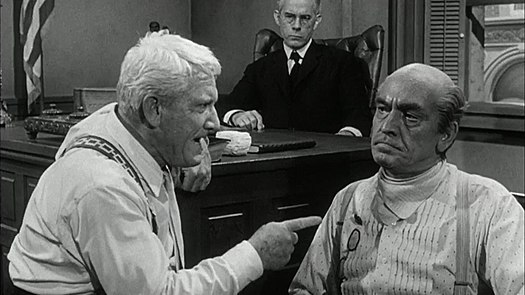
Spencer Tracy (left) as Clarence Darrow, and Fredric March (right) as William Jennings Bryan in the trailer for the film *Inherit the Wind*; Harry Morgan (in the background) plays the judge.
Stage, film and television
- Jerome Lawrence and Robert Edwin Lee's play *Inherit the Wind* (1955), fictionalizes the 1925 Scopes "Monkey" Trial as a means to discuss the then-contemporary McCarthy trials. It portrays Darrow and Bryan as the characters named Henry Drummond and Matthew Brady.[85] The playwrights state in a note at the opening of the play that it is not meant to be a historical account,[86] and there are numerous instances where events were substantially altered or invented.[87][88] Despite the disclaimer in the play's preface that the trial was its "genesis" but it is "not history",[89] the play has largely been accepted as history by the public.[88][90][91][92] (Lawrence and Lee later said that it was written in response to McCarthyism and was chiefly about intellectual freedom.)[93][94]
- Adaptations:
- Inherit the Wind was made into a 1960 film directed by Stanley Kramer, with Spencer Tracy as Drummond and Fredric March as Brady. Although there are numerous changes in the plot, they include more of the actual events recorded in the trial transcript, such as when Darrow implies that the court is prejudiced, being cited for contempt of court for his comments and his subsequent statement of contrition that persuaded the judge to drop the charge.
- There have also been three television versions of the play, with Melvyn Douglas and Ed Begley in 1965, Jason Robards and Kirk Douglas in 1988, and Jack Lemmon and George C. Scott in 1999.
- Adaptations: