Creosote
[
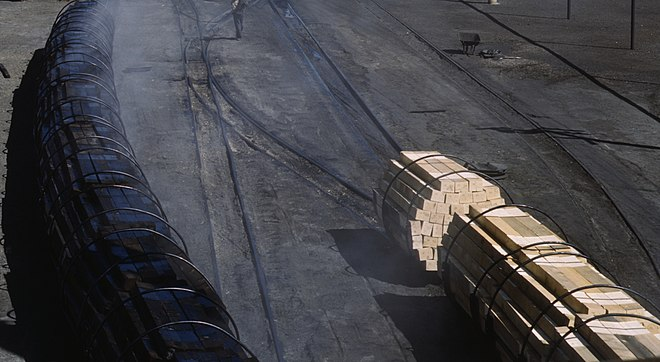
Wood railroad ties before (right) and after (left) infusion with creosote
ALTERNATIVE NAME/S: Wood-tar creosote or coal-tar creosote
DETAILS: Creosote is a name given to two entirely different substances, coal-tar creosote and wood-tar creosote. Today, the term generally applies to the commercially used coal-tar distillate, which is a complex mixture of over 300 known chemicals, largely hydrocarbons.
Creosote contains phenol ( carbolic acid*) as well as other phenolic compounds which inhibit the growth of bacteria and discourage attack by insects, and it is commonly used as a wood preservative capable of penetrating the wood to give long-lasting protection - it prevents timber from drying out and splitting, inhibits the growth of fungi and, at the same time, destroys insects which would otherwise damage the wood. The creosote distilled from wood tar is also a mixture of phenolic compounds, and was once used extensively for pharmaceutical purposes.
The first reference to a British patent for coal tar dates from 1681, but it was not until the 1780s, when the inventor Archibald Cochrane*, who in 1778 had the idea of applying coal tar to the bottom of ships to prevent the effects of woodworm, that coal tar was produced on any scale. Although Cochrane designed and built a number of kilns in which to carbonize the coal, and soon developed a suitable varnish, his idea was resisted by the British Admiralty until the early 1800s.
By the 1810s, coal tar was being sold in large quantities to London shipbuilders; although during this period tar distillers generally worked with both wood and coal tars, research increasingly concentrated on coal tar as more and more became available as a by-product of the gas industry.
During the 1810s, the German chemist Friedrich Christian Accum described tar manufacture in two books, and by the 1820s coal tar was being sold as pitch or re-distilled and sold as paint and varnish to preserve wood against wet and dry rot, particularly in ships, and also for water-proofing ropes and making joints gastight. The smell of coal tar made it unacceptable to workers, and it was not used on a large scale by developers until the 1850s, when, with the growth of railways and telegraphs, the need for wood preservation became more pressing.
Meanwhile, during the 1830s, as a prolific waste-material with still limited use, coal tar was being increasingly studied in the laboratory, and in 1834, the German pharmacist Runge*, discovered many important compounds by distilling coal tar from the Berlin gas works. By the late 1830s Runge was proposing the use of the principle coal-tar distillate, creosote, as a means of protecting railway and telegraph timbers, while other experimenters with coal tar were producing improved black varnishes for wood, oil-based lighting and paint for ironwork.
As early as 1838, creosote had been tried as a preservative for railroad cross-ties, and in the same period pitch was also introduced as a material for surfacing roadways. However, these attempts remained on a limited scale until 1853, when the English engineer Henry Burt presented a paper on 'Properties and Preservatives of Timber' to the Institute of Civil Engineers in London. There was great deal of interest in Burt's subject thanks to the urgent need to find an effective wood preservative to protect the enormous number of sleepers that were being produced for the country's fast developing railway network, and the discussion carried on over three evenings.
In his paper, Burt described a process by which timbers could be impregnated under pressure to ensure deep penetration by the creosote, which he patented the same year. Isambard Kingdom Brunel*, was one of the first to recognise the importance of Burt's process for the preservation of railway sleepers and the vast quantities of timber used for piling, and in 1854 he took out a licence for the use of Burt's patent.
Without impregnation, European softwood or beechwood sleepers can only be used for a few years, since natural decay will occur quickly. As a result of creosote impregnation, sleepers will have a service life of up to 45 years, exceeding their natural life by up to 15 times. Most heavy duty wooden items, such as railway sleepers, telegraph and transmission poles, construction timbers and some fence posts, are currently pre-treated with 100 percent coal tar creosote by Burt's process.
From this point on, the use of creosote for wood preservation became universally accepted and, in order to provide creosote for the impregnating plants being set up throughout the United Kingdom, the large-scale distillation of coal tar began - from which, in turn, many new chemicals were derived, laying the foundations of today's organic chemical industry.
In 1881, the by-product coking oven for production of metallurgical grade coke was introduced in Germany, in which it became possible to recover coal tar and pitch in equal quantities.
During the follow decades, creosote was adopted for the treatment of railway sleepers throughout Europe, North America and then elsewhere in the world. (By the late 1950s it was estimated that about 2000 million creosote-impregnated sleepers were in use). Following the successful pre-treatment of railway sleepers, the 19th century gradually saw the extension of the process to the treatment of other items, including marine and freshwater timbers, wooden fencing and timber for farm buildings and, eventually, telegraph and electricity transmission poles.
Telegraph poles are, perhaps, the most visible examples of the longevity that can be achieved: treated to give a minimum service life of 40 years, most last for at least 60, while others have survived for 80 and some for as long as 100 years.
ONE-LINER: carbonaceous chemicals formed by the distillation of various tars and pyrolysis of plant-derived material, such as wood, or fossil fuel. They are typically used as preservatives or antiseptics
OTHER CONNECTIONS: Wood-tar creosote is to some extent used for wood preservation, but it is generally mixed with coal-tar creosote, since the former is not as effective. Commercially available preparations of "liquid smoke", marketed to add a smoked flavour to meat and aid as a preservative, consist primarily of creosote and other constituents of smoke.
Coal-tar creosote, despite its toxicity, was used as a stimulant and escharotic, as a caustic agent used to treat ulcers and malignancies and cauterize wounds and prevent infection and decay. It was particularly used in dentistry to destroy tissues and arrest necrosis.
BIBLIOGRAPHY:
EB