Brunel, IK
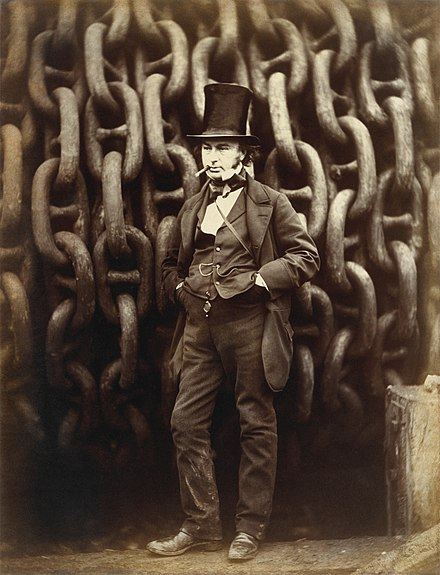
Photo from Wikipedia.
Achievements: SS Great Eastern
Born: April 9, 1806; Portsmouth, Hampshire, England
Died: September 15, 1859; London, England (Aged 53)
Field & Discipline: Engineering
Language: English
Father: Sir Marc Isambard Brunel
Mother: Sophia Kingdom
Siblings: Sophia (Mrs. Benjamin Hawes); Emma (Mrs. George Harrison)
Spouse: Mary Horsley (m. 1836)
Children: Isambard; Henry Marc; Florence
Education: Dr Morell’s School, Hove, Sussex; College of Caen, Normandy; Lycée Henri-Quatre, Paris
Life & Times:
Brunel was seriously injured in March 1826, when a lump of timber fell on him while he was working with his father, [father was] Marc Isambard Brunel*, on the Thames Tunnel Enterprise under the Thames. He later returned to work as the Resident Engineer on the tunnel, with his assistants, Richard Beamish, [assistant was] Gravatt,* and Francis Riley. The tunnel flooded in 1827 and again, in 1829. This time, six men drowned and Brunel was pulled out, unconscious, from the bottom of the main shaft. While he was recovering, his design for the Clifton Suspension Bridge over the Avon near Bristol was accepted and, in June 1831, he began the project. It was still unfinished at his death.
His next major undertaking was on the Bristol Docks. The docks were silting up and there was a danger of ships running aground. Brunel overcame the problem between 1845 and 1849, with a new south dock entrance lock, 262 feet long and 52 feet wide, which allowed access for heavier vessels and made berthing easier.
During the Crimean War, in 1855, Brunel was commissioned to build a prefabricated hospital, to be built in Britain and shipped to the Crimea. The construction of railroads was his main occupation. As well as building them in the West of England, the Midlands and South Wales and Italy, Brunel was advisor on the construction of the Victoria line in Australia and on the East Bengal railway in India.
This work led him into the design of a great number of stations as well as railroad bridges, including the terminus stations at Paddington, London, and Temple Meads, Bristol, as well as the Box tunnel, outside Bath.
One of his most original designs was for the Maidenhead bridge, for which he hit on the idea of using compressed air chambers, or caissons, to install the pier foundations for the bridge. After that, the use of caissons became a standard feature of construction work under ground and water.
As a bridgebuilder, Brunel is probably best remembered for his work (finished in the year he died) on the Royal Albert Bridge, which extended the line of the great Western Railway across the Tamar River and into Cornwall, in southwest England. The bridge had two huge spans of 445 feet and a central pier, built on rock, 80 feet above the high water mark.
Brunel also designed and built two steamships, the Great Western and the Great Britain. The Great Eastern was the first-ever steamship designed for the Atlantic crossing. For a long time it had been considered impractical to design a steamship for such a long route, because it would have been impossible to carry enough coal to fuel the crossing. Brunel understood that this was wrong: water resistance to the progress of a ship increases with the square of the ship’s foremost dimensions, while its capacity to carry a load is increased by the cube of its foremost dimensions. This meant that by building very long ships, Brunel could overcome the problems of water resistance and the need for carrying a heavy load of coal.
The most spectacular of his ships was the [built] Great Eastern*, which was double skinned, with five decks, ten boilers and engines to drive both the paddles and the screw. At almost 700 feet long the ship weighed 18,915 tons. During its design, Brunel also worked with the astronomer [collaborated with] Airy* on the development of an instrument to allow astronomical observations to be made irrespective of a ship’s motion. The Great Eastern made some not very successful passenger voyages, as well as being used as a troop carrier.
Its greatest triumph came when, under the supervision of Kelvin, it wasused for the laying of the first transatlantic telegraph cable in 1866.
During work on the Great Eastern, Brunel’s health began to decline, but he continued to overwork and refused to delegate. In November of 1858, he was diagnosed with a kidney ailment, Bright’s Disease and went abroad for several months for health reasons. Two days before the launch of Great Eastern, Brunel made his final inspection of the ship and not long after, collapsed and died at his home.
Extra Connections:
[his ship carried] Verne* and [his ship carried] Singer* traveled on SS Great Eastern.
Used [used riveting system of] Roberts’* riveting system on the ship.
Commissioned paintings from [commissioned work from] Landseer*.
Failed to work with [didn’t work with] Nasmyth*
His doctor was [treated by] Bright*
Assessment: His work on the railroads contributed to social change in the Victorian era, such as the growth of urban areas and large-scale industry and the increased exchange between different regions.
Oneliner: IK Brunel, great Victorian engineer and shipbuilder
Bibliography:
- Tim Bryan, Brunel: the Great Engineer, Ian Allen, Shepperton, Surrey, 1999.
Wikipedia: Isambard Kingdom Brunel