Gramme
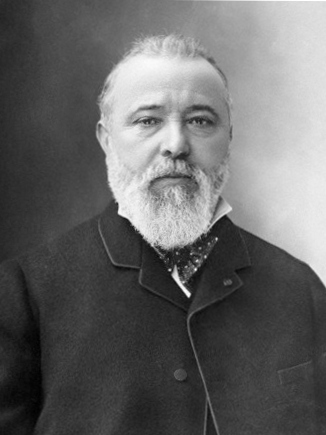
ACHIEVEMENT(S): Dynamo/ generator
DATE/PLACE OF BIRTH: 4 April 1826, at Jehay-Bodegnée, Belgium
DATE/PLACE/AGE AT DEATH: 20 January 1901, in Bois-Colombes, France. Aged 74
DISCIPLINE: Electrical engineer
FIELD: Electronics
EDUCATION: ?
MAJOR WORK: "Sur une machine magneto-electrique produisant des courants continus", 1871
LIFE AND TIMES:
In the late 1850’s in Paris Gramme became interested in improving the batteries used to produce direct current. By 1869 he had constructed his first successful direct-current dynamo, which used a ring armature based on that designed by the professor of physics at the University of Pisa, Antonio Pacinotti.
During the early 1830s, the English physicist and chemist Michael Faraday* had discovered a means of converting mechanical energy into electricity, having found that moving a permanent magnet into and out of a coil of wire induced an electric current in the wire. This process, called electromagnetic induction, provided the working principle for electric generators.
Then, in 1860, Pacinotti wrapped a ring of iron with a continuous coil of wire to form a "ring armature", which was spun between electromagnets. This design produced a fairly steady stream of current because the wire wrappings of the armature were continually passing the electromagnet poles.
Pacinotti's machine was the first practical direct current dynamo because it did not produce isolated pulses of electric current.
The Gramme dynamo was similar to Pacinotti's in design, containing a ring armature which rotated in a two-polar magnet system, a collector (that picked up direct current from the revolving armature), and a core consisting of a coil of soft-iron wire, insulated with bitumen to reduce eddy currents.
This machine produced much higher voltages than previous dynamos, and generated continuous direct current efficiently and for long periods without overheating In July 1871 it was demonstrated to the Academy of Sciences that produced and triggered widespread interest in scientific and industrial circles. Later the same year Gramme achieved long-distance transmission of direct-current electricity.
In 1873 he and Hippolyte Fontaine accidentally discovered that the device was reversible[3] and would spin when connected to any DC power supply. The Gramme machine was the first usefully powerful electrical motor that was successful industrially. Before Gramme's inventions, electric motors attained only low power and were mainly used as toys or laboratory curiosities.
In 1875, Nikola Tesla observed a Gramme machine at the Graz University of Technology. He conceived the idea of using it for alternating current but was unable to develop the idea at this time.[4]
Also in 1871, in partnership with the inventor Hippolyte Fontaine, Gramme opened a factory, named the Societe des Machines Magneto-Electriques Gramme, to manufacture the Gramme ring, the Gramme armature, and the Gramme dynamo.
The success of the Gramme machine was immediate, and his dynamos were produced in a variety of forms for such applications as lighthouse illumination, electroplating, and factory lighting. The majority of Gramme machines were made to be driven by steam-engines, but hand-driven model were made for laboratory work.
In 1874 Gramme dynamos were in use in at least two capital ships of the French navy, and in some vessels of the Russian navy.
Meanwhile, in 1873 a Gramme dynamo was exhibited at the Vienna exhibition, where Gramme made the immensely important discovery that the device was reversible and could be used as an electric motor (i.e. which converts electrical energy to mechanical energy; this process now runs virtually every kind of machine that uses electricity).
Gramme died at Bois-Colombes, France, on 20 January 1901 and was buried in Père Lachaise Cemetery.
ASSESSMENT: Gramme's discoveries of the principles of the dynamo and the electrical machine were of the utmost importance to modern technology.
EXTRA CONNECTIONS: He developed the ideas of Jean-Antoine Nollet*
His dynamo used by Henri Moissan*
In 2005 he ended up at the 23rd place in the election of Le plus grand Belge (The Greatest Belgian),
ONELINER: Zenobe Gramme, inventor of the dynamo
BIBLIOGRAPHY:
DSB, EB
History of Technology
LANGUAGE: French
PARENTS: Mathieu-Josephe Gramme and Catherine Seron
SIBLINGS: ?
SPOUSE: Hortense Nysten, married 1857 (1819-90); Antonie Schentur, married
1891
CHILDREN: ?