Faraday, M
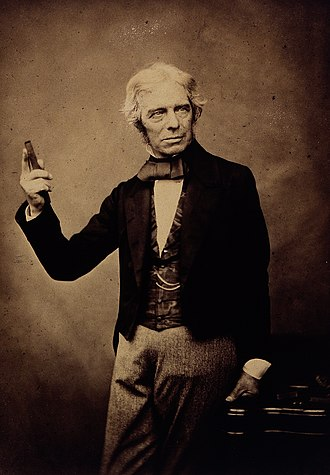
Name: Michael Faraday
Achievements: Discovered electromagnetic induction, the laws of electrolysis, and the principles of the electric motor.
Born: September 22, 1791; Newington, Surrey, England
Died: August 25, 1867; Hampton Court, England (Aged 75)
Field & Discipline: Science; Chemistry; Physics; Electricity; Electromagnetism
Language: English
Father: James Faraday
Mother: Unknown
Siblings: Robert; Margaret
Spouse: Sarah Barnard
Children: None
Education: Unknown
Major Work:
Invention of the dynamo.
Life & Times:
Though first apprenticed to a bookbinder, Faraday attended lectures at the London City Philosophical Society, taking notes, commenting not only on the content of the lectures, but their style of delivery. One day, his boss showed some of Faraday's notes to a customer who was also a member of the Royal Institution. The customer was so impressed, he bought Faraday tickets to a series of four lectures given by chemist [assistant to] Davy.*
Before the lectures, Faraday's notes were sent to Davy, who invited him to come to see him. Davy advised Faraday to give up the idea of becoming a scientist because of the difficulty in making a living. However, during an experiment Davy injured his eyes with a shower of glass and hot chemicals, and from then on needed an assistant. Faraday got the job.
In the autumn of 1813 Davy took Faraday on an 18-month trip to visit scientists in France, Italy, Germany and Belgium. He met Italian physicist [met] Volta* and French physicist [met] Andre-Marie Ampere
In 1825, Davy made him Director of the Laboratory. During the course of his experiments, Faraday produced some new chemical compounds from chlorine and carbon, including tetrachloride, used in stain-removing and fire extinguishers. He lectured on this discovery at the Royal Society in 1820.
Following [picked up on work of] Oersted*'s discovery of the influence of an electric current when passed parallel to a compass needle, Faraday conducted an experiment proving that a freely suspended current-carrying wire rotates around the pole of a magnet. He was immediately accused of having stolen this idea from English chemist [work related to] Wollaston,* and of not having acknowledged Davy's contribution to his work.
Nonetheless, the discovery allowed Faraday to convert electrical force into mechanical force, and in so doing, to discover the principle of the electric motor.
In 1823, Faraday made his most significant chemical discovery: the liquefaction of gases. The following year, he discovered benzene, a chemical he extracted from the residue left after the burning of oil-gas, used for lighting.
In 1826, Faraday founded the Friday Evening Discourses and, the next year, the Juvenile Christmas Lectures, public occasions that raised the profile of science. The success of the lectures owed in large part to Faraday's brilliant lecturing style.
In 1829, he became professor of chemistry at the Royal Military Academy at Woolwich, where he was responsible for giving 25 lectures a year.
In 1833, he was appointed Fullerian Professor at the Royal Institution, a post he held until his death. Like many others scientists, Faraday was intrigued by the hypothesis that if electricity could be used to produce magnetism, then magnetism could be used to generate electricity.
In 1831, after more than 100 experiments, Faraday discovered the electromagnetic induction of currents, finding that as a primary current ceases to flow, an induced current will then pass through a second conductor in the reverse direction. His discovery appeared in "Philosophical Transactions" in 1832.
From this discovery, Faraday went on to produce electricity from ordinary magnetism. By plunging a magnet into a coil of wire, he observed that a current was generated in the wire. This made possible the [made possible] dynamo* developed by [prefigured work of] Gramme*, which, though basic in design, operated with the same principles used in the modern electric power industry.
Faraday thus opened the way for electricity to become one of the most important sources of energy. Faraday was also able to show that there is only one form of electricity, no matter how it is generated. (At the time, electricity was named according to its source. Static electricity was called "frictional"; battery-produced electricity was known as "voltaic").
Faraday then turned his attention to the effects of electricity on chemicals. Davy had observed that when electricity was passed through certain chemicals or chemical solutions, it could break them down. In 1833, Faraday showed that the breakdowns depended on the strength of the current. He also showed that an electric current can be measured by how much electrolyte it decomposes. These ideas are contained in what is known now as Faraday's First Law.
In 1834, Faraday realized that the way a chemical is broken down by electricity was related to the structure of the substance itself. This was the discovery of equivalents in electro-chemical decomposition. Out of this work came the famous Faraday Laws. The discovery also led to the foundation of electrochemistry and the development of the system of electroplating.
To explain his work, Faraday chose to drop the old scientific terms for electricity, which he considered outdated and misleading. He was concerned that contemporaries such as classical scientist [knew] Whewell* of Trinity College, Cambridge, might have wrong preconceptions, so he thought up new words such as "anode", "cathode" and "ion", many of which are still used in science today.
Faraday also developed borosilicate glass (heat resistant glass) which he came across while working to produce new kinds of optical glass. This research eventually led to his discovery of magnetic rotatory polarization in 1846, now called the Faraday Effect.
He was awarded the Blue Ribbon of the Academy of Sciences in France in 1844; all medals of the Royal Society; the Copley medal (twice); and honorary degrees from Oxford and Cambridge. The University of London made him a Senator.
He was offered the presidency of the Royal Society, but declined, never having been interested in the politics of the scientific world. He was a member of 70 learned societies worldwide, and held 90 other honorary titles.
The government awarded him a special pension for his services in 1835, and [given a house by] Queen Victoria* allowed him and his wife a house at Hampton Court in 1858, where he lived until the end of his life in 1867.
Extra Connections:
[possibly foreshadowed by] Henry, Joseph* may have anticipated his induction discovery.
Work related to that of [work related to] Nasmyth*, Brugnatelli*?, Joule?*, [work related to] Drummond*, [work related to] Crookes*, [work related to] Sturgeon* and [work related to] Arago*.
He knew [knew]Baily*, [knew] Somerville* and [knew] Cavendish*.
He taught [taught] Benjamin Richardson*
He influenced [influenced] Whitehead*, [influenced] Burdett-Coutts*
Was a supporter of [a supporter of] WG Armstrong*
He may have invented the [possibly invented] Bunsen burner*
Wheatstone shy so Faraday delivered his lectures for him.
Assessment: A brilliant experimenter, his work laid the foundations for the development of modern electrical science.
Oneliner: Michael Faraday, English discoverer of induction
Bibliography:
- Cantor, Geoffrey, Gooding, David and Frank A. J. L., James, Faraday, Macmillan. London. 1991.