Euclid
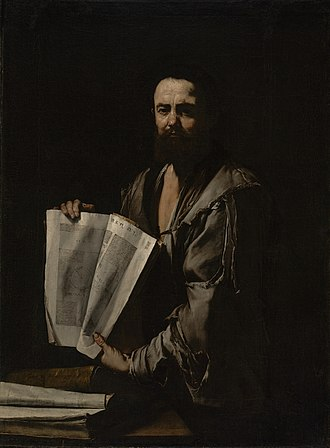
Achievements: Best known for his treatise on geometry: “The Elements.”
Born: flourished c.300 B.C.; Alexandria, Egypt
Died: possibly c.270 B.C.
Field & Discipline: Mathematics; Mathematician; Teacher
Language: Greek
Father: Unknown
Mother: Unknown
Siblings: Unknown
Spouse: Unknown
Children: Unknown
Education: Unknown
Major Work:
“The Elements” (c. 300 B.C.)
Life & Times:
Very little is known about Euclid, and no record exists of his date or place of birth, his education, or his date or place of death. Only two facts (not entirely undisputed) are known concerning him: first, that he succeeded Plato (who died in 347 B.C.), whose work clearly influenced his own, and preceded Archimedes (born c.287 B.C.); and second, that he taught at Alexandria.
Some commentators also claim that he probably attended [influenced by] Plato's* Academy at Athens, the great centre of mathematical studies where he would have learned of the original work by Eudoxus and Theaetetus, but, if this is so, it is likely to have been after Plato's death. What appears to be certain, however, is that around 300 B.C. Euclid was invited by Ptolemy I to teach at the newly-founded university at Alexandria (now in Egypt).
There, Euclid established his own school of mathematics, which, like Plato's, would become internationally famous, and where first Archimedes and much later [his school attended by] Claudius Ptolemy* would study.
It is also recorded that 50 years later, in 250 B.C., Euclid's disciple Apollonius of Perga had been leading the Alexandria school of mathematics for some time, and it has therefore been reasonably suggested that Euclid died in around 270 B.C.
Euclid is not known to have made any original mathematical discoveries, and his most famous work, the “Elements,” is based on the work of mathematicians before him, such as Eudoxus, Thales, Hippocrates of Chios, and Pythagoras. However, it is accepted that some of the proofs are his own and that the excellent design and arrangement of the compilation is entirely his.
The last compiler before Euclid had been Theudius, whose textbook was used in Plato's Academy and was probably used by Aristotle, but with the arrival of Euclid's work, all previous elements were outdated and then forgotten. Euclid's “Elements” is also notable as the earliest substantial Greek mathematical treatise to have survived in almost complete form, because, like several of his other works, it was translated first into Arabic, then into Latin, and from both of these into other European languages.
While Euclid inevitably drew upon the work of his predecessors, his design for the “Elements” was innovative and entirely new. In his work generally, he used two main styles of presentation: the synthetic (in which one proceeds from the known to the unknown via logical steps) and the analytical (in which one posits the unknown and works towards it from the known, again via logical steps).
For the “Elements” he chose the synthetic approach (which suited the subject matter so perfectly that the method became the standard procedure for scientific investigation and exposition for the following two thousand years) in a strictly logical arrangement that required the minimum of assumption, the omission of all superfluous material, and a rigorous commitment to clarity, detail and the logical development of ideas.
Euclid's compiled his “Elements” of geometry in 13 books containing 465 propositions, each volume listing a number of definitions and postulates, followed by theorems, which are then followed by proofs using those definitions and postulates, with every statement proven, no matter how obvious.
The first six books deal with plane geometry (points, lines, triangles, squares, parallelograms, circles, etc), geometric algebra, and the theory of proportions, in the first book of which Euclid begins with five postulates, five common notions, and twenty-three definitions, and then develops the basic properties of plane geometry from the construction of an equilateral triangle in Proposition 1 to his proof of the “Theorem of Pythagoras” in Proposition 47 (the book closes with a proof of the converse of the Pythagorean Theorem in Proposition 48).
Books 7 to 9 are concerned with arithmetic and number theory, while Book 10 deals with Euxodus' theory of irrational numbers.
In Books 11 to 13, Euclid discusses solid geometry, ending with the five "Platonic solids" - the tetrahedron, octahedron, cube, isocahedron, and dodecahedron. Other especially noteworthy subjects include the method of exhaustion, which would be used by Archimedes in the invention of integral calculus, and the proof that the set of all prime numbers is infinite.
Euclid's “Elements” is the earliest substantial Greek mathematical treatise to have survived in almost complete form, because it was translated first into Arabic, then into Latin (first by medieval translators, such as [translated by] Adelard of Bath* and [translated by] Gerard of Cremona*, and later by 17th-century scholars such[translated by] Snell*), and from both of these into other European languages.
The first printed copy came out in 1482, and had developed into the international standard geometry textbook and logic primer by the 1700s. In the late 18th century, Euclid's work was then greatly rearranged and simplified by the French mathematician [edited by] Legendre* in his “Éléments de la geometrie” (1794), thereby creating a more effective textbook and continuing Euclid's influence on mathematical teaching throughout the 19th century in both Europe and America, becoming the prototype of later geometry texts.
During this period Euclid remained highly respected as a mathematician and his “Elements” was considered one of the greatest mathematical works of all time.
Euclid's geometry thus formed the basis for mathematical study over a remarkable 2,000-year period, and his work inevitably acted as a springboard for future generations of mathematicians - for example, proving particularly influential on the mathematical work of the 14th-century Hebrew astronomer, mathematician, and philosopher [influenced] ben Gershom*, the 15th-century scholars and mathematicians [influenced] Pacioli* and [influenced] Della Francesca*, the16th-century Italian mathematician [influenced] Tartaglia*, and the 17th-century English philosopher [influenced] Hobbes* and [influenced] Benedetti*.
Euclid's other important mathematical work, the “Treasury of Analysis” is presented in the analytical mode, and comprised three parts, now known as “The Data,” “On Divisions of Figures” and “Porisms” (now lost).
He also wrote “The Optics” (important for its influence on the work of [influenced] Roger Bacon*and [influenced] Witelo*), “The Phaenomena” (a treatise on the geometry of the sphere foruse in astronomy), and the lost books “Conics” and “Elements of Music.”
Assessment: His work formed the basis for all mathematical thought and expression for the following 2,000 years, making him one of the most influential and best read mathematicians of all time.
Oneliner: Euclid, great ancient Greek mathematician
Bibliography:
- Biographical Dictionary of Mathematicians.
- Dictionary of Scientific Biography.
- Encyclopedia Britannica.
- Sarton Bell, E.T., Men of Mathematics, New York: Simon and Schuster, Inc., 1937.
- Turnbull, Herbert Westren, The Great Mathematicians, New York: New York University Press, 1961.