Bacon, Roger
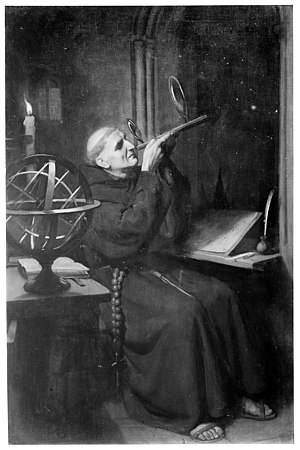
Nickname/Alias: Doctor Mirabilis (Latin: "Wonderful Teacher")
Achievements: Experimental science
Born: c. 1214; Ilchester, Somerset, England
Died: 1292/4; possibly Oxford, England (Aged 78/80)
Field & Discipline: Science; Philosophy
Language: English; Latin
Father: Unknown
Mother: Unknown
Siblings: Unknown
Spouse: None
Children: None
Education: University of Oxford; University of Paris
Major Work:
“Great Work” (1267)
Life & Times:
Roger Bacon was born c.1214 at Ilchester, in Somerset, England, into a wealthy family of the minor nobility, entering Oxford University c.1230, where he attended lectures on the "new logic" of [studied work of] Aristotle* and developed a particular interest in natural philosophy and mathematics.
He received his M.A. probably from the University of Paris c.1237, where during the next ten years he wrote his “Brief Summaries of the Dialectic” and “Synopsis of Grammar,” and lectured at the Faculty of Arts. His teachings covered the "new" Aristotelian works, including the “Metaphysics,” “Physics” and “Prior Analytics” (first studied in the West in the 12th century by [work related to] Thierry of Chartres*, the brother of Bernard of Chartres*).
While at Paris, Bacon became fascinated by “Secret of Secrets,” which was then thought to have been written by Aristotle for his pupil Alexander the Great. This work contained not only instruction on kingship but also occult knowledge, ranging from astrology and numerology to the magical medicinal properties of plants, and an account of a unified science which was claimed to have been transmitted to Aristotle by God through the Hebrews and Egyptians. It was also during this period, in 1242, that Bacon became the first European to describe in detail a method of making gunpowder.
In 1247 returned to Oxford, where he attempted to recover this secret knowledge through experimental research. At Oxford he was greatly influenced by [influenced by] Grosseteste*, a leading figure in the introduction of Greek learning to the West via the Arab commentators.
Bacon was particularly impressed by Grosseteste's translations and optical writings, and decided to devote his life to the study of languages, mathematics (including geometry and astronomy), optics and experimental science.
1247-57 Bacon studied Greek, Arabic and Hebrew and constructed a laboratory for which he designed and made his own instruments, and developed a large variety of systematic alchemical and optical experiments, along with studies on the nature of light and on the rainbow.
However, many of his most interesting ideas and "experiments" seem only to have been suggested: such as his suggestion for a balloon made from thin copper sheet filled with "liquid fire" which he believed would fly, his description of a flying machine with flapping wings, his explanation of the principles of reflection, refraction and spherical aberration and the resulting "invention" of spectacles (which soon came into use), his description of mechanically propelled ships and carriages, and his explanation of a [knew of] camera obscura* (which projects an image through a pinhole) to observe eclipses of the Sun.
These ideas contributed to Bacon's reputation in the popular imagination as a man of diverse and unconventional learning in philosophy, magic and alchemy (hence the soubriquet “Doctor Mirabilis”).
In 1257, Bacon chose to enter the Franciscan order, where he hoped to find support for his work and funds for his scientific instruments, but the new Minister General, Bonaventure particularly opposed studies in astrology and alchemy, and Bacon, who was increasingly vocal in his criticism of those with a more traditional approach to philosophy (which included the great scholars [criticized] Albertus Magnus* and [criticized] Aquinas*), had by the early 1260s become highly unpopular in the Order. Around 1262 he was apparently sent to their convent in Paris, where he was placed under strict surveillance by his superiors and prohibited from either lecturing or circulating his writings.
In response, in 1264 Bacon decided to appeal to Cardinal Guy le Gos de Foulques, to whom he communicated in a series of letters some of his revolutionary ideas concerning the natural world, mathematics, languages, perspective and astrology, arguing that a more accurate experimental knowledge of nature would be of great value to the church and the universities in confirming the Christian faith. (He reasoned that by understanding the nature of things, one would come to understand the nature of God who made them - e.g. he believed that mathematics could be used to verify scriptural claims about creation, such as its chronology and geography).
The following year, the cardinal became Pope Clement IV, and asked Bacon for a work which presented his views in detail. Bacon managed to do so in a remarkably short time without the Order's knowledge, and to have the work delivered to Clement in 1267. The result, the “Great Work,” was an encyclopedia of the sciences and a proposal for a complete revision of educational reform which proposed including languages and the sciences in the curriculum of university studies.
It was then followed in 1268 by supplements (including his “On perspective,” which not only gave an account of optics but also synthesized all previous knowledge on the subject in the works of, for example, [synthesized work of] Euclid*, [synthesized work of] Ptolemy* and [synthesized work of] Al Hazen*).
Although Clement died in November 1268 and left no recorded opinion, Bacon continued to write on these topics for the next ten years, battling suppression by the Franciscan authorities and criticizing both the Franciscan and Dominican Orders for their educational practices. After 1268 he produced a Greek grammar, a Hebrew grammar and the “Compendium of the Study of Philosophy” (c.1272). He also began work on another encyclopedia, of which only two sections appeared – the “General Principles of Natural Philosophy” and the “General Principles of Mathematical Science,” written during the 1270s and considered Bacon's most mature work.
At some point between 1277 and 1279, Bacon's teachings were condemned by the Minister General of the Franciscan Order, Jerome of Ascoli (the future Pope Nicholas IV), and Bacon was imprisoned in Paris for an indeterminate period.
Bacon managed before his death to compose at least one more work, the “Compendium of the Study of Theology,” in which he made important contributions to the study of meaning in language , and extended his criticisms of contemporary theologians and scholars to include the moral vices of Christendom as a whole.
Extra Connections: He influenced the work of Renaissance artist [influenced] Ghiberti*
Gerbert, Albert Magnus and Roger Bacon said to make speaking heads.
Assessment: A major figure in the development of scientific thought.
Oneliner: Roger Bacon, medieval thinker and possibly first experimenter
Bibliography:
- Dictionary of Scientific Biography.
- Easton, Stewart C., Roger Bacon and His Search for a Universal Science, Oxford, 1971.
- Encyclopedia Britannica.