Kieselguhr Diatom DTE
Kieselguhr/Diatomaceous earth DTE
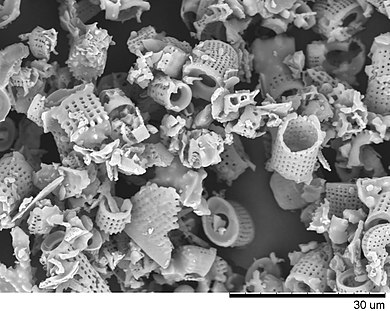
Scanning electron micrograph of diatomaceous earth
TIME: Industrial use from mid-19th century.
LOCATION: United States, Denmark, France, Russia and Algeria.
CATEGORY: Form of silica.
DISCIPLINE: Chemical industry.
SHORT DESCRIPTION: A light-coloured, porous, and friable sedimentary rock composed of the siliceous shells of diatoms (microscopic unicellular aquatic plants).
Diatomaceous earth consists of the fossilized remains of diatoms, a type of hard-shelled microalgae.
When well-hardened it is called diatomite.
DESCRIPTION: Discovered by Hensen*, kieselguhr, or diatomaceous earth, occurs in earthy beds and, although it resembles chalk, it is much lighter and does not effervesce in acid. The largest deposit of kieselguhr in the United States can be found in northern Santa Barbara County, California, where beds more than 1,000 feet deep extend over several square miles and vary from soft earth to hard, compact rock that can be sawn into blocks.
Other production has come from Nevada, Washington, and Oregon. Outside the US, there are well-developed kieselguhr mines in Denmark, France, and Russia and there are a number of deposits in Algeria as well.
The oldest and most common commercial use for kieselguhr is as a very mild abrasive in metal polishes and toothpaste. Its most striking use, though, was in the early development of dynamite* by the Swedish industrialist Nobel*.
In 1863, Nobel soaked gunpowder with nitroglycerine and fired the mixture with an ordinary burning fuse and later discovered that nitroglycerine could be detonated by the explosion of a number of different materials, such as fulminate of mercury.
In 1866 and 1867, Nobel experimented with charcoal and other substances and found that kieselguhr, with a composition of nearly 95% siliceous shells, was ideal for the purpose. It was inert, non-combustible and, after a little heating and preparation, very porous.
This meant that it could retain a large amount of nitrogylcerine, like water in a sponge, with no serious exudation, or sweating, when it was stored. Processing resulted in a dry and granular material, so Nobel was able to produce a solid that was resistant to shock, but easily exploded by heat or percussion.
This kieselguhr dynamite was generally made by mixing three parts of nitrogylcerine with one part dry kieselguhr, with the resulting paste then shaped by hand into cylindrical sticks.
Prior to the mixing, a small percentage of the kieselguhr was replaced by mixture of sodium and ammonium carbonates, talc and ochre. This product, patented by Nobel in 1867, became known as Dynamite No.1 and was used as explosive sticks in quarrying and construction work.
Kieselguhr was also used in the mid-19th century as a filter for clarifying sugar and syrups, and has now been adapted to almost all industrial filtration processes, including the processing of oils (see Meges Mouries* and the development of margarine) , beverages, antibiotics, solvents, and chemicals.
Kieselguhr is used as a filler or extender in a huge range of products, including paper, paint, brick, tile, ceramics, linoleum, plastic, soap and detergents, as a vehicle for herbicides and fungicides, and in sound insulation.
It is also used in the insulation of boilers, blast furnaces and other processes in which high temperatures have to be maintained. At temperatures around 1,000° F, diatomaceous earth is a more efficient insulator than asbestos or magnesia, because it doesn’t shrink as much and won’t fail at red heat.
ONELINER: kieselguhr important to Nobel's invention of dynamite, but also as a filter for margarine.
OTHER CONNECTIONS:
It is used as a filtration aid, mild abrasive in products including metal polishes and toothpaste, mechanical insecticide, absorbent for liquids, matting agent for coatings, reinforcing filler in plastics and rubber, anti-block in plastic films, porous support for chemical catalysts, cat litter, activator in coagulation studies, a stabilizing component of dynamite, a thermal insulator, and a soil for potted plants and trees as in the art of bonsai.
BIBLIOGRAPHY:
Encyclopaedia Britannica