Audimeter
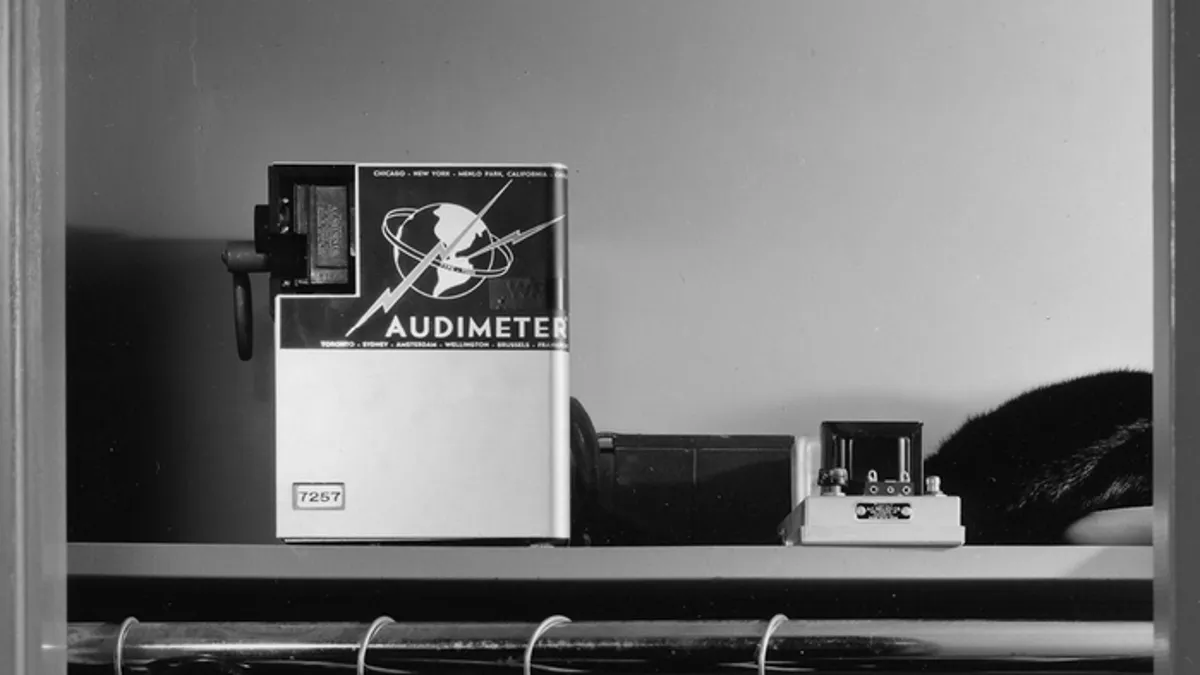
The February 1945 issue of Radio-Craftmagazine included an article titled “Radio Audience Meter” which looked at the machine that was revolutionizing audience measurement. First installed in homes on a trial basis in 1939, the Audimeter was placed next to a family’s existing radio.
The article included photo cutaways that showed how the Audimeter worked. Back in those days, radios had dials. Fitted with a series of gears, the Audimeter was a standalone device connected to a radio. It had an arm that moved whenever the radio dial was turned. So whenever the radio station was changed, the Audimeter’s arm would swivel along a long tape that was slowly rolling inside this gadget. The tape inside was about 100 feet long and three inches wide and reportedly lasted for about a month of recording.
The market researchers would collect the tapes by visiting each house monthly and shipping the tapes to a plant in Chicago. Once there, the tapes were processed by dozens of laborers feeding the tapes into tabulation machines.
“The Audimeter made it more scientific,” Buzzard noted about the measuring device. “They got automatic readings.”
And words like “scientific” and “automatic” were all the rage for gadgets of the 1940s, even if by today’s standards there was quite a bit of legwork involved.

Illustrations showing how the Audimeter worked and how that data was turned into graphs Image: February 1945 issue of Radio-Craft
Arthur C. Nielsen wrote an article for The Journal of Marketingin 1942 that presented a vision for the future of radio advertising. Nielsen (yes, that Nielsen) explained that while they still do plenty of in-person interviews and phone polls to find out what people are watching, his company had started to use the Audimeter, originally built by two professors at MIT named Robert F. Elder and L.F. Woodruff.
Nielsen explained that their Audimeter was in about 200 Midwest homes representing a certain cross section of America and promised that there would soon be about 1,000 across the country.
“At first glance a sample of 200 Audimeters may seem rather small, but it must be kept in mind that each of these remarkable instruments produces, in the course of a year, an amount of information approximately equal to that which could be obtained from about 500,000 coincidental telephone calls!” Nielsen wrote.
“In other words,” he continued, “these 200 Audimeters have produced, to date, a volume of information approximately equal to what could have been secured only by the use of about 300,000,000 coincidental telephone calls!” And while the math isn’t quite adding up, you get the picture. It’s a lot of information.
“Furthermore,” he added, “the Audimeter produces a great deal of information which cannot be secured by any other method.”
What kind of information? Not only could market researchers decipher what programs people listened to, the Audimeter tape could also tell them how long they listened. And because researchers knew about the families whose homes they equipped with Audimeters, they knew information like income level, number of kids, and really anything else that advertisers might find useful. If, for example, a maker of toothpaste wanted to reach more upper middle class women in the midwest with three kids, they knew precisely what programs those women were most likely listening to.
[Graphs showing how often families changed the radio station in the 1940s Image: February 1945 issue of Radio-Craft]
And if it was inconvenient to install the Audimeter directly on the radio set, it could be hidden away in a closet and it would communicate with the radio remotely. The top image on this post shows just such a “Hunter Audimeter,” but below we see what it looks like from the back.
[The Hunter model Audimeter, which could be put in a closet and communicated with a family’s radio nearby Image: February 1945 issue of Radio-Craft]
Its success is due partly to the brainpower within the Massachusetts Institute of Technology, where it was born, but also to Arthur Nielsen, the one-time electrical engineer turned market researcher who recognised its potential.
It was at a meeting of the US Market Research Council at New York’s Yale Club in 1936 that MIT’s inventiveness and Nielsen’s entrepreneurism came together.
At the urging of his major advertising clients, Nielsen had come to hear Robert Elder, an MIT marketing instructor, who had helped evolve the Audimeter with Louis Woodruff, an assistant professor of engineering.
Elder confessed to being "really hipped on the idea that the effectiveness of advertising could be measured if we could be just smart enough to figure out how to do it".
Nielsen recognised that the Audimeter, which used paper tape to record families’ radio listening habits, was work-in-progress but was impressed enough to buy it.
Having tested the device, the AC Nielsen Company used it to launch the Nielsen Radio Index in 1942.
By the 50s, Audimeters were also being used to measure the burgeoning medium of TV.
ELDERWOODRUFF
In the 1920s, under Secretary of Commerce Herbert Hoover, the American government promoted advertising. Hoover himself delivered an address to the Associated Advertising Clubs of the World in 1925 called 'Advertising Is a Vital Force in Our National Life."[45]^(https://en.wikipedia.org/wiki/History_of_advertising#cite_note-45) In October 1929, the head of the U.S. Bureau of Foreign and Domestic Commerce, Julius Klein, stated "Advertising is the key to world prosperity."[46]^(https://en.wikipedia.org/wiki/History_of_advertising#cite_note-46) This was part of the "unparalleled" collaboration between business and government in the 1920s, according to a 1933 European economic journal.[47]^(https://en.wikipedia.org/wiki/History_of_advertising#cite_note-47)
Albert Lasker: Salesmanship in print
Main article:Albert Lasker
Chicago, along with New York, was the center of the nation's advertising industry. Albert Lasker, known as the "father of modern advertising," made Chicago his base 1898–1942. As head of the Lord and Thomas agency, Lasker devised a copywriting technique that appealed directly to the psychology of the consumer. Women seldom smoked cigarettes; he told them if they smoked Lucky Strikes they could stay slender. Lasker's use of radio, particularly with his campaigns for Palmolive soap, Pepsodent toothpaste, Kotex products, and Lucky Strike cigarettes, not only revolutionized the advertising industry but also significantly changed popular culture.[58]^(https://en.wikipedia.org/wiki/History_of_advertising#cite_note-58)
Lasker had an inquiring mind about what advertising was and how it worked. Lasker believed that advertising consisted of news and information was news, He changed his mind when a colleague Johnny Kennedy told him, "News is a technique of presentation, but advertising is a very simple thing. I can give it to you in three words, it is 'salesmanship in print'".[59]^(https://en.wikipedia.org/wiki/History_of_advertising#cite_note-59) Lasker and Kennedy used this concept with the 1900 Washer Co. (later Whirlpool). Their campaign was so successful that, within four months of running the first ad, they attracted additional clients and their "advertising spend" went from $15,000 a year to $30,000 a month. Within six months, their firm was one of the three or four largest advertisers in the nation.
In 1908 Lasker recruited Claude C. Hopkins to the firm, specifically to work on the Van Camp Packaging Company (Van Camp's) account. The relationship lasted for 17 years. Lasker helped create America's infatuation with orange juice. Lord & Thomas acquired the Sunkist Growers, Incorporated account in 1908, when the citrus industry was in a slump. Lasker created campaigns that not only encouraged consumers to eat oranges, but also to drink orange juice.[60]^(https://en.wikipedia.org/wiki/History_of_advertising#cite_note-60)
Among Lasker's pioneering contributions was the introduction into public schools of classes that explained to young girls about puberty and menstruation (done to promote Kotex tampons). He is also credited as the creator of the soap opera genre, and using radio and television as media driven by advertising.[61]^(https://en.wikipedia.org/wiki/History_of_advertising#cite_note-61)[62]^(https://en.wikipedia.org/wiki/History_of_advertising#cite_note-62) Lasker took time off from business to help the presidential campaign of Republican Warren Harding in 1920, using high-powered advertising techniques that helped produce a massive landslide.[63]^(https://en.wikipedia.org/wiki/History_of_advertising#cite_note-63)