Soap Opera
A soap opera, daily soap or soap for short, is typically a long-running radio or television serial, frequently characterized by melodrama, ensemble casts, and sentimentality.[1] The term "soap opera" originated from radio dramas originally being sponsored by soap manufacturers.[2] The term was preceded by "horse opera", a derogatory term for low-budget Westerns.[citation ^needed]
BBC Radio's The Archers, first broadcast in 1950, is the world's longest-running radio soap opera.[3] The longest-running current television soap is Coronation Street, which was first broadcast on ITV in 1960,[4] with the record for the longest running soap opera in history being held by Guiding Light, which began on radio in 1937, transitioned to television in 1952, and ended in 2009.
According to Albert Moran, one of the defining features that make a television program a soap opera is "that form of television that works with a continuous open narrative. Each episode ends with a promise that the storyline is to be continued in another episode".[5] In 2012, Los Angeles Times columnist Robert Lloyd wrote of daily dramas:
Although melodramatically eventful, soap operas such as this also have a luxury of space that makes them seem more naturalistic; indeed, the economics of the form demand long scenes, and conversations that a 22-episodes-per-season weekly series might dispense with in half a dozen lines of dialogue may be drawn out, as here, for pages. You spend more time even with the minor characters; the apparent villains grow less apparently villainous.[6]
Soap opera storylines run concurrently, intersect and lead into further developments. An individual episode of a soap opera will generally switch between several concurrent narrative threads that may at times interconnect and affect one another or may run entirely independent to each other. Episodes may feature some of the show's current storylines, but not always all of them.
Especially in daytime serials and those that are broadcast each weekday, there is some rotation of both storyline and actors so any given storyline or actor will appear in some but usually not all of a week's worth of episodes. Soap operas rarely conclude all the current storylines at the same time. When one storyline ends, there are several other story threads at differing stages of development. Soap opera episodes typically end on some sort of cliffhanger, and the season finale (if a soap incorporates a break between seasons) ends in the same way, only to be resolved when the show returns for the start of a new yearly broadcast.
Evening soap operas and those that air at a rate of one episode per week are more likely to feature the entire cast in each episode and represent all current storylines. Evening soap operas and serials that run for only part of the year tend to bring things to a dramatic end-of-season cliffhanger.
In 1976, Time magazine described American daytime television as "TV's richest market", noting the loyalty of the soap opera fan base and the expansion of several half-hour series into hour-long broadcasts in order to maximize ad revenues.[7] The article explained that at that time, many prime time series lost money, while daytime serials earned profits several times more than their production costs.[7] The issue's cover notably featured its first daytime soap stars, Bill Hayes and Susan Seaforth Hayes of Days of Our Lives,[8][9] a married couple whose onscreen and real-life romance was widely covered by both the soap opera magazines and the mainstream press at large.[10]
The first program generally considered to be a "soap opera" or daytime serial by scholars of the genre is Painted Dreams,[11][12]^ which premiered on WGN radio Chicago, on October 20, 1930.[12]^ It was regularly broadcast in a daytime time slot, where most listeners would be housewives; thus, the shows were aimed at – and consumed by – a predominantly female audience.[2]^ Clara, Lu, 'n Em would become the first network radio serial of the type when it aired on the NBC Blue Network at 10:30 p.m. Eastern Time on January 27, 1931.
Although it did not make the move until February 15, 1932, Clara, Lu 'n Em would become the first network serial of the type to move to a weekday daily timeslot, and so also became the first network daytime serial.
Plots and Storylines
The main characteristics that define soap operas are "an emphasis on family life, personal relationships, sexual dramas, emotional and moral conflicts; some coverage of topical issues; set in familiar domestic interiors with only occasional excursions into new locations".[14]^(https://en.wikipedia.org/wiki/Soap_opera#cite_note-Bowles-119-14) Fitting in with these characteristics, most soap operas follow the lives of a group of characters who live or work in a particular place, or focus on a large extended family. The storylines follow the day-to-day activities and personal relationships of these characters. "Soap narratives, like those of film melodramas, are marked by what Steve Neale has described as 'chance happenings, coincidences, missed meetings, sudden conversions, last-minute rescues and revelations, deus ex machina endings.'" These elements may be found across the gamut of soap operas, from EastEnders to *Dallas*.[15]^(https://en.wikipedia.org/wiki/Soap_opera#cite_note-Geraghty-30-15)
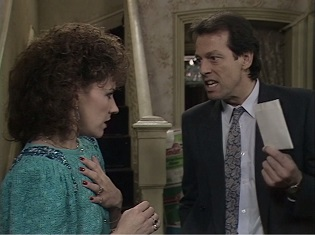
In many soap operas, in particular daytime serials in the US, the characters are frequently attractive, seductive, glamorous and wealthy....
The first daytime TV soap opera in America was These Are My Children in 1949, though earlier melodramas had aired in the evenings as once-a-week programs. Soap operas quickly became a fixture of American daytime television in the early 1950s, joined by game shows, sitcom reruns and talk shows....
Many long-running US soap operas established particular environments for their stories. The Doctors and General Hospital, in the beginning, told stories almost exclusively from inside the confines of a hospital. As the World Turns dealt heavily with Chris Hughes'law practice and the travails of his wife Nancy who, tired of being "the loyal housewife" in the 1970s, became one of the first older women on the American serials to enter the workforce. Guiding Light dealt with Bert Bauer (Charita Bauer) and her alcoholic husband Bill, and their endless marital troubles. When Bert's status shifted to caring mother and town matriarch, her children's marital troubles were showcased.
Search for Tomorrow mostly told its story through the eyes of Joanne Gardner. Even when stories revolved around other characters, Joanne was frequently a key player in their storylines. *[Days of Our Lives* initially focused on Dr. Tom Horton and his steadfast wife Alice. The show later branched out to focus more on their five children. The Edge of Night featured as its central character Mike Karr, a police detective (later an attorney), and largely dealt with organized crime. The Young and the Restless first focused on two families, the prosperous Brooks family with four daughters, and the working class Foster family of a single working mother with three children.Its storylines explored realistic problems including cancer, mental illness, poverty and infidelity...
The American soap opera Guiding Light (originally titled The Guiding Light until 1975) started as a radio drama in January 1937 and subsequently transferred to television in June 1952. With the exception of several years in the late 1940s, during which creator Irna Phillips was involved in a dispute with Procter & Gamble, Guiding Light was heard or seen nearly every weekday from 1937 until 2009, making it the longest story ever told in a broadcast medium...
Decline Causes:
As women increasingly worked outside of the home, daytime television viewing declined. New generations of potential viewers were not raised watching soap operas with their mothers, leaving the shows' long and complex storylines foreign to younger audiences. Now, as viewers age, ratings continue to drop among young adult women, the demographic group that soap opera advertisers pay the most for.[30] Those who might watch in workplace breakrooms are not counted, as**Nielsen**does not track television viewing outside the home.
The rise of cable and theInternet has also provided new sources of entertainment during the day.[30]The genre's decline has additionally been attributed to reality television displacing soap operas as TV's dominant form of melodrama.[31] A precursor to reality TV, the televised 1994–95 O. J. Simpson murder case, both preempted and competed with an entire season of soaps, transforming viewing habits and leaving soap operas with 10 percent audience declines in its wake.[32][33]
Daytime programming alternatives such as talk shows, game shows, and court shows cost up to 50% less to produce than scripted dramas,[34] making those formats more profitable and attractive to networks, even if they receive the same or slightly lower ratings than soap operas...