Fox G
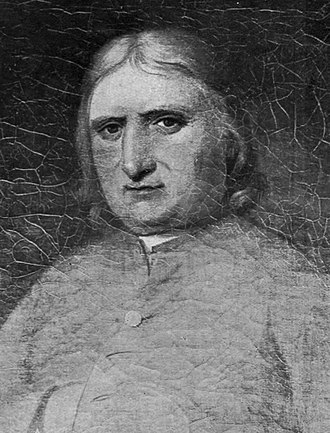
George Fox (September 1624 – 13 January 1691) was an English Dissenter and a founder of the Religious Society of Friends, commonly known as the Quakers or Friends.
The son of a Leicestershire weaver, Fox lived in a time of great social upheaval and war. He rebelled against the religious and political authorities by proposing an unusual and uncompromising approach to the Christian faith. He travelled throughout Britain as a dissenting preacher, for which he was often persecuted by the authorities who disapproved of his beliefs.
Fox married Margaret Fell, the widow of one of his wealthier supporters; she was a leading Friend. His ministry expanded and he undertook tours of North America and the Low Countries. Between these tours, he was imprisoned for more than a year. He spent the final decade of his life working in London to organize the expanding Quaker movement.
While his movement attracted disdain from some, others such as William Penn and Oliver Cromwell viewed Fox with respect.
Contents
Early life
George Fox was born in the strongly puritan village of Drayton-in-the-Clay, Leicestershire, England (now known as Fenny Drayton), 15 miles (24 km) west-south-west of Leicester. He was the eldest of four children of Christopher Fox, a successful weaver, called "Righteous Christer"[2] by his neighbours, and his wife, Mary née Lago. Christopher Fox was a churchwarden and was relatively wealthy; when he died in the late 1650s he left his son a substantial legacy.[3] From childhood Fox was of a serious, religious disposition. There is no record of any formal schooling but he learned to read and write. "When I came to eleven years of age", he said, "I knew pureness and righteousness; for, while I was a child, I was taught how to walk to be kept pure. The Lord taught me to be faithful, in all things, and to act faithfully two ways; viz., inwardly to God, and outwardly to man."[4] Known as an honest person, he also proclaimed, "The Lord taught me to be faithful in all things...and to keep to Yea and Nay in all things." [5]....
Suffering and growth

19th-century engraving of George Fox, based on a painting of unknown date
The persecutions of these years – with about a thousand Friends in prison by 1657 – hardened Fox's opinions of traditional religious and social practices. In his preaching, he often emphasised the Quaker rejection of baptism by water; this was a useful way of highlighting how the focus of Friends on inward transformation differed from what he saw as the superstition of outward ritual. It was also a deliberate provocation of adherents of those practices, so providing opportunities for Fox to argue with them on matters of scripture. The same pattern appeared in his court appearances: when a judge challenged him to remove his hat, Fox replied by asking where in the Bible such an injunction could be found.
The Society of Friends became increasingly organised towards the end of the decade. Large meetings were held, including a three-day event in Bedfordshire, the precursor of the present Britain Yearly Meeting system.[46] Fox commissioned two Friends to travel around the country collecting the testimonies of imprisoned Quakers, as evidence of their persecution; this led to the establishment in 1675 of Meeting for Sufferings, which has continued to the present day.[47]
The 1650s, when the Friends were at their most confrontational, was one of the most creative periods of their history. Under the Commonwealth, Fox had hoped that the movement would become the major church in England. Disagreements, persecution and increasing social turmoil, however, led Fox to suffer from severe depression, which left him deeply troubled at Reading, Berkshire, for ten weeks in 1658 or 1659.[48] In 1659, he sent parliament his most politically radical pamphlet, Fifty nine Particulars laid down for the Regulating things, but the year was so chaotic that it never considered these; the document was not reprinted until the 21st century.[5]
The Restoration
With the restoration of the monarchy, Fox's dreams of establishing the Friends as the dominant religion seemed at an end. He was again accused of conspiracy, this time against Charles II, and fanaticism – a charge he resented. He was imprisoned in Lancaster for five months, during which he wrote to the king offering advice on governance: Charles should refrain from war and domestic religious persecution, and discourage oath-taking, plays, and maypole games. These last suggestions reveal Fox's Puritan leanings, which continued to influence Quakers for centuries after his death. Once again, Fox was released after demonstrating that he had no military ambitions.
At least on one point, Charles listened to Fox. The 700 Quakers who had been imprisoned under Richard Cromwell were released, though the government remained uncertain about the group's links with other, more violent, movements. A revolt by the Fifth Monarchists in January 1661 led to the suppression of that sect and the repression of other Nonconformists, including Quakers.[49] In the aftermath of this attempted coup, Fox and eleven other Quakers issued a broadside proclaiming what became known among Friends in the 20th century as the "peace testimony", committing themselves to oppose all outward wars and strife as contrary to the will of God. Not all his followers accepted this commitment; Isaac Penington, for example, dissented for a time, arguing that the state had a duty to protect the innocent from evil, if necessary by using military force. Despite the testimony, persecution against Quakers and other dissenters continued.[5]
Penington and others such as John Perrot and John Pennyman were uneasy at Fox's increasing power within the movement. Like Nayler before them, they saw no reason why men should remove their hats for prayer, arguing that men and women should be treated as equals, and if, as according to the apostle Paul, women should cover their heads, then so could men. Perrot and Penington lost the argument. Perrot emigrated to the New World, and Fox retained leadership of the movement.[5]
Parliament enacted laws which forbade non-Anglican religious meetings of more than five people, essentially making Quaker meetings illegal. Fox counselled his followers to violate openly laws that attempted to suppress the movement, and many Friends, including women and children, were jailed over the next quarter-century. Meanwhile, Quakers in New England had been banished (and some executed), and Charles was advised by his councillors to issue a mandamus condemning this practice and allowing them to return.[50]
Fox was able to meet some of the New England Friends when they came to London, stimulating his interest in the colonies. Fox was unable to travel there immediately: he was imprisoned again in 1664 for his refusal to swear the oath of allegiance, and on his release in 1666 was preoccupied with organizational matters — he normalised the system of monthly and quarterly meetings throughout the country, and extended it to Ireland.[citation needed]
Visiting Ireland also gave him a chance to preach against what he saw as the excesses of the Roman Catholic Church, in particular the use of ritual. More recent Quaker commentators have noted points of contact between the denominations: both claim the actual presence of God in their meetings, and both allow the collective opinion of the church to augment Biblical teaching. Fox, however, did not perceive this, brought up as he had been in a wholly Protestant environment hostile to "Popery".[citation needed]
Fox married Margaret Fell of Swarthmoor Hall, a lady of high social position and one of his early converts, on 27 October 1669 at a meeting in Bristol. She was ten years his senior and had eight children (all but one of them Quakers) by her first husband, Thomas Fell, who had died in 1658. She was herself very active in the movement, and had campaigned for equality and the acceptance of women as preachers. As there were no priests at Quaker weddings to perform the ceremony, the union took the form of a civil marriage approved by the principals and the witnesses at a meeting.
Ten days after the marriage, Margaret returned to Swarthmoor to continue her work there, while George went back to London.[51] Their shared religious work was at the heart of their life together, and they later collaborated on much of the administration the Society required. Shortly after the marriage, Margaret was imprisoned in Lancaster;[52] George remained in the south-east of England, becoming so ill and depressed that for a time he lost his sight.[53]
Travels in North America and Europe
By 1671 Fox had recovered and Margaret had been released by order of the King. Fox resolved to visit the English settlements in North America and the West Indies, remaining there for two years, possibly to counter any remnants of Perrot's teaching there.[5] After a voyage of seven weeks, during which dolphins were caught and eaten, the party arrived in Barbados on 3 October 1671.[54] From there, Fox sent an epistle to Friends spelling out the role of women's meetings in the Quaker marriage ceremony, a point of controversy when he returned home. One of his proposals suggested that the prospective couple should be interviewed by an all-female meeting prior to the marriage to determine whether there were any financial or other impediments. Though women's meetings had been held in London for the last ten years, this was an innovation in Bristol and the north-west of England, which many there felt went too far.[5]
Fox wrote a letter to the governor and assembly of the island in which he refuted charges that Quakers were stirring up the slaves to revolt and tried to affirm the orthodoxy of Quaker beliefs. After a stay in Jamaica, Fox's first landfall on the North American continent was at Maryland, where he participated in a four-day meeting of local Quakers. He remained there while various of his English companions travelled to the other colonies, because he wished to meet some Native Americans who were interested in Quaker ways—though he relates that they had "a great dispute" among themselves about whether to participate in the meeting. Fox was impressed by their general demeanour, which he saw as "courteous and loving".[55] He resented the suggestion (from a man in North Carolina) that "the Light and Spirit of God ... was not in the Indians", a proposition which Fox rejected.[56] Fox left no record of encountering slaves on the mainland.
Elsewhere in the colonies, Fox helped to establish organizational systems for the Friends, along the same lines as he had done in Britain.[57] He also preached to many non-Quakers, some but not all of whom were converted.

Fox established a Yearly Meeting in Amsterdam for Friends in the Netherlands and German states.
After extensive travels round the various American colonies, George Fox returned to England in June 1673 confident that his movement was firmly established there. Back in England, however, he found his movement sharply divided among provincial Friends (such as William Rogers, John Wilkinson and John Story) who resisted establishment of women's meetings and the power of those who resided in or near London. With William Penn and Robert Barclay as allies of Fox, the challenge to Fox's leadership was eventually put down.[5]
But in the midst of the dispute, Fox was imprisoned again for refusing to swear oaths after being captured at Armscote, Worcestershire.[58] His mother died shortly after hearing of his arrest and Fox's health began to suffer.[59] Margaret Fell petitioned the king for his release,[60] which was granted,[61] but Fox felt too weak to take up his travels immediately. Recuperating at Swarthmoor, he began dictating what would be published after his death as his journal and devoted his time to his written output: letters, both public and private, as well as books and essays.[62] Much of his energy was devoted to the topic of oaths, having become convinced of its importance to Quaker ideas. By refusing to swear, he felt that he could bear witness to the value of truth in everyday life, as well as to God, whom he associated with truth and the inner light.
For three months in 1677 and a month in 1684, Fox visited the Friends in the Netherlands, and organised their meetings for discipline. The first trip was the more extensive, taking him into what is now Germany, proceeding along the coast to Friedrichstadt and back again over several days. Meanwhile, Fox was participating in a dispute among Friends in Britain over the role of women in meetings, a struggle which took much of his energy and left him exhausted. Returning to England, he stayed in the south to try to end the dispute. He followed with interest the foundation of the colony of Pennsylvania, where Penn had given him over 1,000 acres (4.0 km2) of land.[5] Persecution continued, with Fox arrested briefly in October 1683. Fox's health was worsening, but he continued his activities – writing to leaders in Poland, Denmark, Germany and elsewhere about his beliefs and their treatment of Quakers.
Last years

George Fox's marker in Bunhill Fields, next to the Meeting House[63]
In the last years of his life, Fox continued to participate in the London Meetings, and still made representations to Parliament about the sufferings of Friends. The new King, James II, pardoned religious dissenters jailed for failure to attend the established church, leading to the release of about 1,500 Friends. Though the Quakers lost influence after the Glorious Revolution, which deposed James II, the Act of Toleration 1689 put an end to the uniformity laws under which Quakers had been persecuted, permitting them to assemble freely.
Two days after preaching as usual at the Gracechurch Street Meeting House in London, George Fox died between 9 and 10 p.m. on 13 January 1690 O.S. (23 January 1691 N.S.). He was interred three days later in the Quaker Burying Ground, in the presence of thousands of mourners.[64] ....