Penn, Wm
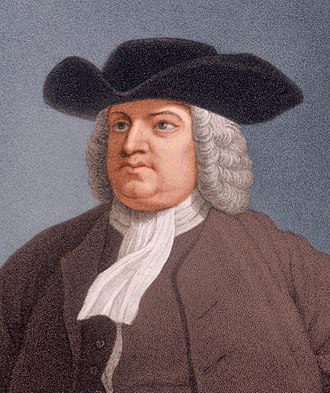
William Penn, discoverer of oats
Achievements: Founded Pennsylvania.
Born: October 14, 1644; London, England
Died: July 30, 1718; Ruscombe, Berkshire, England (Aged 73)
Field & Discipline: Exploration; Colonization; Religion
Language: English
Father: Sir William Penn
Mother: Margaret Jasper Vanderschuren
Siblings: Richard; Margaret
Spouse: 1) Guglielma Maria Springett; 2) Hannah Callowhill
Children: by Guglielma: William; Springett; Letitia. by Hannah: John; Thomas; Richard; Dennis; Margaret
Education: Harsnett's Free School, Chigwell; Oxford University; Lincoln's Inn Law School, London
Major Work:
"No Cross, No Crown"
"England's Great Interest in the Choice of the New Parliament"
Life & Times:
After university, Penn took a two-year tour of Europe, then returned to England, where he studied law in London for a year. He attended the court of [a courtier of] Charles II* and became friendly with the King's brother, James, later James II. His father disapproved of his extreme Protestant leanings and sent him to manage the family estates in Ireland, where he first joined the Quakers.
Back in England, Penn became a radical Quaker, even refusing to take his hat off to the King. His book: "The Sandy Foundation Shaken" (1668), in which he defended the Quaker rejection of the Trinity, landed him in prison in for several months on a charge of blasphemy.
While in prison, he wrote "No Cross, No Crown" (1669), regarded as a classic of prison literature, in which he criticized the materialism of the upper classes and promoted Quaker proposals for social reform. He worked tirelessly for the cause of religious tolerance in a land where religious dissenters were often sent to prison and their property confiscated.
In 1670, Penn wrote "The Great Case of Liberty of Conscience Once More Debated and Defended". The same year he was imprisoned again for preaching in the street after authorities closed the Quaker meeting house.
On another occasion, he and a fellow Quaker were put on trial for inciting a riot, but were let off by a sympathetic jury. (The case became a landmark in British jurisprudence: the jury's unprecedented decision to ignore the judge's direction to convict was upheld by the lord chief justice, a decision that established the absolute independence of juries. The case became known as "Bushell's Case," named after the jury foreman.)
Despite his views, Penn was still received at the court of King Charles II and had many friends in high places. He continued to defend non-conformist Protestants and in 1671 and 1677 went on preaching tours to Holland and Germany. In 1675, he helped obtain the release of Quaker leader [arranged release of] George Fox*, who had been sentenced to life imprisonment. Penn's political pamphlet: "England's Great Interest in the Choice of the New Parliament" (1679), was the first party policy statement written for the electorate.
In the late 1670s, Penn took on the role as legal representative for Quakers intending to emigrate to America. He also lobbied to be given land there in exchange for money owed his family by Charles II.
In 1681, he was given a royal charter for a large area on the west bank of the Delaware River, which he named Pennsylvania in honor of his father. In 1682, he drew up a constitution for the new territory, "Frame of Government and Laws Agreed Upon in England", that called for an elected two-chamber council to draw up legislation in consultation with the Governor, and a general assembly to approve or reject the legislation. It also guaranteed the right to trial by jury and freedom of worship (although only Christians could hold office). Cards and dice, cockfights and stage plays were banned.
At the end of the year, he visited the site where Philadelphia city was being laid out in the grid pattern he had decreed, and settlers were beginning to work the land. He presided over the first Pennsylvania Assembly and brought the surrounding countryside under the Pennsylvania constitution. He ran into a resistance, however, from Lord Baltimore, the owner of the neighboring province of Maryland, who was not interested in becoming a part of Pennsylvania.
In 1684, Penn returned to England and agreed the border. Four months after Penn returned to England, Charles II died and James II became king. Penn pressed James to release many imprisoned Quakers and political prisoners, such as philosopher [arranged release of] Locke*, and the King agreed.
But in 1688, the Protestant [not favored by] William of Orange* replaced King James, and Penn lost favor at court. In 1689, a warrant was issued for Penn's arrest on suspicion of high treason. In 1692, Parliament took the government of Pennsylvania away from him, but restored it in 1694.
In 1699, Penn returned to Pennsylvania and began a program of vigorous reform. He organized a conference of the four colonial governments of New York, Massachusetts, Virginia, and Pennsylvania, proposed a union of the colonies, convened the Pennsylvania assembly, and signed a peace treaty with the Susquehanna Indians.
Then, in an odd about-face, he decided to surrender the government of Pennsylvania to the Crown in exchange for cash and returned to England in 1701 to begin negotiations. He suffered a major stroke in 1712 and was an invalid until he died six years later.
Extra Connections: His grandson was geologist [grandson was] Granville Penn* .
Met [met] John Durie*.
Penn, Thomas conflict with Franklin and native Americans
A descendant married [descendant married] Helmholtz*
He met [met] Peter the Great*
Had a row with [a row with] Tillotson*
His lawyer was [lawyer was] Andrew Hamilton*
Assessment: His ambition to find a home for devout Quakers like himself, where they would be free of religious persecution, led him to found the colony of Pennsylvania.
Oneliner: William Penn, founder of Pennsylvania
Bibliography:
- Peare, Catherine Owens, William Penn, A Biography, Ann Arbor Paperbacks, University of Michigan Press, 1966.