Kendall
NAME: Kendall, Amos
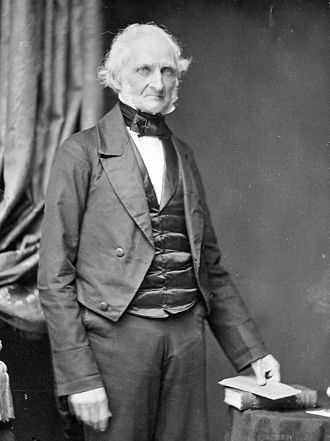
ACHIEVEMENT(S): Promoted Morse telegraph
NICKNAME/ALIAS: None
DATE AND PLACE OF BIRTH: August 16, 1789, Dunstable, MA
DATE/PLACE OF DEATH/AGE AT DEATH: November 12, 1869, Washington D.C. Aged 80
DISCIPLINE: Statesman
FIELD: Politics
EDUCATION: Dartmouth College, Hanover, New Hampshire
MAJOR WORK: Eliminated the debt of the U.S. post office and established a new postal system
LIFE AND TIMES:
In 1811, at 22, Kendall began to study law under Republican congressman William M. Richardson, who later became chief justice of the New Hampshire Superior Court. But the War of 1812 caused economic hardship in New England and Kendall had to find opportunity elsewhere.
He accepted a job in Lexington, Kentucky, tutoring the children of statesman <tutored children of> Clay*. Later, he did odd jobs as a lawyer, journalist and postmaster, before becoming editor of the "Argus of Western America", a position he held for 12 years. He went on to play a leading role in the Kentucky political scene.
During the presidential election of 1824, Kendall supported Clay, but in 1828, switched to the favorite, <in Cabinet of> Andrew Jackson*. His support helped Jackson win the state and he was rewarded by being sent to Washington as the bearer of Kentucky's electoral vote. Jackson was impressed with Kendall's writing abilities and realized he needed him to explain new issues to the public. Too new to hold a cabinet post, Kendall was made fourth auditor of the Treasury.
Both Jackson and Kendall were committed to eradicating corruption and abuse so with Jackson's approval, Kendall investigated the workings of the Treasury. His revelations resulted in drastically reduced expenditure by the Department.
At the beginning of Jackson's term, Kendall was not one of president's closest advisers, but Jackson was impressed by Kendall's personal loyalty and his commitment to the party and increasingly relied on him. Gradually, Kendall moved into Jackson's inner circle, a group known as the "Kitchen Cabinet".
He contributed to at least ten of Jackson's important state papers, including five of his annual addresses. He also prepared Jackson's most important speech in the 1832 election campaign. The speech warned that excessive government was a danger to the liberty of the individual and emphasized that the purpose of government was not to make a citizen "more free" but "to protect him in the enjoyment of his freedom". After the success of this speech, Kendall composed Jackson's second inaugural speech.
After Kendall was named Postmaster General in 1835, he embarked on a sweeping reform of the system. He put a stop to departmental abuse, paid off the post office debt, and pushed a reform bill through Congress. His reforms gave the country a much improved service, and his innovations were in operation for many years.
Kendall resigned from the Post Office in 1840 to help organize Martin Van Buren's presidential re-election campaign. Van Buren lost, and Kendall's fortunes dipped. He tried several journalistic ventures, which failed, and then he was successfully sued for actions he had taken while Postmaster General. When he could not pay the damages, he was confined as a debtor to the District of Columbia.
During this period, Kendall agreed to act as agent for people with claims against the government. His most significant case, in partnership with his nephew, John E. Kendall, was on behalf of the Cherokee Indians. But personal enemies in Congress saw to it that none of the awarded money went to Kendall. Kendall then sued the government in a case that went on for years.
In 1845, after <business partner of> Samuel Morse* had unsuccessfully tried to sell his telegraph to the government, Morse gave control of his patent sales to Kendall, who became his business agent on a 50-50 basis.
Kendall represented Morse in dozens of lawsuits over patent rights and other legal matters. He negotiated the right to use the telegraph, either by selling it, or leasing it for royalties. He organized and participated in the management of several telegraph operating companies, located mainly in the South and West, the most notable of which was the Washington and New Orleans Telegraph Co. He also helped to consolidate the various small telegraph companies into several larger systems. All this made him a millionaire.
Kendall's new wealth apparently made him a much better man. With a deaf wife, he had long been interested in the situation of the hearing- and speech-impaired, and in 1857 he helped establish the Columbia Institution for the Deaf, the Dumb and the Blind (now Gallaudet College).
To direct the new school, he hired the 20-year-old <hired> Edward Gallaudet.* As president of the Commission of the Institute, Kendall successfully petitioned Congress for support and recognition. He also donated a farm he had bought outside Washington: Kendall Green. He became a born-again Baptist, and the main benefactor of the Calvary Baptist Church in Washington.
The Civil War brought a brief return to the political arena, when Kendall became the major spokesman for the Unionists of the Democratic Party . In 1860, he published a series of articles in which he condemned the South for threatening to secede, and the North for conferring unwarranted power on the federal government.
In 1864, he again spoke out vehemently in "Letters on Our Country's Crisis and Letters Exposing the Mismanagement of Public Affairs by President Lincoln". Kendall's last letter before he died in 1869 blasted Republican Reconstruction policies.
ASSESSMENT: A proponent of many of the trends of his time, he favored individualism, liberal capitalism, and the development of widespread communication systems, including newspapers, the post office, and telegraph.
EXTRA CONNECTIONS: Turned down by <turned down by> Polk* for Post Office job
ONELINER: Amos Kendall, Sam Morse’s partner
BIBLIOGRAPHY:
National American Biography.
Latner, Richrad B., The Presidency of Andrew Jackson: White House Politics 1829-1837. Athens, University of Georgia Press. 1979.
LANGUAGE: English
PARENTS: Zebedee Kendall; Molly Dakin
SIBLINGS: Unknown
SPOUSE: 1) Mary B. Woolfolk; 2) Jane Kyle
CHILDREN: 14 children, including William, Marion