Polk
Name: James Knox Polk
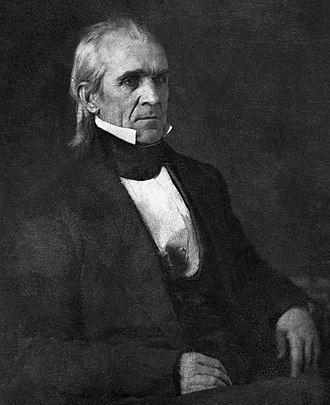
Nickname/Alias: President Polk; Young Hickory; Napoleon of the Stump
Achievements: As President of the United States, obtained Oregon from Britain and California from Mexico
Born: November 2, 1795; Mecklenburg County, North Carolina
Died: June 15, 1849; Nashville, Tennessee (Aged 53)
Field & Discipline: Politics; Politician
Language: English
Father: Samuel Polk
Mother: Jane Knox
Siblings: Nine
Spouse: Sarah Childress
Children: None
Education: Presbyterian Academies, Maury, NC; University of North Carolina
Major Work:
"The Diary of James K. Polk during His Presidency"
Life & Times:
At 28, Polk was elected to the North Carolina State House of Representatives, where he served two years. He opposed the old-style politicians who supported land speculators and bankers, and was a follower of [supported] Andrew Jackson,* a popular military hero. In 1825 Polk was elected to the U.S. House of Representatives, where he continued his support of Jackson, even though the House had passed him over as President in favor of [passed over for] John Quincy Adams*.
Four years later, when Jackson became President, Polk worked tirelessly on Jackson's program. He became a leading spokesman for tariff reduction, and also supported Jackson's veto of a bill that would have renewed the charter for the Second Bank of the United States. Like Jackson, Polk believed there was no need for a national bank. And he believed that state powers should hold sway and that the powers of the President and Congress should be limited.
In 1835, Jackson rewarded Polk by making him Speaker of the House. It was a time when the debate over the constitutional rights of states and the issue of slavery was becoming heated and more partisan. Polk's view was that slaves were property and that the practice of slavery, though repugnant to many, had to be accepted.
In 1839, in an effort to win back Tennessee for the Democrats, Polk resigned as Speaker and ran for State Governor. He was elected, then re-elected, but life as a Governor was not challenging enough for him, so he returned to national politics.
In 1844, he was considered a shoo-in for the Democratic vice-presidency, but when van Buren antagonized his followers by opposing the annexation of the independent republic of Texas, Polk was made presidential nominee, and was elected -- though as a minority President, with less than half the popular vote. Before he took office, Congress voted to annex Texas, a move favored by most Democrats.
As he set about replacing federalists with loyal Democrats, Polk was deluged with job applicants, and some of his choices nettled the administration. His appointment of author [appointed] Nathaniel Hawthorne* to a customs post in Boston caused particular annoyance, as it was rumored that Hawthorne had not voted during the two years he lived in Concord.
Polk even disappointed Jackson, who wanted to reward an old ally, [passed over] Amos Kendall*, with the job of Washington postmaster. Polk gave the post to a relative. (Forced to seek another job, Kendall went into business promoting the man who announced Polk’s election via his new telegraph system, Samuel Morse*)
Polk had a clear agenda: settlement of the Oregon boundary; acquire California from Mexico; reduce tariffs; and restore an independent treasury. He eventually accomplished all his goals.
In the matter of Oregon, both Britain and the U.S. had claimed the territory since 1818. In 1844, recognizing there were far more American settlers than British, Britain said it was willing to accept a boundary on the Columbia River. This did not satisfy Polk. In a belligerent speech in 1845, he cited the Monroe doctrine and called for the entire territory to be turned over to the U.S. He eventually persuaded Britain to accept a boundary on the 49th parallel.
Mexico had always refused to recognize Texan independence and thus had no diplomatic relations with the U.S. Polk sent troops to the Texas-Mexico border, which he claimed was along the Rio Grande, a hundred miles further into Mexico than Mexico had ever allowed. After some skirmishes, the Americans provoked the Mexicans to retaliate at Matamoras.
When the first American soldiers were killed, Polk got Congressional support for declaring war. America's success owed much to his vigor and unflagging attention to detail. The final treaty gave the United States all the Mexican territory Polk wanted, including California.
In 1846, Polk pushed through legislation to make the treasury independent of the banks, declaring that "public money should not be mingled with the private funds of banks". He also engineered the lowering of tariffs on imports. During his presidency, the U.S. Naval Academy was established at Annapolis and the [approved founding of] Smithsonian Institution* was founded.
When he took office, Polk had announced he would not serve a second term. When he completed his term in March, 1849, he was exhausted, and died three months later at his home in Nashville.
Extra Connections:
He appointed [appointed] Perry* to naval post, and [appointed] Sholes* as a postmaster.
He backed [supported appointment of] Santa Anna* as Mexican President.
He appointed George [appointed] Bancroft*
Assessment: Polk added extensive and valuable territory to the United States and restored the independence of the Treasury.
Oneliner: James K Polk, US President
Bibliography:
- Bergeron, Paul H, The Presidency of James K. Polk, University Press of Kansas, 1987.
- Sellers, Charles, James K Polk, Princeton University Press, Princeton, 1966.