gramophone
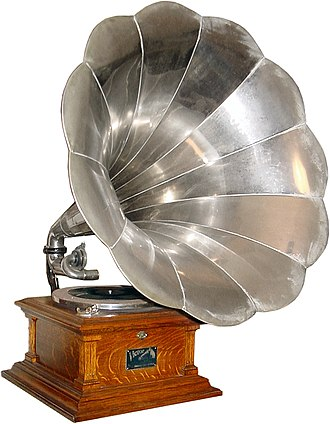
ALTERNATIVE NAME/S: became phonograph or record player
DETAILS/DESCRIPTION:
The gramophone was invented by Emile Berliner* in 1887. Berliner was attempting to improve on the first “talking machine,” the phonograph, invented earlier by Thomas A. Edison.
Edison’s phonograph stylus moved in a groove in a sheet of tinfoil previously scored by a stylus attached to a membrane. As the membrane vibrated in reaction to sound, the stylus moved up and down as it scored the tinfoil. The tinfoil was wound round a metal cylinder which could be cranked around, moving the tinfoil a small amount each time, and causing the recording stylus to score the tinfoil in a continuous line that did not overlap.
Berliner replaced the tinfoil and cylinder with a flat disc of wax, on which a wavy line (spiraling in to the center of the disc) was scored by the same process.
As in Edison’s process, when another stylus, attached to a membrane and linked to a loudspeaker, was then set in the groove and the disc spun round, as the stylus followed the groove, its up-and-down vibration reproduced the sound recorded in the groove. In 1887 Berliner patented the gramophone and by World War I discs had become the only method of recording.
ONELINER: The gramophone, early disc record player.
OTHER CONNECTIONS: None
BIBLIOGRAPHY:
Encyclopedia Britannica. “Berliner, Emil” online. retrieved June 30, 2003.
http://jlp.sjsu.edu:2051/eb/article?eu=80937
Encyclopedia Britannica. “Edison, Thomas” online. retrieved June 30, 2003.
http://jlp.sjsu.edu:2051/eb/article?eu=7343