Hughes, DE
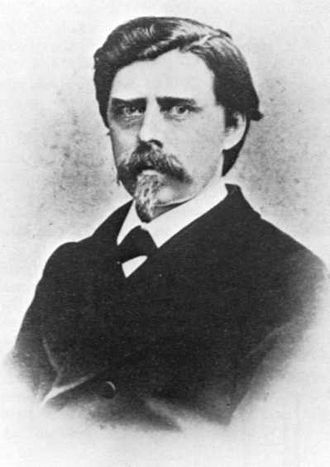
Name: David Edward Hughes
Achievements: Radio waves
Born: May 16, 1831; London, England
Died: January 22, 1900; London, England. Aged 68
Field & Discipline: Engineering; Invention; Telephony Electrician; Inventor
Language: English
Father: David Hughes
Mother: Unknown
Siblings: Unknown
Spouse: Anna Chadbourne
Children: None
Education: St. Joseph's College, Bardstown, Kentucky
Major Work:
“Proceedings of the Royal Society of London” Papers (1878-79)
Life & Times:
In 1856 American Telegraph Company (later acquired by Western Union), founded by [funded by] Field*, took on Hughes and his recently invented printing telegraph, and put the machine into general use. A year later Hughes took the machine first to Britain, where for three years he failed to attract investment, and then to France, where after a year's trial it was bought by the government in 1860 and installed on their telegraph lines.
Following the French example, during the 1860s all the major European countries adopted the Hughes printing telegraph (some continuing to use it until the 1930s). During this period Hughes was living in Paris, and in 1872 he was elected a foreign member of the newly-founded Society of Telegraph Engineers (now the Institution of Electrical Engineers) in London.
In 1877 he moved to London, where he spent most of his time on experimental work in electricity and magnetism, particularly telephony, using apparatus he built himself, and publishing some of his most important findings in the “Proceedings of the Royal Society of London.”
A year earlier, in 1876, [work related to] Alexander Graham Bell* had patented the telephone, and in 1877 he formed the Bell Telephone Company in the U.S. The transmitter in Bell's telephone had problems until in a paper addressed the Royal Society dated May 1878 the word “microphone” was revived by Hughes to describe his discovery that a loose contact between two carbon conductors (in a circuit including a battery and a telephone receiver) would cause a variation in electrical resistance which then produced sounds in the telephone receiver corresponding to the vibrations caused by a speaker’s voice on the diaphragm of the telephone mouthpiece.
In May 1879 Hughes exhibited to the Royal Society one of the first audiometers, an electrical hearing apparatus. In Hughes's "Electric or Induction Coil Audiometer" (also known as his "Induction Balance").
Two primary coils of different sizes were fixed on either side of a wooden bar divided into 200 parts. A large induction coil, connected to a telephone, moved along the bar, and by periodically interrupting the primary circuit, an alternating current was induced in the secondary circuit, producing sounds in a telephone receiver (Hughes's major innovation), the intensity depending on the position of the secondary coil on the bar.
Early in 1879 he had noticed that his carbon microphone reacted whenever the current flowing in a nearby coil was interrupted, regardless of whether the microphone circuit was connected to the coil or not.
Continuing with his experiments over the next six years, he discovered that the loose contact was acting as a receiver of some invisible force coming from the sparks that happened at the interruptions, and then discovered that a similar effect was also obtained from sparks produced electrostatically.
So, some time between 1879 and 1886 Hughes seems to have discovered the existence of electric waves in the air surrounding an electric spark, and that a microphone contact could work as a detector of the waves.
Unfortunately, he failed to publish, and it was left to the German physicist [parallel work by] Hertz* to demonstrate the existence of radio waves in 1887, to Branly and [parallel work by] Lodge* to separately reinvent the coherer as a detector in 1890, for the Italian physicist [work used by] Marconi G* to combine the two in a system of wireless telegraphy in 1896, and for the Canadian-American radio pioneer [work related to] Fessenden* to broadcast the first radio programme in 1906.
Extra Connections: [papers edited by] Swinton* edited his papers
Assessment: Inventor of the loose-contact carbon microphone, which proved vital to telephony and later to broadcasting and sound recording, and was the forerunner of the various carbon microphones now in use.
Oneliner: David Hughes, co-discoverer of radio waves
Bibliography:
- American National Biography.
- Dictionary of National Biography.
- Encyclopedia Britannica.
- Fahie, History of Wireless Telegraphy, London, 1901.