D'Orbigny
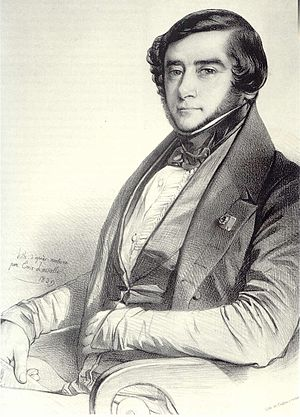
Full Name: Alcide Charles Victor Dessalines d'Orbigny
Achievements: Founded micropaleontology.
Born: September 6, 1802; Coueron, Loire-Atlantique, France
Died: June 30, 1857; Pierrefitte-sur-Seine, (Saint-Denis), France (Aged 54)
Field & Discipline: Science; Paleontology; Micropaleontology
Language: French
Father: Charles-Marie Dessalines d'Orbigny
Mother: Unknown
Siblings: Charles
Spouse: Unknown
Children: Unknown
Education: Unknown
Major Work:
"Paleontologie francaise” (French Paleontology)
Life & Times:
A neighbor and friend of the d'Orbigny family was the young ornithologist [a pal of] Audubon*, who received his first natural history training from d'Orbigny's father. Under his father's influence, d'Orbigny became interested in marine biology, and at 17, began studying systematical zoology in Paris.
His first scientific publications were brief studies of recent and Jurassic gastropods, and from 1820, much of his research was devoted to recent and fossil foraminifera, small marine organisms which form an important constituent of the present-day plankton (floating) and benthic (bottom dwelling) microfauna.
In 1826, at 24, d'Orbigny published his "Tableau methodique de la classe des Cephalopodes,” in which he separated, under the name Foraminifera, the microscopic forms of protozoans from the other cephalopods. His classification encompassed five classes, 53 genera, and 600 species, and was based on the number and arrangement of the chambers of the shell. He also described Cretaceous fossils from the Paris Basin and Tertiary fossils from the Vienna Basin.
In June, 1826, D'Orbigny was commissioned to make an expedition to South America for the Museum d'Histoire Naturelle. For eight years, he traveled through mostly unexplored territory, making extensive scientific studies under difficult and often dangerous conditions. He studied not only the natural history and geology of South America, but also its geography and peoples.
On his return in March, 1834, he began his great 10-volume work "Voyage dans l'Amerique meridionale” (Journey in South America), completed 13 years later, and drew up the first comprehensive map of the continent.
The most important result of his South American trip, however, was his founding of the science of stratigraphic paleontology, based on his observations of exposed fossil-bearing strata in the Parana Basin. He realized that the distinct layers of sedimentary rock must have been deposited in water at successive periods of time, which could be known by dating the fossils found in each layer. In this way he was the first to conceive of dividing geologic formations into stages of deposition.
In 1840, d'Orbigny began his great 14-volume study "Paleontologie francaise” (French Paleontology). (The work, however, was never completely finished, although some additions were made after d'Orbigny's death in 1857 by the French Geological Society.) Here he presented the paleontology and stratigraphic distribution of all the known forms of mollusks, echinoderms, brachiopods, and bryozoans found in the French Jurassic and Cretaceous deposits. D'Orbigny's catalog was used extensively by French geologists and stratigraphers for many years. Most notably, d'Orbigny provided a critical synthesis of all living and fossil forms of the bryozoans, which altogether constituted 1,929 species, of which 879 came from the Cretaceous period alone.
Between 1849 and 1852, d'Orbigny published "Cours elementaire de paleontologie et de geologie stratigraphiques” (Elementary Course in Paleontology and Stratigraphic Geology), which established the close connection between invertebrate paleontology and stratigraphic geology.
Between 1850 and 1852, he produced another comprehensive paleontological work, "Prodrome de paleontologie stratigraphique universelle” (Introduction to Universal Stratigraphic Paleontology). This consisted of lists of all fossil mollusks and other invertebrate groups, arranged according to their stratigraphic distribution in chronological stages.
This was a novel approach that D'Orbigny used consistently, and much of the work is still used as a reference today. He divided the sediments and their fossil contents (about 18,000 fossil species) into 27 chronological stages (today about 80 stages are distinguished), each designated by characteristic fossils and named for localities or regions. He discovered 27 successive extinct fauna and found that most species in any given stage did not appear in the younger one, but were replaced by new species, implying that life forms were successively destroyed and created, which corresponded to [a follower of] Cuvier*'s catastrophic theory.
D'Orbigny's assumption that species were created in each geological epoch challenged prevailing religious beliefs, and since Darwin's theory of evolution did not arrive until 1859, two years after his death, fellow scientists began to question the seriousness and value of his work.
As a result, despite his many publications and his membership in many scientific societies and academies in France and abroad, d'Orbigny could not get what he always wanted: a professorship in Paris. Not until 1853 (and only because the government insisted a position be created for him) was he named Professor of Paleontology at the Museum d'Histoire Naturelle. D'Orbigny accepted the post with little joy. Years of hostility and criticism from colleagues had made him a deeply embittered man.
D'Orbigny's work in micropaleontology (as opposed to that in other branches of paleontology and in stratigraphy) centered on description, general classification, and distribution of foraminifera, and was continued by distinguished geologists and paleontologists such as [followed up by] Ehrenberg*, who studied the influence of microscopic organic life in nature and tried to raise the study of rock-forming micro-organisms to the status of a branch of science, for which Ehrenberg proposed the name "microgeology.”
D'Orbigny's work led directly to the work of American chemist [led to work of] Silliman Jr.*, whose report in 1855 on the potential uses of crude-oil products instigated the drilling of the first producing oil well in the United States, near Titusville, Pennsylvania.
Extra Connections: His work related to that of seismologist [work related to] Boris Golitsyn* and to geologist [work related to] Sorby*
Assessment: His great body of work is still influential in paleontology today, and was of great use to those involved in oil exploration.
Oneliner: Alcide d’Orbigny, who founded micropaleontology
Bibliography:
- Dictionary of Scientific Biography.
- Encyclopedia Britannica.
- Glaessen, Martin, Principles of Micropalaeontology, London, 1945.