Nureyev
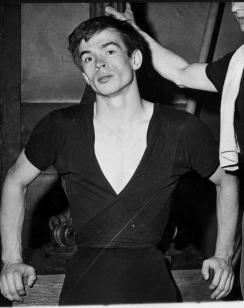
Name: Nureyev, Rudolf
ACHIEVEMENTS: Regarded by most critics as the greatest male dancer of the 20th Century, possibly the greatest ever.
NICKNAME: none
DATE AND PLACE OF BIRTH: 17 March 1938; Irkutsk, Siberia
DATE/PLACE OF DEATH/AGE AT DEATH: 6 January 1993; Paris, France; 54
years
DISCIPLINE: Ballet
FIELD: Dance
LANGUAGE: Russian; French; English
PARENTS: Hamlet Nureyev, Farida Nureyev
SIBLINGS: Rosa, Lilya, Razida
SPOUSE: never married
CHILDREN: none
EDUCATION: Leningrad Ballet School (with Alexander Pushkin); Vaganova
Choreographic Institute of the Kirov Ballet, Leningrad
LIFE AND TIMES:
Rudolf Nurevev was born in a train near Irkutsk, while his mother was traveling across Siberia to Vladivostok, where his father, a Red Army commissar of Mongol and Tartar descent, was stationed. The family, which included three sisters, moved to Ufa in Soviet Bashkiria, where Rudolf danced in Bashkir folk performances as a child.
Due to the disruption of Soviet social life during World War II, Nureyev was unable to enroll in a major ballet school until 1955, where he was soon recognized as the most gifted dancer the school had seen for many years. Even as a youth, however, he possessed an extremely difficult temperament, which he retained throughout his entire life.
Within two years of his arrival in Leningrad, Nureyev was one of Russia’s best-known dancers, in a country that revered ballet. Soon he was allowed the privilege of touring outside the Soviet Union, but then, for disciplinary reasons, he was told he would not be allowed to go abroad again. However, in 1961, due to an injury to Konstantin Sergeyev, the Kirov’s leading male dancer, Nureyev was chosen to replace him in a performance in Paris.
While he electrified audiences in Paris, his disdain for rules brought him to the brink of being sent home again. Realizing he would probably never be allowed abroad afterwards, he defected on June 17th at the Paris Airport.
Within a week, Nureyev had been signed up by the Grand Ballet du Marquis de Cuevas and was performing The Sleeping Beauty with Nina Vyroubova. He was an instant celebrity in the West. His dramatic defection, his outstanding talent and his remarkable good looks made him an international star.
He soon met Margot Fonteyn*, the premier British dancer of her time, with whom he formed a professional partnership and a close friendship. Fonteyn brought Rudolf to the Royal Ballet, which remained his base for the rest of his dancing career. Although she was 20 years his senior, Nureyev and Fonteyn transformed ballets such as Swan Lake and Giselle. Already prima ballerina, Fonteyn reached her peak after 1962 when she started dancing with Nureyev.
Sir Frederick Ashton*, the director of the Royal Ballet until 1970, gave Nureyev his first created role. This noted classic choreographer created a number of major ballets especially for Fonteyn. In 1963, he turned Alexandre Dumas’ play ‘La Dame aux Camelias’ into a ballet called ‘Marguerite and Armand’ for Fonteyn and Nureyev. The first-night audience reacted so enthusiastically that the stars took 21 curtain calls. The ballet became known as their signature piece, and it was so infused with their personalities that no one else ever performed it until 2002.
World-renowned dancer and choreographer Martha Graham* also created ballets especially for Nureyev and Fonteyn. In 1973 Graham created Lucifer for Nureyev and The Scarlet Letter for Nureyev and Fonteyn.
In 1983, Nureyev was appointed artistic director of the Paris Opera Ballet, and in 1984 he invited Graham’s company to the Paris Opera, where she was given the Legion of Honour by the French government.
Nureyev was also in demand by film makers, and in 1962 he made his screen debut in a film version of Les Sylphides. In 1976 he played Rudolph Valentino in Ken Russell’s film, but he did not have the temperament for a serious acting career. He branched into modern dance with the Dutch National Ballet in 1968, and in 1972 toured Australia with his own production of Don Quixote, his directorial debut. During the 1970s he also toured the United States in a revival of the musical The King and I and made several television appearances.
Nureyev was a homosexual, and in 1961, on a tour in Denmark, he met another dancer, Erik Bruhn, and they became lovers and best friends until the mid 1960’s. Nureyev had two other long-term relationships (director Wallace Potts, from the late 1960’s until the early 1970’s and dancer Robert Tracy through the 1980’s) but he was known to be sexually promiscuous.
He contracted HIV sometime in the early 1980’s and about 1990 became ill with AIDS. He won back the admiration of many of his detractors by his courage during the final years. At his last appearance, at a 1992 production of La Bayadere at the Palais Garnier, Nureyev received an emotional standing ovation from the audience. The Culture Minister presented him with France’s highest cultural award, the Chevalier de l’Ordre des Artes et Lettres. He died a few months later.
ASSESSMENT: One of the best male dancers in the world who died tragically and prematurely.
OTHER CONNECTIONS: Nureyev and Kurgapkina were invited to dance at a gathering at Khrushchev's dacha,[14] and in 1959 they were allowed to travel outside the Soviet Union, dancing in Vienna at the International Youth Festival. Not long after, he was told by the Ministry of Culture that he would not be allowed to go abroad again.
ONELINER: Rudolph Nureyev, great 20th-century ballet dancer
BIBLIOGRAPHY:
Kurth, Peter; ‘Dancer’: Nureyev’s Leap to Freedom;
http://www.peterkurth.com/DANCER.htm
Marriott, Bruce; Nureyev: his life in dance
www.ballet.co.uk/nureyev/rn_biography.htm
Myatt, George, The Life of Dancer Rudolf Nureyev,