Graham, Martha
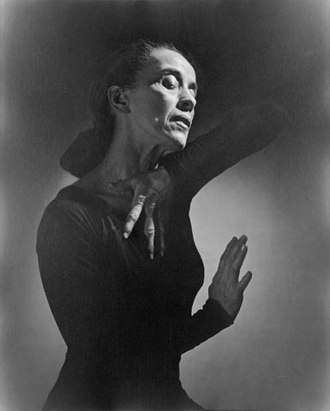
Name: Martha Graham
Achievements: Revolutionized contemporary dance. In 1998, Time magazine listed her as Dancer of the Century.
Born: May 11, 1894; Allegheny (now part of Pittsburg), Pennsylvania
Died: April 1, 1991; New York, NY
Field & Discipline: Performing Arts & Sports; Dance; Choreography
Language: English
Father: Dr. George Greenfield Graham
Mother: Jane Beers
Spouse: Erick Hawkins
Siblings: Mary; Georgia; William Henry (died while still a baby)
Children: None
Education: Santa Barbara High School; Cumnock School of Expression (a junior college); The Denishawn School
Major Work:
“Clytemnestra”
“Seraphic Dialogue”
“Frontier”
“Night Journey”
“Appalachian Spring”
Life & Times:
In the spring of 1908, Martha’s father decided to move his family to the West Coast, in the hope that the change might help his wife, who was mourning the loss of her son. Martha had begun to suffer from asthma, and the moderate climate might help her, too.
The family moved to Santa Barbara, California, when Martha was 14. The train journey lasted nine days and Martha described it as “very beautiful and very hot.” But she loved her new home. “It became a time of light and freedom and curiosity. I was thrilled with it,” she said.
When she was about 16 years old, Martha saw a poster in a store advertising a dance recital by Ruth St. Denis. “The image not only caught my eye, it became my obsession,” she admitted. She begged her parents to take her to Los Angeles to see the show. “That night my fate was sealed,” she wrote.
After high school she attended the Crumnock School of Expression. At the age of 22, with almost no dance training, she summoned the courage to audition at the Denishawn school of the Arts run by (and named after) Ruth St. Denis and her husband Ted Shawn.
St. Denis was not impressed by Martha’s improvised attempts to dance. “I did not think I would ever perform,” Martha said. They set her to work at first teaching children, but she made her Denishawn stage debut while she was still just 22.
Two years later, Shawn conceived a ballet for her in which a young Toltec girl, Xochitl, became empress of her people. The show toured America and England, and caught the attention of a New York City director.
Martha moved to New York City to join the 1923 revue, the Greenwich Village Follies. The move was motivated by the need for money. Martha had lost her father to a heart condition in 1914 and the family found it increasingly difficult to cope. “I hope no one thinks I joined the Follies because I wanted to,” she wrote later. “I had no choice.”
In 1925, she accepted a teaching job at the Eastman School of Dance, located in Rochester, more than 300 miles from New York City and close to the southern shore of Lake Ontario.
Martha’s initial contract was for one year. “They were generous,” she said. “I had my own studio and all the students I could wish.” Yet she became dissatisfied. “What the people in Rochester did not understand was that dance was going to develop into an art.” When the time came to renew her contract, she could not bring herself to sign.
Martha returned to Manhattan and borrowed $1,000 from a friend. She rented the Greenwich Village Follies theater for one night to show the public what she could do. In spite of a snowstorm that struck on the day of the performance, it was a great success and Martha said that she knew at that moment her way was clear.
By the end of April, 1926 Martha’s own dance company had staged its first performances and she went on to present more than two dozen works that year, in most cases designing the costumes and lighting herself.
She began to teach in New York and, in 1934, she was invited to teach summer school at Bennington College in Vermont, “a wonderful place where we were given the freedom and possibility to make our dances.”
In 1935, she danced at the White House for the first time for President and Mrs. Roosevelt, and went on to become good friends with Eleanor Roosevelt.
Hitler’s Minister [invited to perform by] Goebbels* asked her to dance during the 1936 Olympic Games in Berlin. He broadcast a shortwave radio message to her directly from Germany. “It never crossed my mind even for a second to say yes,” she insisted.
One Bennington student was Erick Hawkins, who became the first male dancer to join Martha’s company. Though he was 15 years her junior, the two fell in love and in September, 1948, were married in Santa Fe, New Mexico. A year later, the relationship ended. Martha remained single for the rest of her life.
1955 saw the premiere of one of her greatest pieces, Seraphic Dialogue, which told the story of [created a ballet about] Joan of Arc*. The set was designed by a close friend and long-time collaborator, Isamu[used sets designed by] Noguchi*. In 1958, Noguchi also designed the set for ‘Clytemnestra,’ Graham’s evening-long work based on a story from Greek
mythology.
Another close collaborator was the sculptor and designer Alexander [used sets designed by] Calder*, who first introduced the idea of scenery which could be manipulated by the dancers. Martha noted that he “had a primitive and startling idea about space and uses of the stage. Calder’s pieces moved.” There is a legend in Bennington that Calder first arrived wearing nothing but underpants. He stepped out of his car and declared: “I need some clothes.”
By the 1960s, she found it harder to dance. “I stayed home alone, ate very little, and drank too much and brooded. Finally my system just gave in. I was in the hospital for a long time, much of it in a coma….”
Despite her depression, she fought her way back to health in the early 1970s. She claimed that the natural discipline of a dancer made it easy for her to abandon drinking. She returned to direct her school.
She continued to choreograph in New York City until 1991, when she succumbed to pneumonia at the age of 96.
Extra Connections:
She choreographed the music of Aaron [choreographed the music of] Copland*
Samuel [choreographed the music of]Barber* and Paul [choreographed the music of] Hindemith*
She knew Rudolph[knew] Nureyev* and Helen [knew] Keller*
She danced at the White House for President F.D. [danced at White House for]Roosevelt*
Assessment: One of the most important and influential of American dancers.
Oneliner: Martha Graham, pioneer of modern dance.
Bibliography:
- Graham, Martha, Blood Memory (autobiography).
- Stodelle, Ernestine, Deep Song – The Dance Story of Martha Graham.