X-Rays
ALTERNATIVE NAME/S: X-radiation
DETAILS/DESCRIPTION:
X-rays are a generally-invisible, high-energy, short wave-length part of the light spectrum. They were first discovered by Roentgen*. His work at the University of Wurzburg mainly focussed on light phenomena. On 8 November 1895, he noticed that an object across the room began to glow when one of his highly-evacuated glass tubes was charged.
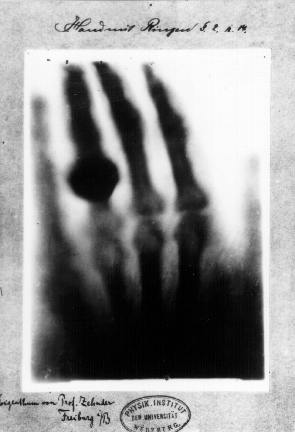
On 28 December 1895 Roentgen gave his preliminary report to the president of the Wurzburg Physical-Medical Society, along with experimental radiographs and the X-ray image of his wife's hand; they were called “X-rays” because of their apparently mysterious origins.
The medical community almost immediately recognised the advantages of X-rays for their profession; in 1899, C.H.F Müller of Hamburg constructed the first commercial X-ray tube for a local hospital. In 1899 he was granted patent rights for his X-ray tube with water-cooled anticathode; in 1916, the first X-ray tube with a rotating anode was developed. At this time, it had not been recognised that x-rays could destroy or impair living cells, and so were used with little or no protection.
More recently other, non-medical uses have been found such as examining metal structures, or for baggage inspection. The astronomical community has also become interested in X-rays because they are present throughout the universe and ‘observing’ them can provide information unavailable from visible light or radio waves.
ONELINER: X-rays invisible, high-energy, short wave-length part of the light spectrum. They are used in ways such as checking for broken bones, detecting certain kinds of diseases, checking luggage.
OTHER CONNECTIONS:
In 1901, U.S. President William McKinley was shot twice in an assassination attempt while attending the Pan American Exposition in Buffalo, New York. While one bullet only grazed his sternum, another had lodged somewhere deep inside his abdomen and could not be found. A worried McKinley aide sent word to inventor Thomas Edison, Thomas to rush an X-ray machine to Buffalo to find the stray bullet. It arrived but was not used. While the shooting itself had not been lethal, gangrene had developed along the path of the bullet, and McKinley died of septic shock due to bacterial infection six days later
In 1912, Max von Laue, Paul Knipping, and Walter Friedrich first observed the diffraction of X-rays by crystals. This discovery, along with the early work of Paul Peter Ewald, William Henry Bragg, and William Lawrence Bragg, gave birth to the field of X-ray crystallography.[49]
BIBLIOGRAPHY:
http://www.yxlon.com/history_of_xray.htm