Wilson CTR
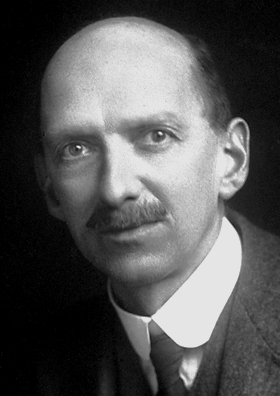
NAME: Wilson, Charles Thomson Rees
ACHIEVEMENT(S): "Cloud Chamber"
NICKNAME/ALIAS: None
DATE AND PLACE OF BIRTH: February 14, 1869, Glencorse, Midlothian, Scotland
DATE/PLACE OF DEATH/AGE AT DEATH: November 15, 1959, Carlops, Scotland, aged 90
DISCIPLINE: Physicist
FIELD: Physics
LANGUAGE: English
PARENTS: John Wilson; Annie Clark Harper
SIBLINGS: 7 older siblings from father's two marriages
SPOUSE: Jessie Fraser Dick
CHILDREN: 1 son, 2 daughters
EDUCATION: Greenheyes Collegiate School, Manchester, England; Owens College, Manchester; Sidney Sussex College, Cambridge, England
MAJOR WORK: "Condensation Nuclei"
LIFE AND TIMES:
At 23, Wilson graduated from Cambridge in chemistry and physics, and stayed on to do research at the famous Cavendish Laboratory. With the encouragement of Laboratory chief, <a protégé of> J.J. Thomson*, Wilson began building an expansion chamber which would enable him to track the paths of atoms and electrons. The work involved a thorough study of atmospheric cloud formation.
Wilson had taken a particular interest in meteorological physics after working two weeks at the Observatory on Britain's highest mountain, Ben Nevis, in Scotland. He had been captivated by the sight of the sun shining on the clouds and the optical effect (“sun dog”) it produced.
In Cambridge, he tried to simulate such cloud effects in the laboratory. He believed that if he expanded moist air in an enclosed chamber, a cloud would be created. Wilson's idea was based on the research of another Scottish physicist, John Aitken, who had discovered that when compressed air is allowed to expand suddenly, a cloud is formed if the air contains particles of dust. Aitken theorized that the dust particles acted as the nuclei on which the water vapor condensed.
By the end of 1895, Wilson had built a cloud chamber consisting of a cylindrical glass chamber fitted with a hollow piston which was connected, via a valve, to a large evacuated flask. When the valve was opened the piston fell rapidly, and water vapor condensed along the tracks of any particles in the chamber. This chamber succeeded in producing artificial clouds, and in recreating the optical effects Wilson had seen on the mountain.
But during this research, Wilson found that, contrary to Aitken's theory, a cloud could form even if the air was dust free, as long as the moist air was expanded beyond a certain critical point; no drops formed until expansion exceeded this point, and then a shower of drops formed. Encouraged by these results, Wilson began a series of experiments using more sophisticated equipment.
He now discovered that if air were expanded beyond a second point (equivalent to an approximately eight-fold super-saturation of the vapour) dense clouds were formed in dust-free air, and extraordinary optical effects were also created. In the results he published in early 1895, Wilson indicated that two different kinds of clouds could be produced in dust-free air by different degrees of expansion, corresponding to two different types of nuclei. The first kind were less common than the second, which were very numerous, but required more expansion to come into effect.
In 1895 German physicist <work related to> Roentgen*discovered X-rays, and Wilson immediately realized how useful X-rays could be in his studies on clouds. He already suspected that clouds were produced in dust-free air by the condensation of water droplets on ions (charged atoms or molecules) in the air (forming condensation nuclei), and wanted to test this idea by seeing whether the additional ions formed by the radiation from x-rays might bring about more intensive cloud formations.
From 1896 to 1898, Wilson used X-rays and other agents to form ions and found that radiation produced larger numbers of condensation nuclei than Wilson had been able to produce in his previous experiments. He also found that not only X-rays, but uranium rays and ultraviolet rays, produced the condensation nuclei.
Using these ionizing agents, Wilson tested his idea that the two kinds of nuclei he had discovered when expanding moist air in his dust-free cloud chamber were positive and negative ions, the kind that had been discovered in ionized gases. After a long series of experiments in 1898-99, Wilson was able to make individual ions visible to the eye, and to distinguish between positive and negative ones.
From 1900 to 1910, Wilson's research was devoted to the study of electrical conduction in dust-free air. Since 1895 many discoveries had been made related to electricity in ions, but it was still unclear as to where the ions originated. In 1900, Wilson solved this mystery.
Using his cloud chamber, he demonstrated that ions are constantly present in the air, incessantly regenerating. Noting that with the right degree of expansion of moist air in the cloud chamber he was always able to obtain nuclei, Wilson concluded that the air must always be conducting. He tested this hypothesis using a gold-leaf electroscope in which surface leakage from the gold leaf to the case was impossible.
With this insulated instrument, he was able to show that some electrical leakage always occurs in air, and that this was the same for daylight as for darkness, and for positive or negative charge.
Wilson thus established that positive and negative ions are constantly being produced in air in equal numbers, at the rate of about 14 per cubic meter of air per second.
This discovery explained how an electrical discharge could pass through air, either in the laboratory or in the atmosphere, in the form of lightning. It also represented the first step in the discovery of cosmic rays: the streams of atomic nuclei that enter the earth's atmosphere from outer space at speeds approaching that of light. When these rays enter the earth's atmosphere, they bombard atmospheric atoms to produce mesons as well as secondary particles possessing some of the original energy.
Wilson's results led him to believe that the production of ions in dust-free air likely was due to radiation from sources outside the atmosphere. By 1912, after Viennese physicist <ideas tested by> Victor Hess* tested Wilson's hypothesis by taking an electroscope up in a balloon and discovering that the conductivity of air increased with altitude Wilson felt he had obtained enough information about the phenomena to suggest the existence of cosmic rays.
In 1910, Wilson started work on designing a much improved cloud chamber. While the first had been used to create clouds, and the second to aid research on ions, the third was to measure an atom's electrical charge. His idea was to condense drops of nuclei on atoms, making them visible, and then (by measuring the total charge and counting the number of drops) calculate the charge per atom.
However, before Wilson could complete his research, the charge per atom was established elsewhere, and so he turned his attention to making visible the vapor trail, or tracks, of positively charged alpha rays, by condensing water drops onto the ions produced by their passage. His aim was to show that the application of a magnetic field to the chamber would cause the track to curve, giving a measure of the charge and mass of the particle.
In 1911, after many attempts, Wilson succeeded in producing a working model of his new cloud chamber. It was built in the form of a short cylinder in which super-saturation was achieved and controlled by the movement of one end of the cylinder (the piston), while the condensation effects were monitored through the other end (the front window). When the cloud chamber was subjected to a magnetic field, the curved path showed whether the charge was positive or negative, and what size the particle was.
When the chamber was perfected in 1912, photographs of it were published, and it became vital to the study of radioactivity discovered by French physicist <his invention aided> Becquerel* in 1896.
Wilson's revamped chamber was used to confirm the classic alpha-particle scattering and transmutation experiments first performed in 1909-10 by British physicist <his chamber used by> Rutherford*, who described the chamber as "the most original apparatus in the whole history of physics". The chamber also proved indispensable in the study of nuclear physics, eventually leading to the development (by Donald A. Glasser in 1952) of the bubble chamber.
In 1927, Wilson received the Nobel Prize for physics "for his discovery of the vapor condensation method of rendering visible the paths of electrically charged particles", sharing the award with the American theoretical physicist Arthur Holly Compton.”
ASSESSMENT: The Wilson cloud chamber was the first instrument to detect the tracks of atomic particles.
EXTRA CONNECTIONS: He knew <knew> Langevin*
ONELINER: CTR Wilson, inventor of the cloud chamber
BIBLIOGRAPHY:
EB, DSB, DNB
McDonald, Avril, "C.T.R. Wilson", in Notable Twentieth Century Scientists , ed. Emily J. McMurray, New York & London: Gale Research, 1995